
Free CTAL-TA_V4.0 Sample Questions and 100% Cover Real Exam Questions (Updated 47 Questions)
Download Real ISQI CTAL-TA_V4.0 Exam Dumps Test Engine Exam Questions
NEW QUESTION # 11
Your project is developing an application to process claims against insurance policies. Which of the following is a good example of CRUD completeness testing?
- A. A review of the requirements to check that all user needs for CRUD operations on a claim record have been elicited
- B. A set of test cases that verify the sequence of creating, reading, updating, reading and deleting a claim, and then check that it can no longer be read
- C. A review of the technical specifications to check that the abilities to create, read, update and delete a claim have been included in the application architecture
- D. A set of test cases that, when executed, verify the application's ability to independently create, read, update and delete a claim
Answer: C
Explanation:
The correct answer is C because CRUD completeness testing is a static activity. CTAL-TA v4.0 defines CRUD as create, read, update, and delete, and states that CRUD testing verifies the lifecycle of data entities processed by the test item. The syllabus distinguishes two parts: CRUD completeness testing , which statically verifies whether all possible CRUD operations occur for every entity, and CRUD consistency testing , which dynamically checks whether functions interact correctly when handling the entity.
For an insurance-claims application, the key entity is the claim . A technical review checking whether the architecture/specification includes the ability to create, read, update, and delete claim records directly matches CRUD completeness. It is concerned with whether the full claim lifecycle has been included, not whether the lifecycle behaves correctly during execution. Option A is a strong example of CRUD consistency testing because it executes a lifecycle sequence and checks post-delete behavior. Option B is also dynamic execution, so it is not the best match for completeness. Option D is requirements elicitation completeness, not specifically CRUD completeness for the implemented claim entity. Reference: CTAL-TA v4.0, Section 3.2.1 CRUD Testing .
NEW QUESTION # 12
The following decision table shows the rules for sending a package. Same day delivery will not be provided for big packages. All combinations of same day delivery and international destination have been removed as they are infeasible.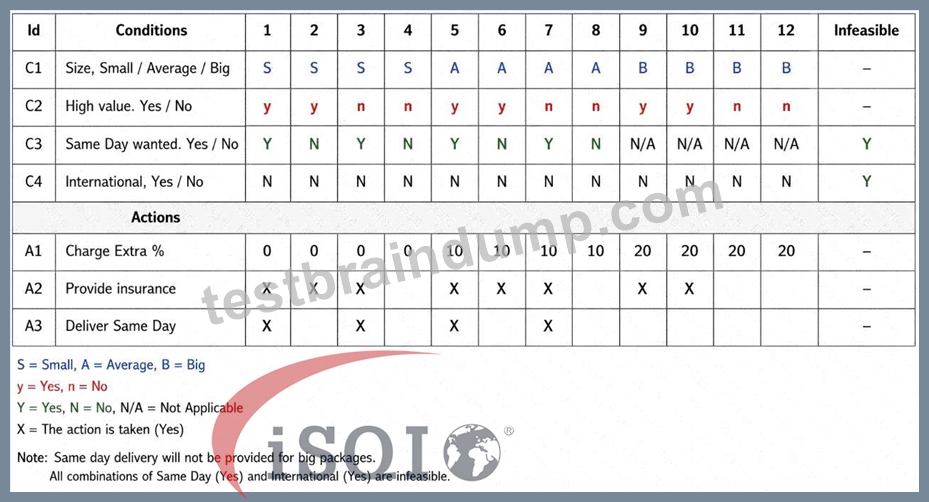
How many columns will the table have after all possible minimization has been performed?
- A. 0
- B. 1
- C. 2
- D. 3
Answer: C
Explanation:
The correct answer is C because the fully minimized decision table has 8 columns . CTAL-TA v4.0 states that decision-table minimization derives an equivalent table with fewer rules by merging action-equivalent rules using the don't-care operator "-"; action-equivalent rules that differ in only one condition and cover all possible values of that condition may be merged. It also recommends disregarding or removing infeasible rules before merging.
For Small packages, columns 1 and 3 are action-equivalent: both charge 0% , provide insurance, and deliver same day. They differ only in High value , so they merge into one rule. Columns 2 and 4 cannot merge with them because same-day delivery and/or insurance differ. Therefore Small reduces from 4 rules to 3 . For Average packages, the same structure applies: columns 5 and 7 merge, while 6 and 8 remain separate.
Average also reduces from 4 rules to 3 . For Big packages, same-day is N/A , so columns 9 and 10 are action- equivalent and merge; columns 11 and 12 also merge. Big reduces from 4 rules to 2 .
Total minimized columns = 3 + 3 + 2 = 8 . Option A misses the valid merges for same-day insured Small and Average packages. Option D over-minimizes by combining rules that are not action-equivalent. Reference:
CTAL-TA v4.0, Section 3.3.1 Decision Table Testing .
NEW QUESTION # 13
Your project is developing an application to generate quotes for motor insurance. The calculation requires a wide range of input data and a reliable model of it has been built in a spreadsheet. There will not be enough time to get adequate functional correctness coverage from the base choice or pairwise techniques, so you have decided to do some random testing based on a probability distribution of variable values that is weighted towards their business criticality.
Which limitation of random testing should you be MOST concerned about?
- A. Dependency on an automated test oracle to establish test results
- B. The tests will focus on validation rather than verification
- C. Missing defects that are rooted in the meaning of data semantics
- D. Generating tests that will exercise the same conditions repeatedly
Answer: C
Explanation:
The correct answer is A because the major risk in this scenario is that randomly generated input combinations may fail to represent semantically meaningful insurance situations . CTAL-TA v4.0 defines random testing as selecting test data from the input domain according to a specified probability distribution, and explicitly lists its limitations as including "neglecting data semantics" and "potentially missing defects related to data meaning." In a motor insurance quote engine, defects often arise not merely from raw value combinations, but from the business meaning of combinations: driver age, vehicle type, claims history, postcode risk, policy excess, occupation, and coverage options may interact in ways that are legally or commercially significant.
Random testing weighted by business criticality can improve sampling relevance, but it still may not deliberately target these meaningful relationships unless they are explicitly modeled.
Option B is a known limitation, but redundancy is less critical here because the distribution can be controlled and the main concern is business-rule correctness. Option C is weakened because a reliable spreadsheet model already exists and can act as an oracle. Option D is incorrect because the issue is not simply validation versus verification; CTAL-TA notes that random testing distributions can support either purpose depending on how they are chosen. Reference: CTAL-TA v4.0, Section 3.1.3 Random Testing , under Test Analysis and Test Design .
NEW QUESTION # 14
The test basis for your latest project contains the activity diagram that is shown below. The business architect has confirmed that this model has been reviewed and approved by the stakeholders.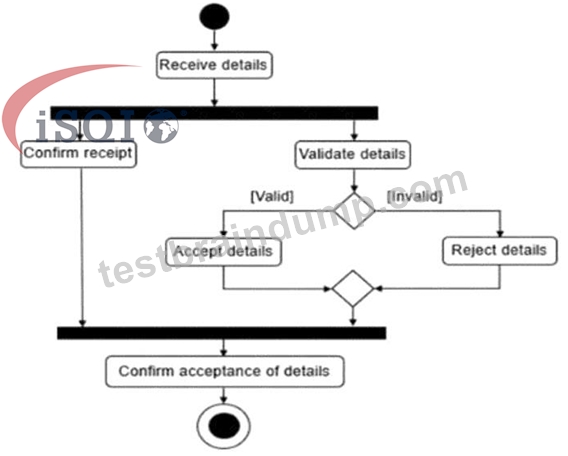
Which of the following conclusions is correct?
- A. The diagram may contain a defect but this cannot be confirmed until the results of the tests created from it are known
- B. The diagram contains at least one defect because it contains an internal inconsistency
- C. The diagram may contain a defect but this cannot be confirmed until test cases have been designed from it
- D. The diagram is correct because it has been reviewed and approved by the stakeholders
Answer: B
Explanation:
The correct answer is D . The diagram contains an internal inconsistency that can be identified directly from the model, without waiting for test design or execution. The activity diagram shows Receive details , then splits into parallel activities: Confirm receipt and Validate details . The validation path then branches into
[Valid] Accept details and [Invalid] Reject details . However, after either acceptance or rejection, the flow rejoins and continues to Confirm acceptance of details . That means the model allows rejected details to proceed into an activity that confirms acceptance, which is logically inconsistent.
CTAL-TA v4.0 states that scenario-based testing uses workflow models such as activity diagrams, use cases, flowcharts, BPMN diagrams, sequence diagrams, and collaboration diagrams to derive scenarios through the test item. The syllabus also emphasizes that modeling and test analysis can reveal defects in the test basis, including workflow-related defects, before dynamic test execution begins.
Option A is wrong because the inconsistency is visible statically; test execution is not needed to confirm it.
Option B is also wrong because formal test cases are not required before recognizing the contradiction.
Option C is dangerous and incorrect: stakeholder approval does not prove technical or logical correctness.
The issue is a structural workflow defect in the model itself. Reference: CTAL-TA v4.0, Scenario-Based Testing and Test Analysis of the Test Basis .
For the first process, when 'Something is needed', which option contains the MOST appropriate keywords for action and verification?
Required Goods / Check PR
Enter Required Goods I Check PR Created
Enter Details of Required Goods / Is PR Created?
Required Goods Entry I PR Creation Check
NEW QUESTION # 15
A simple DVD player is described in the following state transition diagram:
States shown in the diagram: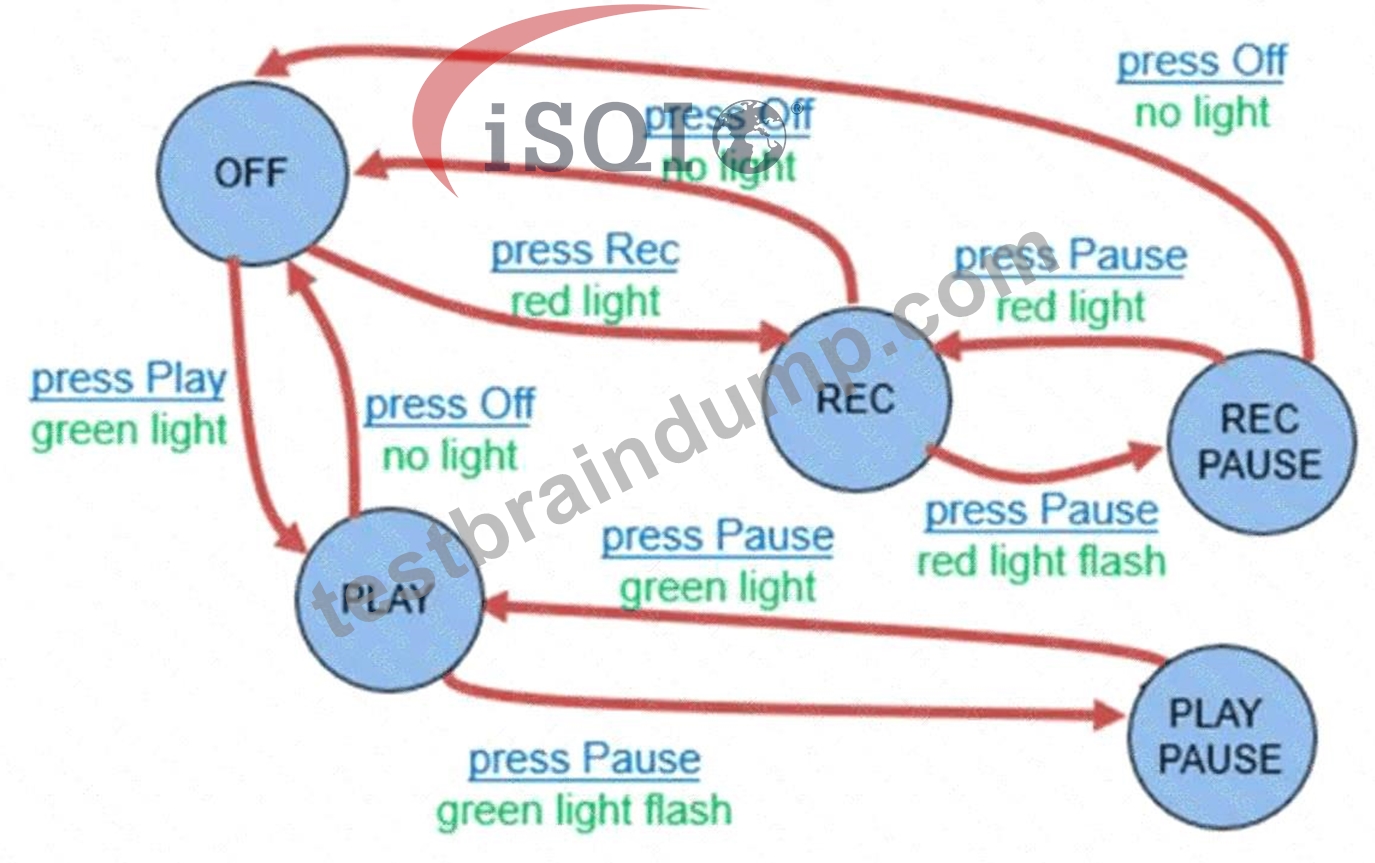
All round trips are feasible, even those that do not start at OFF. How many test cases will be needed for complete round-trip coverage?
- A. 0
- B. 1
- C. 2
- D. 3
Answer: A
Explanation:
The correct answer is B , because complete round-trip coverage requires every feasible round trip in the state model to be covered, not only those that start from the initial OFF state. CTAL-TA v4.0 explicitly includes state transition testing with N-switch and round-trip coverage as the focus of its state transition topic. A round trip is a path that starts and ends in the same state, normally without repeating an intermediate state.
The feasible round trips are:
* OFF # PLAY # OFF
* PLAY # OFF # PLAY
* OFF # REC # OFF
* REC # OFF # REC
* REC # REC PAUSE # REC
* REC PAUSE # REC # REC PAUSE
* PLAY # PLAY PAUSE # PLAY
* PLAY PAUSE # PLAY # PLAY PAUSE
* OFF # REC # REC PAUSE # OFF
* REC # REC PAUSE # OFF # REC
* REC PAUSE # OFF # REC # REC PAUSE
That gives 11 round trips. The warning in the question is important: if only OFF-starting round trips were counted, the answer would be too low. Option A overcounts by adding a non-modeled or duplicate round trip.
Options C and D miss feasible non-OFF-starting round trips. Reference: CTAL-TA v4.0, Section 3.2.2 State Transition Testing , round-trip coverage.
NEW QUESTION # 16
A savings bank rewards its customers with a £100 bonus when they reach the age of 21, if they have held a savings account for more than 3 years and have at least £2,000 in the account at that time.
Assume that Age is measured in whole years, Account term in whole years, and Account balance to two decimal places, i.e., pounds and pence.
The intended rule is:
IF Age = 21 AND Account term > 3 years AND Account balance > = £2000.00 THEN Pay £100 bonus You have a suite of test cases with the following values:
* TC1 Age = 21, Account term = 3 years, Account balance = £2000.00
* TC2 Age = 20, Account term = 6 years, Account balance = £500.00
* TC3 Age = 20, Account term = 2 years, Account balance = £3000.00
Which of the following test cases should you add to the suite to achieve 100% Reliable domain coverage?
- A. Age = 21, Account term = 3 years, Account balance = £1999.99
- B. Age = 20, Account term = 4 years, Account balance = £2000.01
- C. Age = 22, Account term = 4 years, Account balance = £2000.00
- D. Age = 22, Account term = 4 years, Account balance = £1999.99
Answer: D
Explanation:
The correct answer is B . Reliable domain coverage requires stronger boundary evidence than simplified domain coverage. CTAL-TA v4.0 defines ON, OFF, IN, and OUT points and states that for borders defined by < , #, > , or #, reliable domain coverage requires one ON, one OFF, one IN, and one OUT point . For an equality operator, it requires one ON point and two OFF points located on different sides of the border .
The existing tests already cover several required items. For Age = 21 , TC1 gives the ON point and TC2/TC3 give the lower-side OFF point at age 20; the missing equality-side point is age 22. For Account term > 3 , TC1 gives OFF at 3, TC2 gives IN at 6, TC3 gives OUT at 2; the missing ON point is 4. For Account balance > = £2000.00 , TC1 gives ON at £2000.00, TC3 gives IN at £3000.00, and TC2 gives OUT at
£500.00; the missing closest OFF point is £1999.99. Option B supplies all three missing items in a single test case: age 22, term 4, and balance £1999.99. Reference: CTAL-TA v4.0, Section 3.1.1 Domain Testing , Reliable domain coverage.
NEW QUESTION # 17
The following activity diagram, drawn in Business Process Modeling Notation (BPMN), shows the process of raising a Purchase Request (PR), getting it authorized and raising a Purchase Order from it.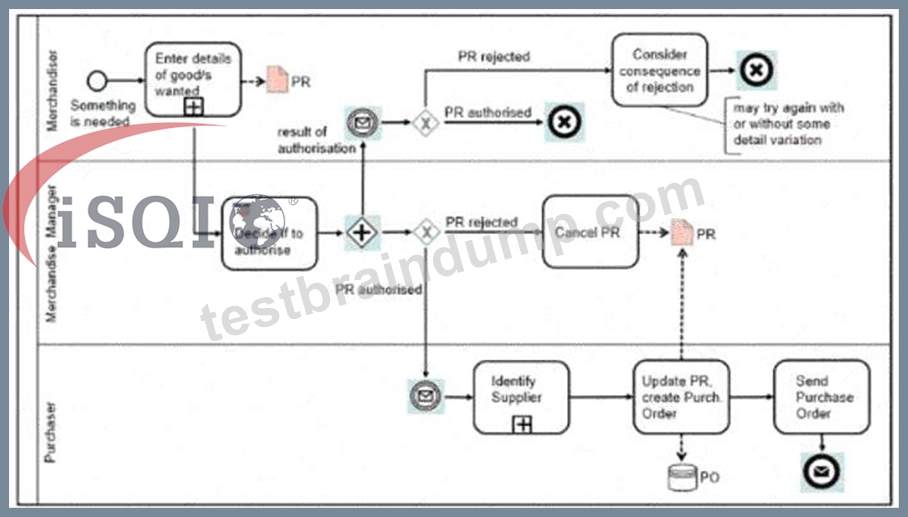
What is the minimum quantity of test cases that will be needed to cover all scenarios?
- A. 0
- B. 1
- C. 2
- D. 3
Answer: C
Explanation:
The correct answer is B , because the BPMN model contains two executable end-to-end scenarios . CTAL- TA v4.0 classifies scenario-based testing as a behavior-based technique where the Test Analyst creates a scenario model from action sequences that form workflows through the test item. The syllabus specifically mentions activity diagrams and BPMN-style workflow models as scenario-model sources, and states that test cases are designed to cover the identified scenarios.
In the diagram, the process starts when something is needed and the merchandiser enters the details of goods wanted. The manager then decides whether to authorize the PR. From that decision, there are only two real scenario outcomes. The first is the authorized scenario : the PR is authorized, the supplier is identified, the PR is updated and a Purchase Order is created, and the Purchase Order is sent. The second is the rejected scenario : the PR is rejected, the PR is cancelled, and the merchandiser considers the consequence of rejection.
The notification/result-of-authorization flow does not create separate scenarios; it is part of the same authorized or rejected process path. The note saying the merchandiser may try again is not a modeled loop because no BPMN flow returns to the start. CTAL-TA states that when the scenario model has no loops, each scenario can be tested with a separate test case. Therefore, the minimum quantity is 2 test cases .
NEW QUESTION # 18
A pricing system for determining the postage cost of a company's letters examines two input variables, representing the length L of the envelope in centimeters and the weight W of the letter in grams. Envelopes can only have three lengths: 15 cm Small, 20 cm Standard, and 25 cm Large.
For standard length envelopes, 20 cm, a premium postage rate is applied if the weight is equal to or greater than 50 grams. This is represented as:
IF L = 20 AND W > = 50 THEN RETURN Cost "Premium rate"
Which set of test points, each represented as variables L, W , achieves 100% simplified domain coverage for the Standard letter postage cost domain?
- A. (20,50), (20,51), (15,60), (25,60)
- B. (20,50), (20,49), (15,60), (25,60)
- C. (20,40), (20,50), (20,60), (15,60), (25,60)
- D. (20,50), (20,49), (19,60), (21,60)
Answer: B
Explanation:
The correct answer is B . Simplified domain coverage requires boundary-focused ON and OFF points. CTAL- TA v4.0 states that for borders defined by < , #, > , or #, simplified domain coverage requires one ON and one OFF point. For an equality border, it requires one ON point and two OFF points on different sides of the border, with OFF points as close as possible according to the given precision.
The premium Standard-letter domain is defined by L = 20 and W > = 50 . For the W > = 50 border, (20,50) is the ON point because 50 is included, and (20,49) is the closest OFF point. For the L = 20 equality border, (20,50) also serves as the ON point, while (15,60) and (25,60) are OFF points on the two available sides of the Standard envelope length, because envelope lengths are restricted to 15, 20, and 25 cm.
Option A includes unnecessary extra points and does not represent the minimal required simplified coverage set. Option C uses 19 and 21, which are invalid envelope lengths. Option D misses the closest OFF point for the inclusive weight boundary because it uses 51 instead of 49. Reference: CTAL-TA v4.0, Section 3.1.1 Domain Testing , simplified domain coverage.
NEW QUESTION # 19
You are a TA in the development of a road traffic control application, which will be installed at busy road junctions, to control the operation of traffic signal lights according to sensors that detect traffic volume. This safety-critical project is still in the early stages of test planning and the project schedule is tight.
The Test Manager has asked you if crowd testing should be included in the project's test strategy. You do NOT think it should. Which limitation of crowd testing MOST influences your view?
- A. Coordinating with testers in various locations and time zones, with cultural differences and language barriers, can be challenging
- B. Sharing software with external testers poses data security and confidentiality risks
- C. Ensuring comprehensive test documentation and managing a large number of findings can be challenging
- D. Testing quality can vary significantly depending on the skills of individual testers
Answer: D
Explanation:
The correct answer is A . Crowd testing can provide scale, diversity of devices, and real-world variety, but its major weakness for a safety-critical road traffic control system is the variability of tester skill and therefore the variability of test quality. CTAL-TA v4.0 discusses crowd testing as a technique that may be useful in some contexts but has limitations, including variability in tester capability, control, coordination, documentation, and confidentiality. For a safety-critical system, the decisive factor is not geographical inconvenience or volume of findings; it is the need for controlled, rigorous, repeatable, competent testing against safety-relevant behavior.
Traffic signal control software must be tested using disciplined techniques, traceable test conditions, formal models, carefully selected scenarios, and controlled environments. Incorrect behavior could cause accidents, traffic conflict, or unsafe signal timing. Crowd testers are unlikely to have the necessary domain knowledge, safety-testing discipline, access to representative simulation rigs, or ability to produce the evidence expected for a safety-critical project.
Option B is a real crowd-testing limitation, but coordination overhead is not the strongest objection here.
Option C may matter, but the question gives no special confidentiality driver. Option D is relevant, but documentation burden is secondary to the unacceptable variability in testing quality. Reference: CTAL-TA v4.
0, Section 3.5.1 Crowd Testing .
NEW QUESTION # 20
A Customer Relationship Management (CRM) system will be developed for a company that runs a chain of hotels. These are some of the requirements relating to staff in the call center.
* R1. High. An operator shall be able to find and see the details of a customer's booking. The data that may be used for the search include customer name, customer registration number (in the company's loyalty enrolment scheme) and booking reference.
* R2. High. An operator shall be able to amend a customer's booking. The data that may be amended include check-in and check-out dates, hotel, room type and tariff (with / without breakfast).
* R3. High. Before a booking amendment is accepted, the system shall display to the operator any difference in price with respect to the original booking. The operator shall confirm that the customer accepts the revised price and then the system shall record the accepted amendment.
* R4. Medium. Details of the amended booking shall be sent to the customer (see requirements for original customer booking for details).
* R5. High. Details of the extra amount payable shall be sent to the billing system for customer invoicing (see requirements for invoicing of the original customer booking for details).
You have been asked to review these requirements using this checklist:
* Specific - does each requirement deal with only a single aspect of the solution?
* Clear - is each requirement expressed in an unambiguous way with no possibility of interpretation or uncertainty about its meaning?
* Complete - does the set of requirements cover all of the stakeholders' reasonable needs?
* Unique - does each requirement address something that no other requirement also covers?
Assume that the other requirements referred to by R4 and R5 have been reviewed with a satisfactory outcome.
Considering these five requirements, to which checklist items would you answer 'No'?
- A. 3 and 4
- B. 2 and 3
- C. 1 and 4
- D. 1 and 2
Answer: B
Explanation:
The correct answer is D . The two checklist items that should be answered No are Clear and Complete .
CTAL-TA v4.0 places requirements review and defect prevention under the Test Analyst's static testing responsibilities. It also identifies perspective-based reading and checklist-based review as techniques for finding defects in the test basis before test design and execution. The official sample-answer material confirms that checklist items should support detection of defects such as ambiguity, incompleteness, and inconsistency, rather than merely restating requirements.
The requirements are not fully clear because several phrases leave room for interpretation. For example, R1 says customer name may be used for searching, but it does not clarify what happens if multiple bookings match. R3 says "any difference in price" and "original booking," which may be ambiguous if multiple amendments occur. The requirements are also not fully complete because R5 only addresses an "extra amount payable." It does not cover the reasonable business case where the amendment reduces the price and a refund, credit, or billing adjustment is needed.
The requirements are broadly specific enough for this review because each requirement addresses a distinct call-center function. They are also unique because no requirement duplicates another: search, amend, price confirmation, customer notification, and billing interface are separate concerns. Reference: CTAL-TA v4.0, Software Defect Prevention , reviews, checklist-based review, and perspective-based reading.
NEW QUESTION # 21
In which of the following circumstances is the transition from a high-level test case to a low-level test case MOST LIKELY to be deferred from test design to test implementation?
- A. When product risk analysis has not been completed
- B. When the details required depend on the test execution schedule
- C. When specific test data are needed for the test case
- D. When the person who runs the test will not be its author
Answer: C
Explanation:
The correct answer is D . CTAL-TA v4.0 distinguishes between high-level test cases and low-level test cases
. A high-level test case describes the circumstances under which the test object is examined and indicates the test conditions covered, but it does not provide concrete preconditions, input data, expected outputs, or postconditions. A low-level test case is the detailed refinement of that high-level test case and specifies concrete test data, tester actions, expected results, and postconditions.
The syllabus explicitly states that the transition from high-level to low-level test cases is often deferred from test design to test implementation, especially if specific test data is needed . This is because concrete test data may depend on available databases, valid account records, configured environments, external interfaces, data privacy restrictions, or generated identifiers. Until those implementation details are known, a high-level test case may remain abstract.
Option A is incorrect because the execution schedule affects sequencing, not necessarily the abstraction level of a test case. Option B argues for making the test case more understandable, not deferring refinement. Option C is wrong because product risk analysis should guide test prioritization and coverage, but it is not the direct reason for delaying low-level test-case derivation. Reference: CTAL-TA v4.0, Section 1.3.1 High-Level Test Cases and Low-Level Test Cases .
NEW QUESTION # 22
You are working on a project to build a purchasing system. The main requirements for the system are that it shall:
* Allow users to enter details of items that they wish to have purchased and, from these details, create a purchase request.
* Take each purchase request through a workflow that will allow the requestor's line manager to approve the request, reject it or return it for clarification / modification.
* Forward approved requests to the Purchasing Department.
* Allow purchasers to find the best available supplier for each approved request and place the request on that supplier as a purchase order.
The solution is being developed according to the company's traditional V-model methodology. The requirements are clearly documented and include a business process model. Operational profiles have been created to guide performance testing.
Initial item entry will involve a check that each item entered exists on the master stock file and that the user is entitled to request it; this depends on user role and grade. Line manager authorization will be assisted by a recommendation made by the system according to relevant business rules, although the manager can override this recommendation. For approved requests, the workflow will continue to support the process through to placing of the purchase order.
Planning has begun for system testing and the Test Manager has asked you, the senior TA, to help with it.
What would be the MOST effective techniques for functional testing of this project?
a) Combinatorial testing
b) Random testing
c) CRUD testing
d) State transition testing
e) Scenario-based testing
f) Decision table testing
g) Exploratory testing
- A. a, b and g
- B. c, e and g
- C. d, e and f
- D. b, d and f
Answer: C
Explanation:
The correct answer is D because the scenario gives three strong test-basis signals: a workflow, a business process model, and business rules. CTAL-TA v4.0 classifies relevant black-box techniques into data-based, behavior-based, and rule-based techniques, and explicitly includes state transition testing, scenario-based testing, and decision table testing within Chapter 3 test analysis and design. It also requires the Test Analyst to select appropriate techniques for a given situation.
State transition testing fits the purchase request workflow because requests move between states such as created, approved, rejected, returned for clarification, forwarded, and converted to purchase order. CTAL-TA states that behavior-based techniques derive tests from state-dependent or dynamic behavior. Scenario-based testing fits because the requirements include a business process model and end-to-end purchasing flows.
CTAL-TA states that scenario-based testing evaluates behavior in realistic workflows and may use activity diagrams, use cases, flowcharts, or BPMN models. Decision table testing fits because entitlement checks and manager recommendations are driven by business rules involving role, grade, and authorization logic. Rule- based techniques verify stateless business-rule behavior.
Combinatorial testing may help with input combinations, but it is not the best overall functional set here.
Random and exploratory testing are weak choices because the requirements are clear and formal.
NEW QUESTION # 23
You are conducting a system test of an airline's flight reservation system and have written a series of test conditions to address the following requirement specification:
* RS-BK14 - Upon successful processing of payment for a new flight booking, the system shall complete the process by displaying a message notifying the customer that the booking reservation has been applied, appended by the booking reference number and, where applicable, the pre-paid seat numbers.
Which test condition is an example of functional appropriateness testing for this requirement?
- A. After a new flight booking has been processed, an email shall be sent to the customer's email address, confirming the booking reservation details
- B. After successful processing of a payment for a new flight booking, message BK14 shall be displayed to the customer confirming that the booking reservation has been applied
- C. Where the customer has requested and pre-paid for specific seat numbers on a new flight booking, message BK14 shall be displayed along with the booking reference number and the correct seat numbers
- D. The system generated booking reference number shall be displayed to the customer, for each new flight booking
Answer: B
Explanation:
The correct answer is C because functional appropriateness testing checks whether the implemented function helps the user accomplish the intended task or objective. CTAL-TA v4.0 defines functional appropriateness testing as verifying that "the functions facilitate accomplishing specified tasks and objectives" and focuses on whether implemented functionality fulfills users' needs. In this requirement, the user need is simple and operationally important: after successful payment, the customer must receive confirmation that the booking reservation has been applied. Option C directly tests that the confirmation message is displayed after payment and that it communicates the essential task outcome.
Option A is closer to functional correctness because it checks whether specific appended values, booking reference number and pre-paid seat numbers, are correct. Option B checks one required data element, the booking reference number, but it does not verify that the function supports the whole booking-confirmation objective. Option D introduces an email confirmation that is not specified in RS-BK14, so it cannot be the best test condition for this requirement. Reference: CTAL-TA v4.0, Section 4.1 Functional Testing , especially functional appropriateness, functional correctness, and functional completeness.
NEW QUESTION # 24
As an experienced Test Analyst, you have been asked to collaborate in usability test sessions for a new shopping cart application. In which way would you BEST contribute to this activity?
- A. Designing various purchasing scenarios for use during the usability test sessions
- B. Assisting users in verifying that the correct prices have been displayed for items selected
- C. Filling out a WAMMI questionnaire after completion of the usability test sessions
- D. Executing purchasing scenarios during the sessions to ensure that accessibility has been addressed
Answer: A
Explanation:
The correct answer is C because the Test Analyst's strongest contribution to usability test sessions is to help design realistic, representative scenarios that users will attempt during the session. CTAL-TA v4.0 states that usability test sessions involve future users or representatives attempting predefined tasks to determine whether those tasks can be completed effectively, efficiently, and satisfactorily. It further specifies that the Test Analyst may contribute by designing scenarios for usability sessions according to personas, user groups, or operational profiles.
For a shopping cart application, appropriate scenarios could include finding a product, adding multiple items, applying a discount code, changing quantities, selecting delivery options, abandoning and resuming a cart, and completing checkout. These scenarios expose usability barriers in the user journey rather than merely validating functional output.
Option A is too narrow: WAMMI is a questionnaire used to measure user satisfaction, and the Test Analyst may help design or evaluate questionnaires, but simply filling one out is not the best contribution. Option B incorrectly shifts the activity from user-centered usability evaluation to tester execution, and accessibility is only one aspect of usability. Option D is functional correctness testing, not usability testing. Reference:
CTAL-TA v4.0, Section 4.2 Usability Testing .
NEW QUESTION # 25
You are developing test cases for an application which performs complex calculations and have decided to model these calculations on a spreadsheet, to determine expected results from inputs.
Which solution to the test oracle problem BEST describes the approach you are using?
- A. Metamorphic testing
- B. A pseudo-oracle
- C. Deterministic testing
- D. Property-based testing
Answer: B
Explanation:
The correct answer is D . A spreadsheet model used to calculate expected results is best classified as a pseudo- oracle when it has been developed independently from the test object and is used to produce expected outcomes for comparison with the system under test. CTAL-TA v4.0 explains that a test oracle is needed to determine expected results in dynamic testing, and that the test oracle problem occurs when a cost-effective oracle is not readily available because of factors such as data-related complexity, non-determinism, probabilistic behavior, or ambiguous requirements. The syllabus identifies pseudo-oracles as independently developed systems that fulfill the same specification as the test object, including simplified versions of the test object.
Here, the application performs complex calculations, and the spreadsheet is being used as an independent calculation model to determine expected results from the same inputs. That is the classic pseudo-oracle pattern. Option A is wrong because property-based testing verifies general input/output properties rather than exact expected calculation results. Option B is wrong because metamorphic testing checks relations between source and follow-up test cases, not a full expected result from a spreadsheet. Option C is not the named CTAL-TA oracle solution being used here. Reference: CTAL-TA v4.0, Section 1.3.4 Determining Test Oracles .
NEW QUESTION # 26
You are defining key words to test an application which will create a Purchase Request (PR) from details of goods that a Merchandiser wants their organization to buy. When valid details have been entered, the resulting PR will be sent to the Merchandise Manager for authorization.
You have a diagram in Business Process Modeling Notation and this section shows the initial steps in this process: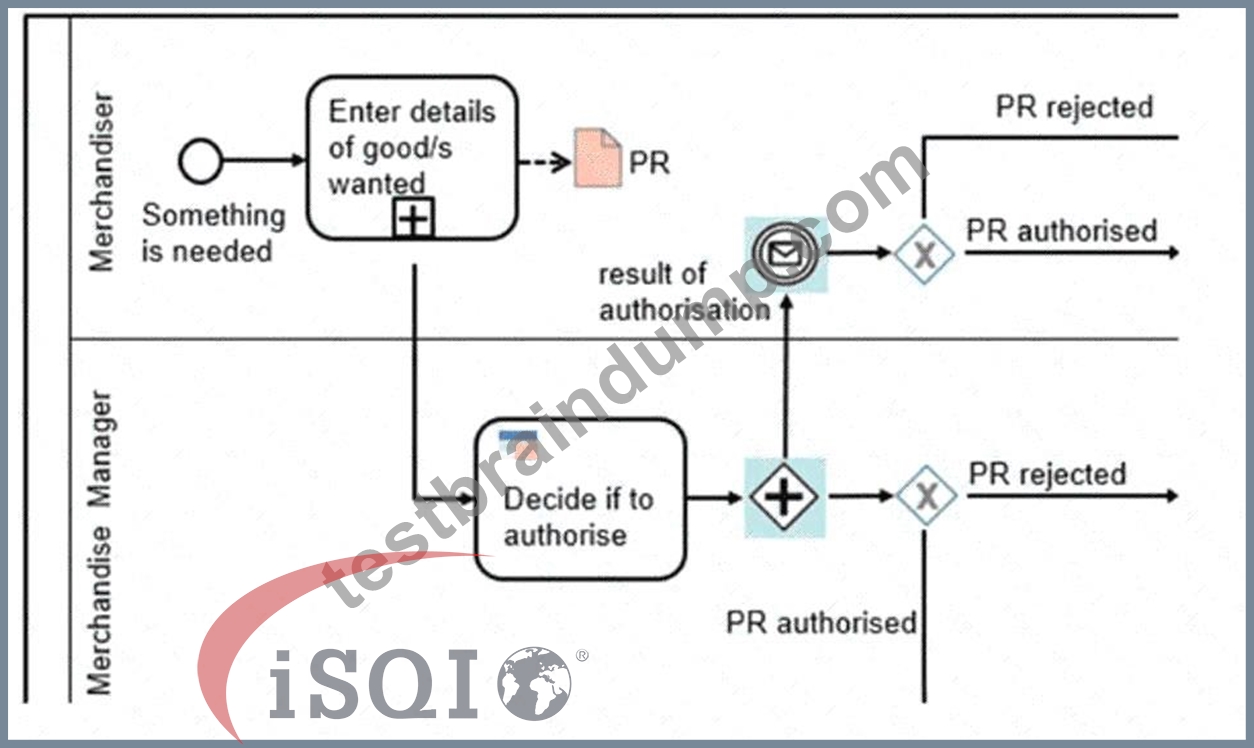
For the first process, when "Something is needed" , which option contains the MOST appropriate keywords for action and verification?
- A. Required Goods / Check PR
- B. Enter Required Goods / Check PR Created
- C. Required Goods Entry / PR Creation Check
- D. Enter Details of Required Goods / Is PR Created?
Answer: B
Explanation:
The correct answer is B . In CTAL-TA v4.0 keyword-driven testing, the Test Analyst identifies and specifies keywords by analyzing the test basis. Keywords are classified into action keywords and verification keywords . Action keywords interact with the test object, such as executing a function, submitting data, or navigating through the application. Verification keywords represent assertions that check whether the actual result matches the expected result. The syllabus also states that keywords should contain a verb plus noun , use the imperative form , and be unique in meaning.
Option B , Enter Required Goods / Check PR Created , is strongest because both keywords use imperative verb-based wording. Enter Required Goods is an action keyword because it describes the business action performed by the Merchandiser. Check PR Created is a verification keyword because it checks the expected result: a Purchase Request has been created.
Option A is weak because Required Goods is only a noun phrase, not an action keyword. Option C has a reasonable action, but Is PR Created? is phrased as a question rather than an imperative verification keyword. Option D uses noun-style labels rather than clear executable keywords. Reference: CTAL-TA v4.0, Section 1.3.6 Developing Test Scripts Using Keyword-Driven Testing .
NEW QUESTION # 27
The following minimized decision table shows the rules for rewarding members of a hotel's loyalty scheme who have booked a room, according to the type of room (luxury or not) and/or whether they have prepaid for breakfast (yes or no). The loyalty scheme has tiers Bronze, Silver and Gold. All combinations are feasible.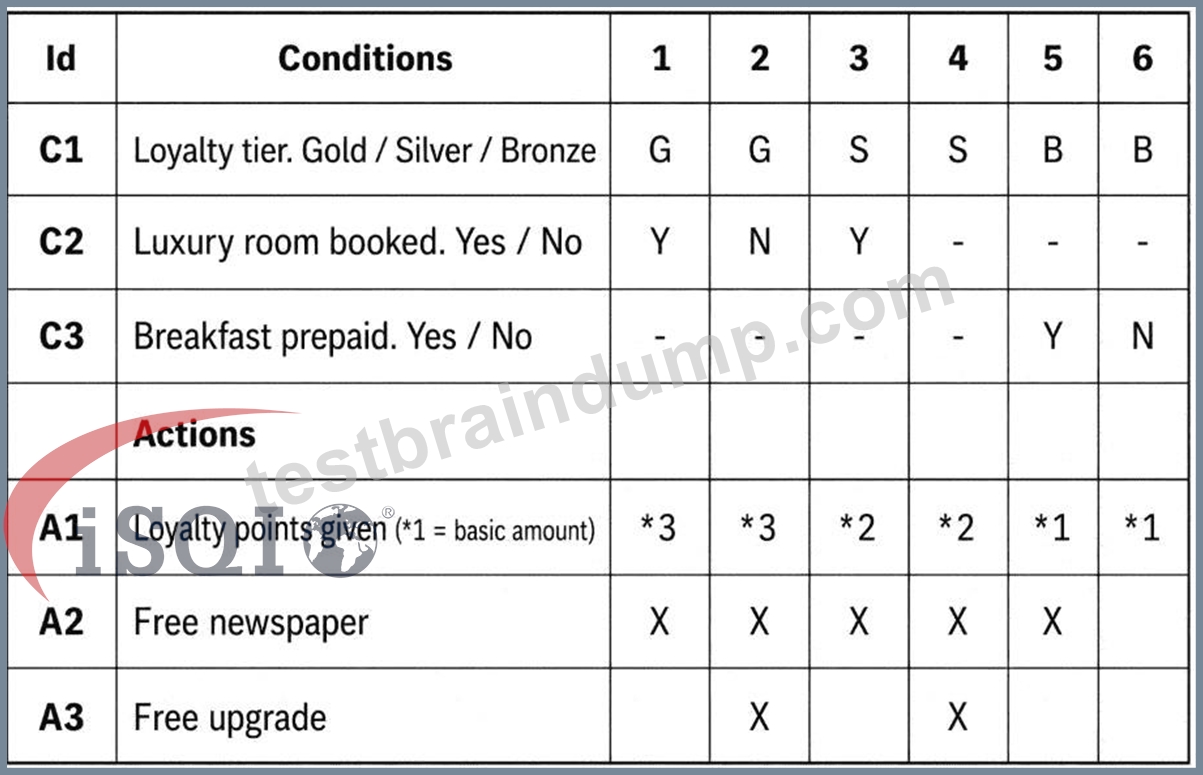
Using the checksum procedure, what do you notice about the structure of the minimized table?
- A. The table may have been minimized correctly
- B. There is rule overlap, in the sense that one combination is covered by > 1 rule, or additional rules are not shown
- C. The decision table is incomplete, in the sense that at least one condition value is not represented in any of the rules
- D. There are additional rules that are not shown
Answer: B
Explanation:
The correct answer is B . In CTAL-TA v4.0 decision table testing, the checksum procedure is used to detect structural problems in a minimized decision table. A rule without any "-" condition represents one full-table combination. Each "-" multiplies that rule's checksum by the number of possible values for that condition. If the minimized-table checksum is higher than the original-table checksum, some rules overlap or additional rules exist; if it is lower, the table is incomplete; if equal, the minimization may be structurally correct.
The original full table has 3 loyalty tiers × 2 luxury-room values × 2 breakfast values = 12 feasible combinations . The minimized rules score as follows: Rule 1 G/Y/- = 2 , Rule 2 G/N/- = 2 , Rule 3 S/Y/- = 2
, Rule 4 S/-/- = 4 , Rule 5 B/-/Y = 2 , Rule 6 B/-/N = 2 . Total checksum = 2 + 2 + 2 + 4 + 2 + 2 = 14 . Since
14 > 12 , the minimized table cannot be structurally clean. The overlap is visible: Rule 3 covers Silver + Luxury + either breakfast value , while Rule 4 covers Silver + any room type + any breakfast value , so the Silver/Luxury combinations are covered twice. Option C is wrong because all condition values are represented. Option D alone is weaker than B , because the actual symptom here is overlap. Reference: CTAL- TA v4.0, Section 3.3.1 Decision Table Testing .
NEW QUESTION # 28
You are your employer's most experienced TA. The organisation performs root cause analysis (RCA) thoroughly, but infrequently and only on individual defects that went live at the highest of the five Severity levels.
After six months of live operation for one system, particular concern has been expressed about the volume of usability and security defects and there is a strong desire to reduce their quantities. You have recommended adding product quality characteristics, per ISO 25010, to the defect report template.
How might this recommendation support RCA?
- A. Classification by Quality Characteristic will enable more detailed analysis of the defect detection percentage (DDP)
- B. In combination with Severity, Quality Characteristic will isolate groups of defects that are causing most concern, so that RCA can be performed at group level
- C. In combination with knowledge about how the defect was fixed, it will speed up RCA
- D. It will enable Pareto analysis to be performed across the quality characteristics, in order to focus on those which have most defects
Answer: B
Explanation:
The correct answer is B . The organization already performs RCA, but only infrequently and only for individual live defects at the highest severity level. That approach misses recurring lower-severity or medium- severity defect patterns, especially where many defects share the same quality concern. CTAL-TA v4.0 includes supporting root cause analysis with defect classification and aligns the syllabus with the ISO/IEC
25010:2023 product quality model, including quality characteristics such as functional suitability, usability, security, compatibility, and others.
Adding Quality Characteristic to the defect report template enables defects to be grouped by the quality attribute they affect. Combined with Severity , this allows the team to isolate clusters such as high-volume usability defects or serious security defects and then perform RCA on a meaningful defect group rather than only on isolated live failures. That directly supports the stated goal: reducing the quantities of usability and security defects.
Option A is partly useful because Pareto analysis can identify high-volume categories, but by itself it is defect counting, not the strongest RCA support. Option C concerns defect detection percentage, which is a different analysis objective. Option D is weak because "how the defect was fixed" may help investigation, but it does not provide the systematic classification needed to target recurring root causes. Reference: CTAL-TA v4.0, Sections 5.3.2 Supporting Root Cause Analysis with Defect Classification and Appendix F Software Quality Model .
NEW QUESTION # 29
Your company, which specializes in medical software, has designed an application for use on smartphones and tablets that calculates a person's BMI, Body Mass Index.
How can a Test Analyst BEST contribute to interoperability testing for this application?
- A. Verifying that users with disabilities can access their BMI effectively and efficiently using the application
- B. Verifying that the application works on all intended target smartphones and tablet devices and their operating systems
- C. Verifying that the application co-exists with other health applications on the target device without affecting their performance
- D. Verifying that the application integrates with the national health service system, receiving and processing the correct BMI data file
Answer: D
Explanation:
The correct answer is A because interoperability testing verifies whether the test object can interact correctly with other components or systems, exchange information, and use the exchanged information correctly.
CTAL-TA v4.0 states that interoperability testing verifies compatibility with components or systems with which the test object is intended to interact, and that its goal is to verify that two or more systems can exchange information and mutually use the exchanged information. It also specifically identifies defects in data transformation, interpretation or use of exchanged data, communication flows, protocols, standards compliance, and end-to-end functionality as interoperability concerns.
For a BMI medical application, integration with a national health service system and the correct receiving and processing of a BMI data file directly tests external system interaction and exchanged-data correctness.
Option B is accessibility testing, not interoperability. Option C describes coexistence testing, which CTAL- TA separates from interoperability under compatibility testing. Option D is adaptability or cross-platform environment testing because it checks target devices and operating systems, not interaction with another system. Reference: CTAL-TA v4.0, Section 4.4 Compatibility Testing , especially Interoperability Testing
.
NEW QUESTION # 30
......
New CTAL-TA_V4.0 exam dumps Use Updated ISQI Exam: https://actualtests.testbraindump.com/CTAL-TA_V4.0-exam-prep.html
