
Give Push to your Success with Netskope NCCSA NSK300 Exam Questions
NSK300 100% Guarantee Download NSK300 Exam PDF Q&A
NEW QUESTION # 35
You want to verify that Google Drive is being tunneled to Netskope by looking in the nsdebuglog file. You are using Chrome and the Netskope Client to steer traffic. In this scenario, what would you expect to see in the log file?
- A.

- B.

- C.

- D.

Answer: C
Explanation:
When verifying that Google Drive traffic is being tunneled to Netskope using Chrome and the Netskope Client, you would expect to see log entries indicating that the traffic is being directed through Netskope's proxy. Specifically, Option A is correct as it shows the process "google drive" being tunneled tonsProxy. The log entry for Option A indicates that a TLS tunneling flow from a local address and process (Google Drive) is being directed to a host (play.googleapis.com) and then to Netskope's proxy (nsProxy).This is consistent with how Netskope tunnels specified traffic for security and policy enforcement1.
The expected log entries are based on the standard operation of Netskope Client and how it steers traffic to Netskope's cloud services, as detailed in Netskope's documentation1.
NEW QUESTION # 36
You have an NG-SWG customer that currently steers all Web traffic to Netskope using the Netskope Client.
They have identified one new native application on Windows devices that is a certificate-pinned application.
Users are not able to access the application due to certificate pinning. The customer wants to configure the Netskope Client so that the traffic from the application is steered to Netskope and the application works as expected.
Which two methods would satisfy the requirements? (Choose two.)
- A. Bypass traffic using the bypass action in the Real-time Protection policy.
- B. Tunnel traffic to Netskope and bypass traffic inspection at the Netskope proxy.
- C. Configure domain exceptions in the steering configuration for the domains used by the native application.
- D. Configure the SSL Do Not Decrypt policy to not decrypt traffic for domains used by the native application.
Answer: B,D
NEW QUESTION # 37
You are the network architect for a company using Netskope Private Access. Multiple users are reporting that they are unable to access an application using Netskope Private Access that was working previously. You have verified that the Real-time Protection policy allows access to the application, private applications are steered for the users, and the application is reachable from internal machines. You must verify that the application is reachable through Netskope Publisher In this scenario, which two tools in the Netskope Ul would you use to accomplish this task? (Choose two.)
- A. Clear Private App Auth under Users in Skope IT
- B. Reachability Via Publisher in the App Definitions page
- C. Troubleshooter tool in the App Definitions page
- D. Applications in Skope IT
Answer: B,C
Explanation:
In the scenario where users are unable to access an application through Netskope Private Access, and after verifying that the Real-time Protection policy allows access, the application is steered for the users, and it is reachable from internal machines, the next step is to verify the application's reachability through the Netskope Publisher. The two tools in the Netskope UI that would be used to accomplish this task are:
A). Reachability Via Publisher in the App Definitions page - This tool allows you to check if the application is reachable through the configured Publishers. It is essential to ensure that the application's connectivity is intact and that there are no issues with the Publishers themselves.
B). Troubleshooter tool in the App Definitions page - The Troubleshooter tool can help diagnose and resolve issues related to application reachability. It provides insights into potential problems and offers guidance on how to fix them.
These tools are designed to assist in troubleshooting and ensuring that applications are accessible through Netskope Private Access.
The explanation is based on the standard procedures for managing private applications and troubleshooting within the Netskope Private Access environment as outlined in the Netskope Knowledge Portal
NEW QUESTION # 38
You deployed the Netskope Client for Web steering in a large enterprise with dynamic steering. The steering configuration includes a bypass rule for an application that is IP restricted. What is the source IP for traffic to this application when the user is on-premises at the enterprise?
- A. Loopback IPv4
- B. Netskope data plane gateway IPv4
- C. Enterprise Egress IPv4
- D. DHCP assigned RFC1918 IPv4
Answer: C
Explanation:
When a user is on-premises at the enterprise and accesses an application that is IP restricted, the source IP for traffic to this application is the Enterprise Egress IPv4 address.
The Enterprise Egress IP represents the external IP address of the enterprise network as seen by external services or applications.
This IP address is used for communication between the user's device and external resources, including applications that are IP restricted. Reference:
The answer is based on general knowledge of networking concepts and how IP addresses are used in enterprise environments.
NEW QUESTION # 39
You want to verify that Google Drive is being tunneled to Netskope by looking in the nsdebuglog file. You are using Chrome and the Netskope Client to steer traffic. In this scenario, what would you expect to see in the log file?
- A.
- B.
- C.
- D.
Answer: A
NEW QUESTION # 40
You recently began deploying Netskope at your company. You are steering all traffic, but you discover that the Real-time Protection policies you created to protect Microsoft OneDrive are not being enforced.
Which default setting in the Ul would you change to solve this problem?
- A. Disable the default Microsoft appsuite SSL rule.
- B. Disable the default certificate-pinned application
- C. Remove the default steering exception for Cloud Storage.
- D. Remove the default steering exception for domains.
Answer: D
Explanation:
When deploying Netskope and steering all traffic, if you find that the Real-time Protection policies for Microsoft OneDrive are not being enforced, the likely issue is with the default steering exceptions. To resolve this, you should remove the default steering exception for domains . This is because the default exceptions may include domains related to Microsoft services, which could prevent the Real-time Protection policies from being applied to traffic directed towards OneDrive. By removing these exceptions, you ensure that all traffic, including that to OneDrive, is subject to the policies you have set up.
NEW QUESTION # 41
You need to extract events and alerts from the Netskope Security Cloud platform and push it to a SIEM solution. What are two supported methods to accomplish this task? (Choose two.)
- A. Use Cloud Ticket Orchestrator.
- B. Use Cloud Log Shipper.
- C. Stream directly to syslog.
- D. Use the REST API.
Answer: B,D
Explanation:
To extract events and alerts from the Netskope Security Cloud platform and integrate them with a SIEM (Security Information and Event Management) solution, you can utilize the following supported methods:
* Cloud Log Shipper (CLS):
* The Cloud Log Shipper is designed to forward Netskope logs to external systems, including SIEMs.
* It allows you to export logs in real-time or batch mode to a destination of your choice.
* By configuring CLS, you can ensure that Netskope events and alerts are sent to your SIEM for further analysis and correlation.
Reference: Netskope Documentation on Cloud Log Shipper
REST API:
The Netskope Security Cloud provides a comprehensive REST API that allows you to programmatically retrieve data, including events and alerts.
You can use the REST API to query specific logs, incidents, or other relevant information from Netskope.
By integrating with the REST API, you can extract data and push it to your SIEM solution.
Reference: Netskope REST API Documentation
References:
Netskope Cloud Security
Netskope Resources
Netskope Documentation
These methods ensure seamless data flow between Netskope and your SIEM, enabling effective security monitoring and incident response.
NEW QUESTION # 42
You configured a pair of IPsec funnels from the enterprise edge firewall to a Netskope data plane. These tunnels have been implemented to steer traffic for a set of defined HTTPS SaaS applications accessed from end-user devices that do not support the Netskope Client installation. You discover that all applications steered through this tunnel are non-functional.
According to Netskope. how would you solve this problem?
- A. Disable Perfect Forward Secrecy on the tunnel configuration.
- B. Downgrade from IKE v2 to IKE v1.
- C. Restart the tunnel to stop the tunnel from flapping.
- D. Install the Netskope root and intermediate certificates on the end-user devices.
Answer: D
Explanation:
When applications steered through an IPsec tunnel are non-functional, it is often due to the lack of proper trust establishment between the end-user devices and the Netskope data plane. The solution is to install the Netskope root and intermediate certificates on the end-user devices . This ensures that the devices recognize and trust the encrypted connection established by the IPsec tunnel, allowing the HTTPS SaaS applications to function correctly. Without these certificates, the devices may not be able to verify the security of the connection, leading to application failures.
This solution is based on standard practices for securing IPsec tunnels and ensuring device compatibility with encrypted traffic steering, as outlined in Netskope's documentation on traffic steering and IPsec configuration
NEW QUESTION # 43
You deployed Netskope Cloud Security Posture Management (CSPM) using pre-defined benchmark rules to monitor your cloud posture in AWS, Azure, and GCP. You are asked to assess if you can extend the Netskope CSPM solution by creating custom rules for each environment.
Which statement is correct?
- A. With Netskope CSPM, you can create custom rules using Domain Specific Language for AWS. Azure, and GCP
- B. With Netskope CSPM, you can create custom rules using Domain Specific Language for AWS. Azure, but not for GCP.
- C. Custom rules using Domain Specific Language are only available when using SSPM.
- D. You will need to evaluate SaaS Security Posture Management (SSPM) in addition to CSPM so that rules applied to GCP will align with Google Workspace
Answer: A
Explanation:
Netskope Cloud Security Posture Management (CSPM) allows for the creation of custom rules using Domain Specific Language (DSL) for all three major cloud platforms: AWS, Azure, and GCP. This capability is integral to CSPM and enables organizations to tailor their security posture assessments to their specific needs across different cloud environments.
The ability to create custom rules using DSL within Netskope CSPM for AWS, Azure, and GCP is documented in the Netskope Knowledge Portal. It provides detailed instructions on how to build custom rules under Policies > Security Posture > Profiles & Rules for security assessment of resources across these cloud platforms
NEW QUESTION # 44
You successfully configured Advanced Analytics to identify policy violation trends Upon further investigation, you notice that the activity is NULL. Why is this happening in this scenario?
- A. A policy violation was identified using API Protection.
- B. The SSPM policy was not configured during setup.
- C. The REST API v1 token has expired.
- D. A user accessed a static Web page.
Answer: D
Explanation:
The reason for the activity being NULL in this scenario is likely becausea user accessed a static Web page.In Netskope's Advanced Analytics, when the activity is reported as NULL, it often indicates that there was no dynamic interaction or transaction to record, which is typical when a static web page is accessed1. Static web pages do not generate the kind of events or activities that are tracked by policies, hence they appear as NULL in the activity field.
This explanation is supported by the Netskope Knowledge Portal, which mentions that applications fields with null values indicate incidents generated from web traffic, such as accessing static web pages2.Further information on interpreting NULL values in Advanced Analytics reports can be found in the Netskope documentation1.
NEW QUESTION # 45
Your CISO asks that you to provide a report with a visual representation of the top 10 applications (by number of objects) and their risk score. As the administrator, you decide to use a Sankey visualization in Advanced Analytics to represent the data in an efficient manner.
In this scenario, which two field types are required to produce a Sankey Tile in your report? {Choose two.)
- A. Pivot Ranks
- B. Dimension
- C. Measure
- D. Period of Type
Answer: B,C
Explanation:

To produce a Sankey Tile in a report that visually represents the top 10 applications by number of objects and their risk score, you would need:
Dimension (A): This field type would be used to represent the nodes in the Sankey visualization, which could be the applications in this case1.
Measure (B): This field type would provide the weight of the links between the nodes, representing the number of objects or the risk score associated with each application1.
These two field types are essential for creating a Sankey visualization as they define the structure and flow of data between different stages or categories within the visualization.
NEW QUESTION # 46
You are attempting to merge two Advanced Analytics reports with DLP incidents: Report A with 3000 rows and Report B with 6000 rows. Once merged, you notice that the merged report is missing a significant number of rows.
What is causing this behavior?
- A. Visualizations have a system limit of 5000 rows.
- B. Filters are applied differently to dimensions and measures
- C. Netskope automatically deduplicates data in merged reports.
- D. Missing data is due to viewing limits.
Answer: D
Explanation:
When merging two Advanced Analytics reports in Netskope, if the merged report is missing rows, it is likely due to viewing limits within the system. Netskope's Advanced Analytics platform has limitations on the number of rows that can be viewed at once, which can result in missing data when dealing with large reports.
This viewing limit ensures performance and manageability of the data within the system.
The behavior of data viewing limits in Netskope Advanced Analytics is discussed in the Netskope Knowledge Portal, which provides insights into how data is explored and managed within the platform1
NEW QUESTION # 47
A company has deployed Explicit Proxy over Tunnel (EPoT) for their VDI users They have configured Forward Proxy authentication using Okta Universal Directory They have also configured a number of Real- time Protection policies that block access to different Web categories for different AD groups so. for example, marketing users are blocked from accessing gambling sites. During User Acceptance Testing, they see inconsistent results where sometimes marketing users are able to access gambling sites and sometimes they are blocked as expected They are seeing this inconsistency based on who logs into the VDI server first.
What is causing this behavior?
- A. Forward Proxy authentication is configured but not enabled.
- B. Forward Proxy is not configured to use the Cookie Surrogate
- C. Forward Proxy is not configured to use the IP Surrogate
- D. Forward Proxy is configured to use the Cookie Surrogate
Answer: B
Explanation:
* The inconsistent results observed during User Acceptance Testing (where marketing users sometimes access gambling sites and sometimes are blocked) are likely due to the configuration of the Forward Proxy.
* Cookie Surrogate: The Cookie Surrogate is a mechanism used in Forward Proxy deployments to maintain user context across multiple requests. It ensures that user-specific policies are consistently applied even when multiple users share the same IP address (common in VDI environments).
* Issue: If the Forward Proxy is not configured to use the Cookie Surrogate, it may lead to inconsistent behavior. When different users log into the VDI server, their requests may not be associated with their specific user context, resulting in varying policy enforcement.
* Solution: Ensure that the Forward Proxy is properly configured to use the Cookie Surrogate, allowing consistent policy enforcement based on individual user identities. References:
* Netskope Security Cloud Operation & Administration (NSCO&A) - Classroom Training
* Netskope Security Cloud Introductory Online Technical Training
* Netskope Architectural Advantage Features
NEW QUESTION # 48
You deployed IPsec tunnels to steer on-premises traffic to Netskope. You are now experiencing problems with an application that had previously been working. In an attempt to solve the issue, you create a Steering Exception in the Netskope tenant tor that application: however, the problems are still occurring Which statement is correct in this scenario?
- A. Steering bypasses for IPsec tunnels must be applied at your edge network device.
- B. Exceptions only work with IP address destinations
- C. You must create a private application to steer Web application traffic to Netskope over an IPsec tunnel.
- D. You must deploy a PAC file to ensure the traffic is bypassed pre-tunnel
Answer: A
Explanation:
In the scenario where you have deployed IPsec tunnels to steer on-premises traffic to Netskope and are experiencing issues with an application, the correct statement is C: Steering bypasses for IPsec tunnels must be applied at your edge network device. This means that to effectively bypass the steering for a specific application, the configuration must be done on the network device that is establishing the IPsec tunnel, such as a firewall or router. This device controls the traffic before it enters the tunnel, so applying the bypass there ensures that the application's traffic does not get directed through the tunnel and can reach its destination directly.
NEW QUESTION # 49
You are architecting a Netskope steering configuration for devices that are not owned by the organization The users could be either on-premises or off-premises and the architecture requires that traffic destined to the company's instance of Microsoft 365 be steered to Netskope for inspection.
How would you achieve this scenario from a steering perspective?
- A. Use reverse proxy.
- B. Use IPsec and GRE tunnels.
- C. Use DPoP and Secure Forwarder
- D. Use explicit proxy and the Netskope Client
Answer: A
NEW QUESTION # 50
You want to integrate with a third-party DLP engine that requires ICAP. In this scenario, which Netskope platform component must be configured?
- A. Secure Forwarder
- B. Netskope Adapter
- C. On-Premises Log Parser (OPLP)
- D. Netskope Cloud Exchange
Answer: A
Explanation:
To integrate Netskope with a third-party DLP engine using ICAP, you must configure the Netskope Secure Forwarder.
Secure Forwarder is the only Netskope component that supports:
* ICAP communication
* Forwarding inline web traffic to external DLP engines
* Bidirectional ICAP requests/responses (REQMOD/RESPMOD)
This allows Netskope to send inspected content to your on-prem or third-party DLP appliance for additional scanning.
Why the other options are incorrect
* A. On-Premises Log Parser (OPLP)Used for ingesting logs into Netskope - not for ICAP or traffic processing.
* C. Netskope Cloud ExchangeUsed for integrations with SIEM, SOAR, ticketing, threat intel - not for inline DLP.
* D. Netskope AdapterUsed mainly for SSPM/API integrations - not relevant for ICAP or external DLP engines.
NEW QUESTION # 51
Review the exhibit.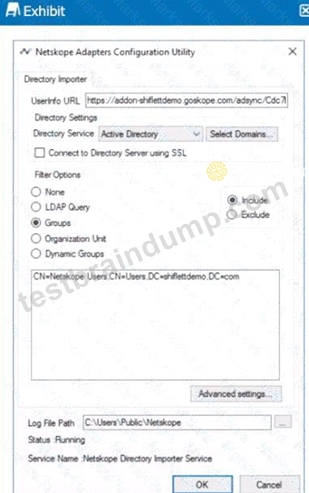
You installed Directory Importer and configured it to import specific groups ot users into your Netskope tenant as shown in the exhibit. One hour after a new user has been added to the domain, the user still has not been provisioned to Netskope.
What are three potential reasons for this failure? (Choose three.)
- A. The default collection interval is 180 minutes, therefore a sync may not have run yet.
- B. The user is not a member of the group specified as a filter
- C. Active Directory integration is not enabled on your tenant.
- D. The server that the Directory Importer is installed on is unable to reach Netskope's add-on endpomt.
- E. Directory Importer does not support ongoing user syncs; you must manually provision the user.
Answer: A,B,D
Explanation:
The three potential reasons for the failure of a new user not being provisioned to Netskope an hour after being added to the domain could be:
* B. The server that the Directory Importer is installed on is unable to reach Netskope's add-on endpoint:
If the server cannot connect to Netskope's endpoint, it cannot sync the user data. This could be due to network issues, incorrect configuration, or firewall restrictions1.
* C. The user is not a member of the group specified as a filter: The Directory Importer may be configured to import users from specific groups only. If the new user is not a member of these groups, they will not be imported into Netskope1.
* E. The default collection interval is 180 minutes, therefore a sync may not have run yet: The Directory Importer may be scheduled to sync every 180 minutes. If only an hour has passed, the sync process might not have occurred yet, and the user would not be provisioned until the next sync interval1.
These potential reasons are based on the standard operation and configuration of the Netskope Directory Importer as described in the Netskope Knowledge Portal and documentation
NEW QUESTION # 52
What are three valid Instance Types for supported SaaS applications when using Netskope's API-enabled Protection? (Choose three.)
- A. API Data Protection
- B. Behavior Analytics
- C. Quarantine
- D. DLP Scan
- E. Forensic
Answer: A,C,E
NEW QUESTION # 53
Your customer is currently using Directory Importer with Active Directory (AD) to provision users to Nelskope. They have recently acquired three new companies (A. B. and C) and want to onboard users from the companies onto the NetsKope platform. Information about the companies is shown below.
- Company A uses Active Directory.
-- Company B uses Azure AD.
-- Company C uses Okta Universal Directory.
Which statement is correct in this scenario?
- A. Users from Company B and Company C cannot be provisioned because the customer is already using AD Importer.
- B. Company A users cannot be provisioned to Netskope because the customer is already using AD Importer to import users from another Active Directory environment.
- C. Users from Companies A. B, and C can be provisioned to Netskope by deploying additional AD Importers and integrating more than one SCIM solution.
- D. Either Company B or Company C users cannot be provisioned because integration with only one SCIM solution is allowed.
Answer: C
Explanation:
Users from Companies A, B, and C can indeed be provisioned to Netskope. Company A, which uses Active Directory, can continue to use the existing AD Importer. For Company B that uses Azure AD and Company C that uses Okta Universal Directory, integration with SCIM (System for Cross-domain Identity Management) solutions is possible.Netskope supports provisioning users from multiple directories, including Active Directory and cloud-based identity providers like Azure AD and Okta, by using additional AD Importers and integrating more than one SCIM solution12.
The correct approach for provisioning users from different companies that use various directory services is supported by Netskope's capabilities to integrate with multiple identity providers and directory services, as outlined in their documentation and community resources12.
NEW QUESTION # 54
You are consuming Audit Reports as part of a Salesforce API integration. Someone has made a change to a Salesforce account record field that should not have been made and you are asked to venfy the previous value of the structured data field. You have the approximate date and time of the change, user information, and the new field value.
How would you accomplish this task?
- A. Use the Application Events Data Collection within Advanced Analytics and filter on the changed field value.
- B. Query Skope IT for an Access Method of API Connector and search Application Event Details for the Old Value field using the User details and Edit Activity.
- C. Query Skope IT Page Events and look for the specific Page URL that was called under the Application section.
- D. Create a classic report and apply a query that filters on the changed field value.
Answer: B
Explanation:
To verify the previous value of a structured data field in Salesforce after an unauthorized change, you would use Skope IT with an Access Method of API Connector. This method allows you to search the Application Event Details for the 'Old Value' field. By filtering with the user details and the edit activity, you can pinpoint the exact change and retrieve the original value of the field.
NEW QUESTION # 55
......
Get NSK300 Actual Free Exam Q&As to Prepare Certification: https://actualtests.testbraindump.com/NSK300-exam-prep.html
