
Download Latest 200-301 Dumps with Authentic Real Exam Questions
Authentic 200-301 Exam Dumps PDF - Jan-2025 Updated
NEW QUESTION # 245
Refer to the graphic. R1 is unable to establish an OSPF neighbor relationship with R3. What are possible reasons for this problem? (Choose two.)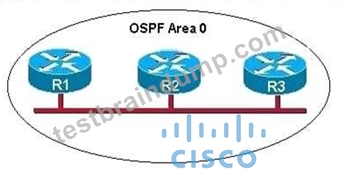
- A. The hello and dead interval timers are not set to the same values on R1 and R3.
- B. R1 and R3 are configured in different areas.
- C. EIGRP is also configured on these routers with a lower administrative distance.
- D. A static route has been configured from R1 to R3 and prevents the neighbor adjacency from being established.
- E. R1 and R2 are the DR and BDR, so OSPF will not establish neighbor adjacency with R3.
- F. All of the routers need to be configured for backbone Area 1.
Answer: A,B
Explanation:
Section: IP Connectivity
Explanation:
This question is to examine the conditions for OSPF to create neighborhood. So as to make the two routers become neighbors, each router must be matched with the following items:
1. The area ID and its types
2. Hello and failure time interval timer
3. OSPF Password (Optional)
NEW QUESTION # 246
Drag and drop the attack-mitigation techniques from the left onto the Types of attack that they mitigate on the right.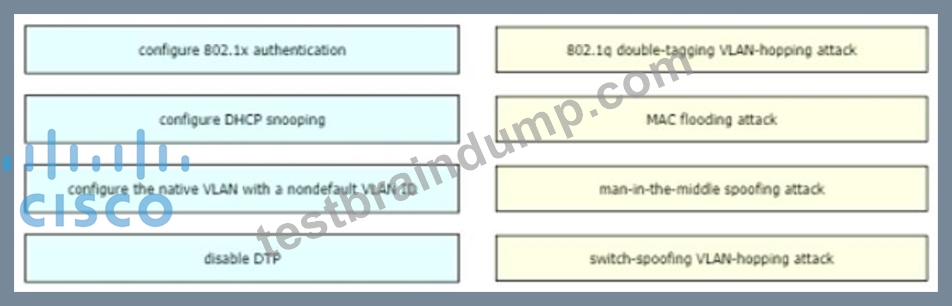
Answer:
Explanation: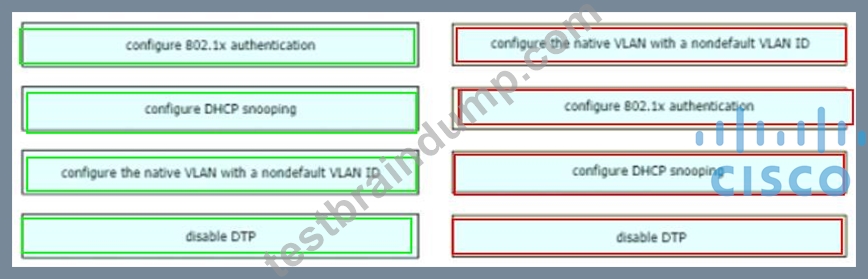
NEW QUESTION # 247
Drag and drop the Cisco IOS attack mitigation features from the left onto the types of network attack they mitigate on the right.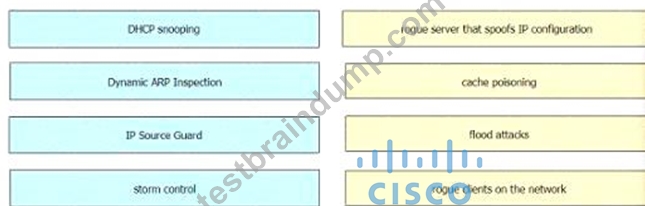
Answer:
Explanation: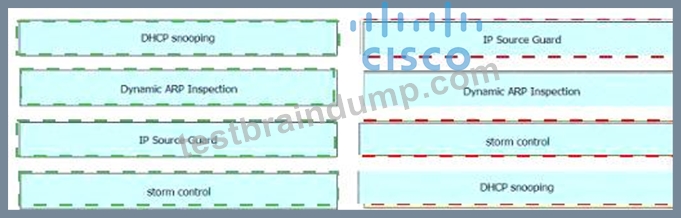
Explanation: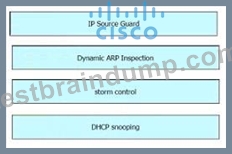
NEW QUESTION # 248
A network analyst is tasked with configured the date and time on a router using EXEC mode. The date must be set to 12:00am. Which command should be used?
- A. Clock timezone
- B. Clock summer-time-recurring
- C. Clock summer-time date
- D. Clock set
Answer: D
NEW QUESTION # 249
Refer to the exhibit.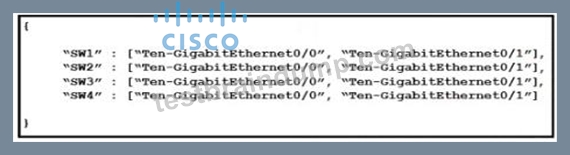
How many JSON objects are represented?
- A. 0
- B. 1
- C. 2
- D. 3
Answer: B
NEW QUESTION # 250
Drag and drop the threat-mitigation techniques from the left onto the types of threat or attack they mitigate on the right.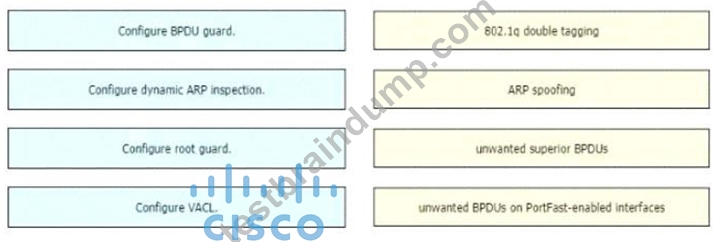
Answer:
Explanation: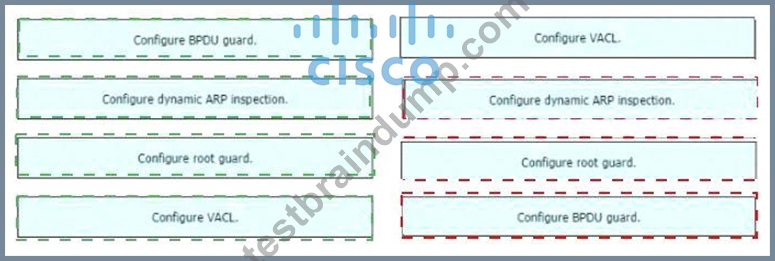
Explanation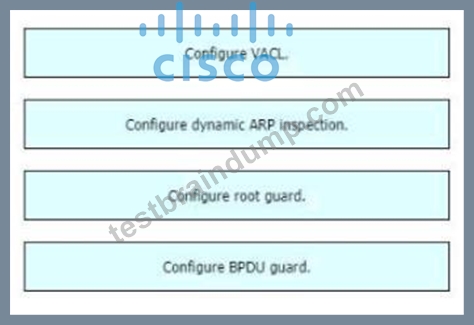
Double-Tagging attack:In this attack, the attacking computer generates frames with two 802.1Q tags. The first tag matches the native VLAN of the trunk port (VLAN 10 in this case), and the second matches the VLAN of a host it wants to attack (VLAN 20).When the packet from the attacker reaches Switch A, Switch A only sees the first VLAN 10 and it matches with its native VLAN 10 so this VLAN tag is removed. Switch A forwards the frame out all links with the same native VLAN 10. Switch B receives the frame with an tag of VLAN 20 so it removes this tag and forwards out to the Victim computer.Note: This attack only works if the trunk (between two switches) has the same native VLAN as the attacker.To mitigate this type of attack, you can use VLAN access control lists (VACLs, which applies to all traffic within a VLAN. We can use VACL to drop attacker traffic to specific victims/servers) or implement Private VLANs.ARP attack (like ARP poisoning/spoofing) is a type of attack in which a malicious actor sends falsified ARP messages over a local area network as ARP allows a gratuitous reply from a host even if an ARP request was not received. This results in the linking of an attacker's MAC address with the IP address of a legitimate computer or server on the network. This is an attack based on ARP which is at Layer 2.Dynamic ARP inspection (DAI) is a security feature that validates ARP packets in a network which can be used to mitigate this type of attack.
NEW QUESTION # 251
When configuring a WLAN with WPA2 PSK in the Cisco Wireless LAN Controller GUI, which two formats are available to select? (Choose two)
- A. decimal
- B. binary
- C. ASCII
- D. hexadecimal
- E. base64
Answer: C,D
NEW QUESTION # 252
Refer to the exhibit.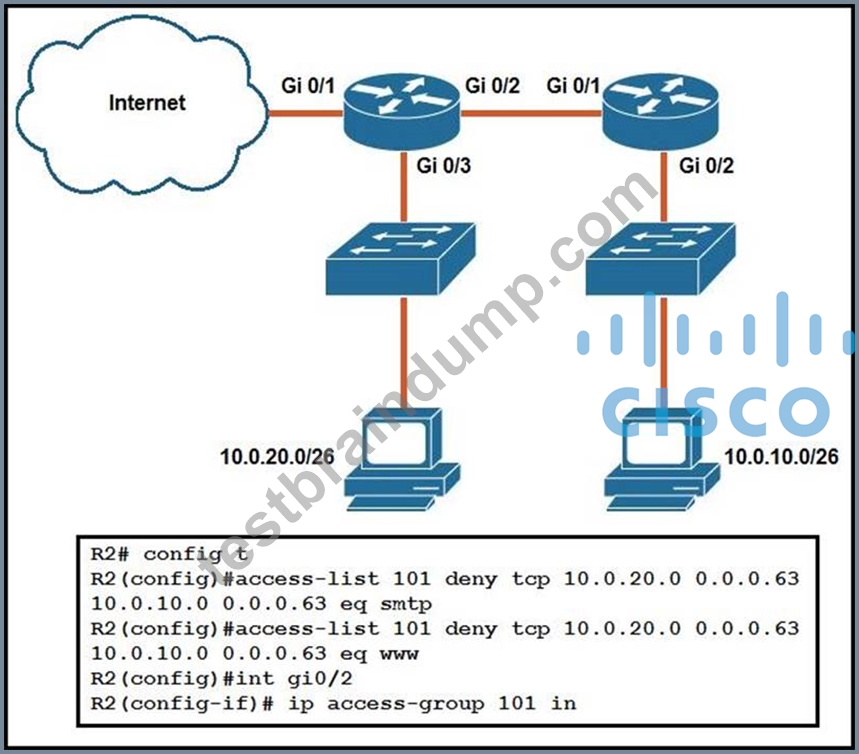
An extended ACL has been configured and applied to router R2. The configuration failed to work as intended.
Which two changes stop outbound traffic on TCP ports 25 and 80 to 10.0.20.0/26 from the 10.0.10.0/26 subnet while still allowing all other traffic? (Choose two.)
- A. The ACL must be moved to the Gi0/1 interface outbound on R2.
- B. The ACL must be configured the Gi0/2 interface inbound on R1.
- C. Add a "permit ip any any" statement to the beginning of ACL 101 for allowed traffic.
- D. Add a "permit ip any any" statement at the end of ACL 101 for allowed traffic.
- E. The source and destination IPs must be swapped in ACL 101.
Answer: D,E
NEW QUESTION # 253
What does traffic shaping do to reduce congestion in a network?
- A. buffers without queuing packets
- B. drops packets
- C. buffers and queues packets
- D. queqes without buffering packets
Answer: C
NEW QUESTION # 254
Refer to the exhibit.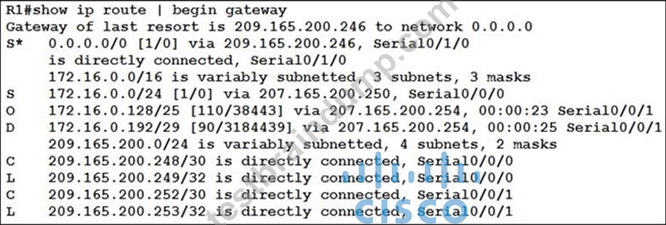
With which metric was the route to host 172.16.0.202 learned?
- A. 0
- B. 1
- C. 2
- D. 3
Answer: C
NEW QUESTION # 255
Drag and drop the AAA functions from the left onto the correct AAA services on the right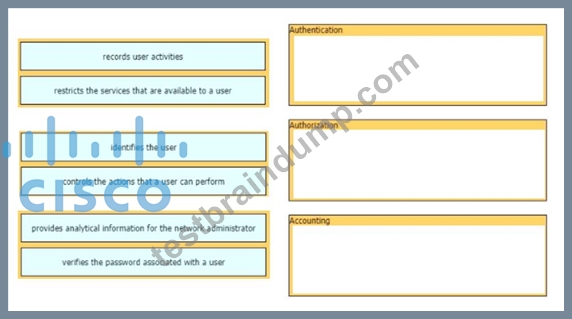
Answer:
Explanation: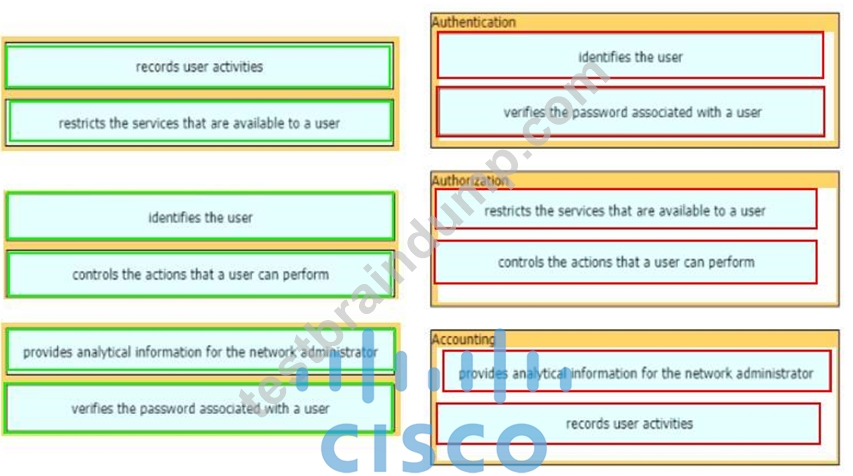
NEW QUESTION # 256
Refer to the exhibit.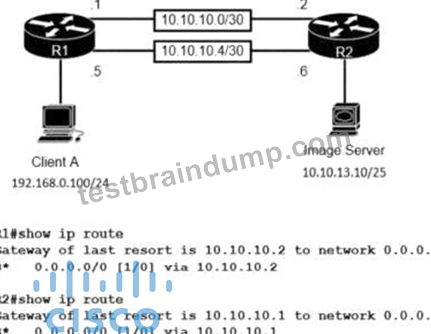
The image server and client A are running an application that transfers an extremely high volume of data between the two. An engineer is configuring a dedicated circuit between R1 and R2. Which set of commands must the engineer apply to the routers so that only traffic between the image server and client A is forces to use the new circuit?
- A. R1(config)#ip route 10.10.13.10 255.255.255.128 10.10.10.6
R2(config)#lp route 192.168.0.100 255.255.255.0 10.10.10.5 - B. R1(config)#ip route 10.10.13.10 255.255.255.255 10.10.10.2
R2(config)#ip route 192.168.0.100 255.255.255.255 10.10.10.1 - C. R1(config)#ip route 10.10.13.10 255.255.255.255 10.10.10.6
R2(config)#ip route 192.168.0.100 255.255.255.255 10.10.10.5 - D. R1(config)#ip route 10.10.13.10 255.255.255.252 10.10.10.6
R2(config)#tp route 192.168.0.100 255.255.255.252 10.10.10.5
Answer: B
NEW QUESTION # 257
Refer to the exhibit.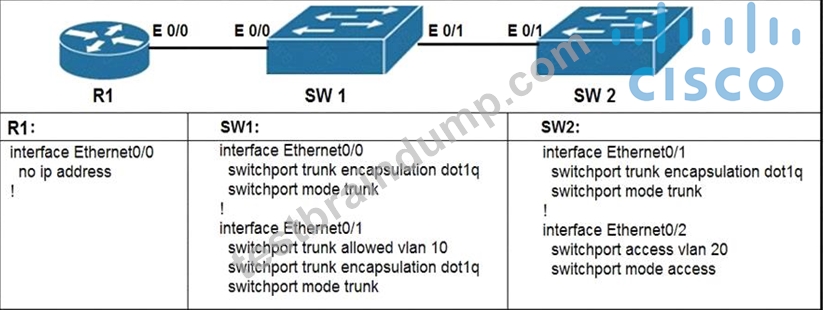
What commands are needed to add a subinterface to Ethernet0/0 on R1 to allow for VLAN 20, with IP address
10.20.20.1/24?
- A. R1(config)#interface ethernet0/0
R1(config)#ip address 10.20.20.1 255.255.255.0 - B. R1(config)#interface ethernet0/0.20
R1(config)#encapsulation dot1q 20
R1(config)#ip address 10.20.20.1 255.255.255.0 - C. R1(config)#interface ethernet0/0.20
R1(config)#ip address 10.20.20.1 255.255.255.0 - D. R1(config)#interface ethernet0/0
R1(config)#encapsulation dot1q 20
R1(config)#ip address 10.20.20.1 255.255.255.0
Answer: B
NEW QUESTION # 258
What makes Cisco DNA Center different from traditional network management applications and their management of networks?
- A. It only supports auto-discovery of network elements in a greenfield deployment.
- B. Its modular design allows someone to implement different versions to meet the specific needs of an organization.
- C. It does not support high availability of management functions when operating in cluster mode.
- D. It abstracts policy from the actual device configuration.
Answer: D
Explanation:
Section: Automation and Programmability
NEW QUESTION # 259
Refer to the exhibit.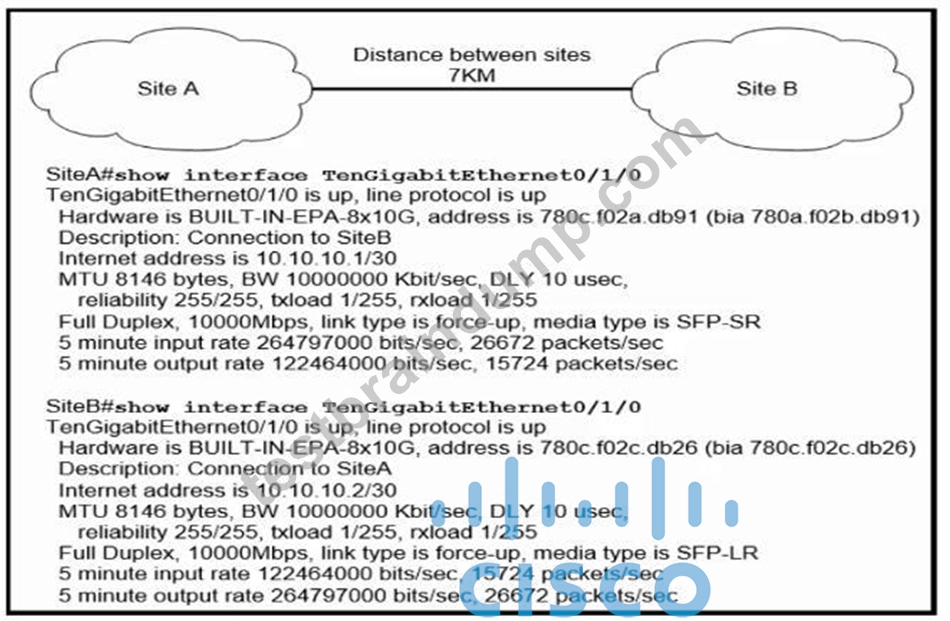
Site A was recently connected to site B over a new single-mode fiber path. Users at site A report Intermittent connectivity Issues with applications hosted at site B.
What is the reason for the problem?
- A. Heavy usage is causing high latency.
- B. The wrong cable type was used to make the connection.
- C. An incorrect type of transceiver has been inserted into a device on the link.
- D. physical network errors are being transmitted between the two sites.
Answer: C
NEW QUESTION # 260
Refer to the Exhibit. After the switch configuration the ping test fails between PC A and PC B Based on the output for switch 1. Which error must be corrected?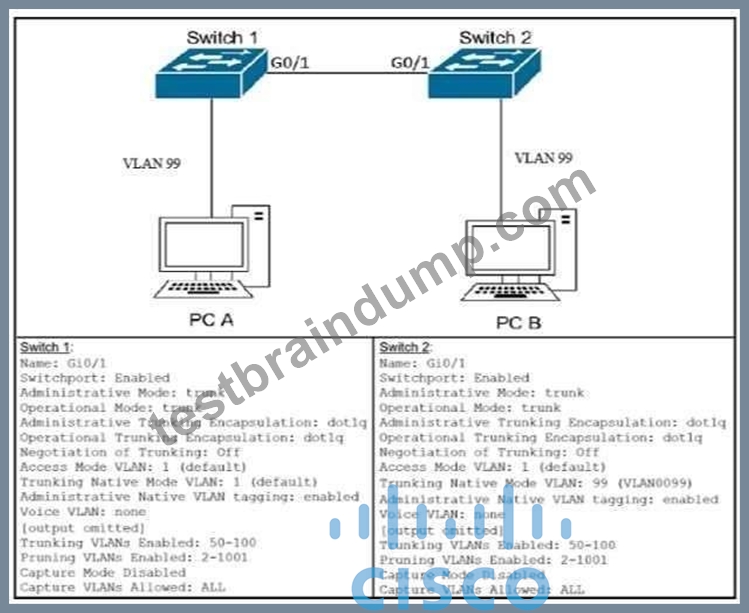
- A. The PCs are m the incorrect VLAN
- B. There is a native VLAN mismatch
- C. All VLANs are not enabled on the trunk
- D. Access mode is configured on the switch ports.
Answer: B
NEW QUESTION # 261
Which NAT type is used to translate a single inside address to a single outside address?
- A. dynamic NAT
- B. NAT overload
- C. PAT
- D. static NAT
Answer: D
NEW QUESTION # 262
Which command do you enter so that a switch configured with Rapid PVST + listens and learns for a specific time period?
- A. switch(config)#spanning-tree vlan 1 priority 4096
- B. switch(config)#spanning-tree vlan 1 hello-time 10
- C. switch(config)#spanning-tree vlan 1 max-age 6
- D. switch(config)#spanning-tree vlan 1 forward-time 20
Answer: D
Explanation:
Forward time : Determines how long each of the listening and learning states last before the port begins forwarding.
Switch(config)# [ no ] spanning-tree vlan vlan_ID forward-time forward_time Configures the forward time of a VLAN. The forward_time value can be from 4 to 30 seconds.
https://www.cisco.com/c/en/us/td/docs/switches/lan/catalyst4500/12-2/15-02SG/configuration/guide/config/spantree.html#56177
NEW QUESTION # 263
When a WPA2-PSK WLAN is configured in the Wireless LAN Controller, what is the minimum number of characters that is required in ASCII format?
- A. 0
- B. 1
- C. 2
- D. 3
Answer: D
NEW QUESTION # 264
Drag and drop the threat-mitigation techniques from the left onto the types of threat or attack they mitigate on the right.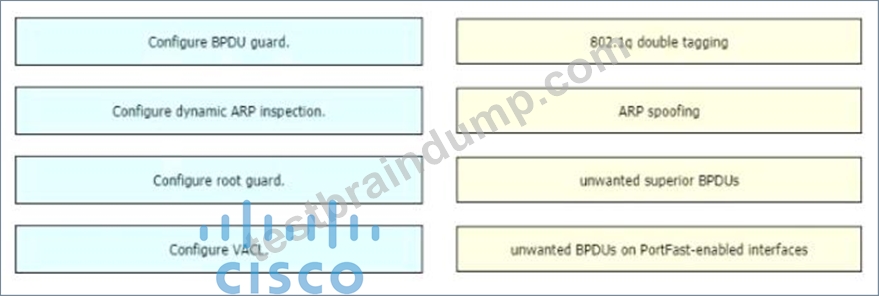
Answer:
Explanation: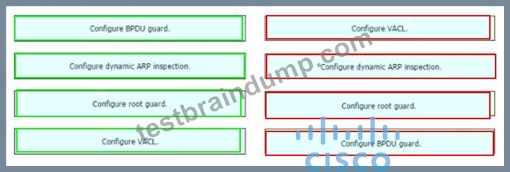
NEW QUESTION # 265
Drag and drop the statements about networking from the left onto the corresponding networking types on the right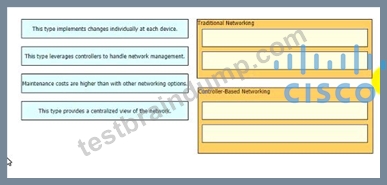
Answer:
Explanation: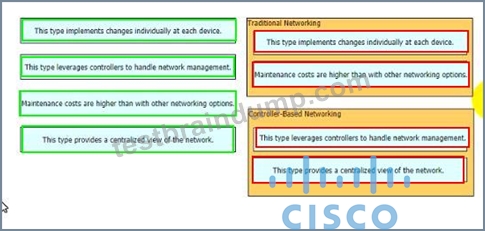
NEW QUESTION # 266
Drag the IPv6 DNS record types from the left onto the description on the right.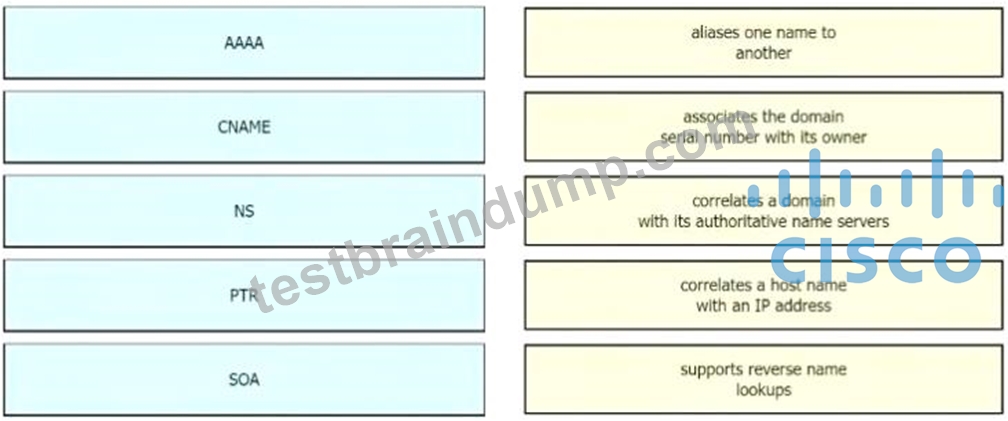
Answer:
Explanation: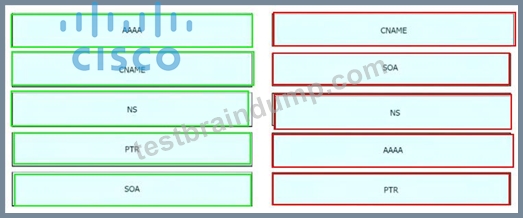
NEW QUESTION # 267
Refer to the exhibit. To which device does Router1 send packets that are destined to host
10.10.13.165?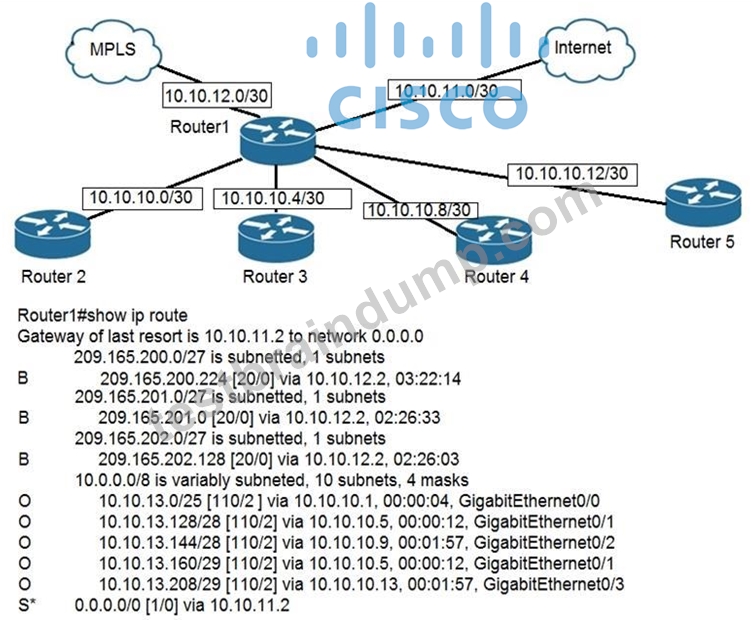
- A. Router4
- B. Router2
- C. Router3
- D. Router5
Answer: C
Explanation:
To reach the host 10.10.13.165 the router choose the route OSPF 10.10.13.160/29 (from
10.10.13.160 to 10.10.13.167) because include the destination address. Now Router 3 is the next hop for this route because the network between Router1 and Router3 it's a 10.10.10.4/30 (from
10.10.10.4 to 10.10.10.7 usable ip for host are .5 and .6) therefore Router3 is the next hop that you see in the routing table of Router1 == 10.10.10.5.
NEW QUESTION # 268
......
200-301 Dumps for success in Actual Exam: https://actualtests.testbraindump.com/200-301-exam-prep.html
