
[Oct 02, 2025] Get New AZ-500 Practice Test Questions Answers
AZ-500 Dumps and Exam Test Engine
To take the Microsoft AZ-500 exam, candidates are required to have a solid understanding of Microsoft Azure cloud services and experience in implementing and managing security controls in cloud environments. AZ-500 exam is suitable for IT professionals, security professionals, cloud architects, and engineers who want to validate their skills and knowledge in securing cloud-based solutions.
Jobs, Responsibilities, and Expected Salary after Passing AZ-500 Exam
The Microsoft Certified: Azure Security Engineer Associate certification coming after acing AZ-500 test is the most direct way to get a job as an Azure security engineer. This role captures aspects such as managing the posture of security within an organization. Other responsibilities of such a specialist include identifying and solving vulnerabilities using varied security tools, implementing protection from threats, and countering escalating security incidents. In addition, you'll be working with a team devoted to ensuring the management of security within the cloud or hybrid environments. You can apply for any of the various job titles associated with Azure security. They include an Azure or cloud security engineer, a senior systems engineer, and a cloud security architect. Per year, cloud security engineers earn $96,800 on average based on what ZipRecruiter.com divulges.
NEW QUESTION # 275
You need to ensure that you can meet the security operations requirements.
What should you do first?
- A. Integrate Security Center and Microsoft Cloud App Security.
- B. Upgrade the pricing tier of Security Center to Standard.
- C. Turn on Auto Provisioning in Security Center.
- D. Modify the Security Center workspace configuration.
Answer: B
Explanation:
The Standard tier extends the capabilities of the Free tier to workloads running in private and other public clouds, providing unified security management and threat protection across your hybrid cloud workloads. The Standard tier also adds advanced threat detection capabilities, which uses built-in behavioral analytics and machine learning to identify attacks and zero-day exploits, access and application controls to reduce exposure to network attacks and malware, and more.
Scenario: Security Operations Requirements
Litware must be able to customize the operating system security configurations in Azure Security Center.
Reference:
https://docs.microsoft.com/en-us/azure/security-center/security-center-pricing
Topic 3, Fabrikam inc
To start the case study
To display the first question in this case study, click the Next button. Use the buttons in the left pane to explore the content of the case study before you answer the questions. Clicking these buttons displays information such as business requirements, existing environment, and problem statements. If the case study has an All Information tab, note that the information displayed is identical to the information displayed on the subsequent tabs. When you are ready to answer a question, click the Question button to return to the question.
General Overview
Fabrikam, Inc. is a consulting company that has a main office in Montreal and branch offices in Seattle and New York. Fabrikam has IT, human resources (HR), and finance departments.
Existing Environment
Network Environment
Fabrikam has a Microsoft 365 subscription and an Azure subscription named subscription1.
The network contains an on-premises Active Directory domain named Fabrikam.com. The domain contains two organizational units (OUs) named OU1 and OU2. Azure AD Connect cloud sync syncs only OU1.
The Azure resources hierarchy is shown in the following exhibit.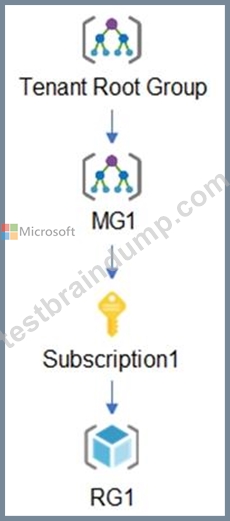
The Azure Active Directory (Azure AD) tenant contains the users shown in the following table.
Azure AD contains the resources shown in the following table.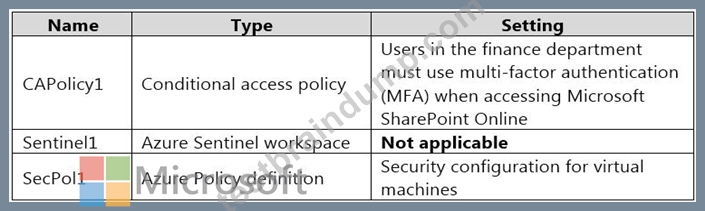
Subscription1 Resources
Subscription1 contains the virtual networks shown in the following table.
Subscription1 contains the network security groups (NSGs) shown in the following table.
Subscription1 contains the virtual machines shown in the following table.
Subscription1 contains the Azure key vaults shown in the following table.
Subscription1 contains a storage account named storage1 in the West US Azure region.
Planned Changes and Requirements
Planned Changes
Fabrikam plans to implement the following changes:
Create two application security groups as shown in the following table.
Associate the network interface of VM1 to ASG1.
Deploy SecPol1 by using Azure Security Center.
Deploy a third-party app named App1. A version of App1 exists for all available operating systems.
Create a resource group named RG2.
Sync OU2 to Azure AD.
Add User1 to Group1.
Technical Requirements
Fabrikam identifies the following technical requirements:
The finance department users must reauthenticate after three hours when they access SharePoint Online.
Storage1 must be encrypted by using customer-managed keys and automatic key rotation.
From Sentinel1, you must ensure that the following notebooks can be launched:
Entity Explorer - Account
Entity Explorer - Windows Host
Guided Investigation Process Alerts
VM1, VM2, and VM3 must be encrypted by using Azure Disk Encryption.
Just in time (JIT) VM access for VM1, VM2, and VM3 must be enabled.
App1 must use a secure connection string stored in KeyVault1.
KeyVault1 traffic must NOT travel over the internet.
NEW QUESTION # 276
You have an Azure subscription that contains an Azure key vault. The role assignments for the key vault are shown in the following exhibit.
Use the drop-down menus to select the answer choice that completes each statement based on the information presented in the graphic. NOTE: Each correct selection is worth one point.
Answer:
Explanation:
Answer is as image below.
NEW QUESTION # 277
You have the Azure virtual machines shown in the following table.
For which virtual machine can you enable Update Management?
- A. VM1, VM2, and VM4 only
- B. VM2 and VM3 only
- C. VM1, VM2, and VM3 only
- D. VM2, VM3, and VM4 only
- E. VM1, VM2, VM3, and VM4
Answer: A
Explanation:
References:
https://docs.microsoft.com/en-us/azure/automation/automation-update-management?toc=%2Fazure%
2Fautomation%2Ftoc.json
NEW QUESTION # 278
You plan to use Azure Disk Encryption for several virtual machine disks.
You need to ensure that Azure Disk Encryption can retrieve secrets from the KeyVault11641655 Azure key vault.
To complete this task, sign in to the Azure portal and modify the Azure resources.
Answer:
Explanation:
See the explanation below.
Explanation
1. In the Azure portal, type Key Vaults in the search box, select Key Vaults from the search results then select KeyVault11641655. Alternatively, browse to Key Vaults in the left navigation pane.
2. In the Key Vault properties, scroll down to the Settings section and select Access Policies.
3. Select the Azure Disk Encryption for volume encryption
4. Click Save to save the changes.
NEW QUESTION # 279
You have an Azure Active Directory (Azure AD) tenant that contains the users shown in the following table.
You create and enforce an Azure AD Identity Protection sign-in risk policy that has the following settings:
Assignments: Include Group1, exclude Group2
Conditions: Sign-in risk level: Medium and above
Access Allow access, Require multi-factor authentication
You need to identify what occurs when the users sign in to Azure AD.
What should you identify for each user? To answer, select the appropriate options in the answer area.
NOTE: Each correct selection is worth one point.
Answer:
Explanation:
Reference:
http://www.rebeladmin.com/2018/09/step-step-guide-configure-risk-based-azure-conditional-access-policies/
https://docs.microsoft.com/en-us/azure/active-directory/identity-protection/concept-identity-protection-policies
https://docs.microsoft.com/en-us/azure/active-directory/identity-protection/concept-identity-protection-risks
NEW QUESTION # 280
You have an Azure subscription that contains the storage accounts shown in the following, table.
You enable Microsoft Defender for Storage.
Which storage services of storages are monitored by Microsoft Defender for Storage, and which storage accounts are protected by Microsoft Defender for Storage? To answer, select the appropriate options in the answer area.
Answer:
Explanation:
NEW QUESTION # 281
You need to create an Azure key vault. The solution must ensure that any object deleted from the key vault be retained for 90 days.
How should you complete the command? To answer, select the appropriate options in the answer area.
NOTE: Each correct selection is worth one point.
Answer:
Explanation:
Explanation
Box 1: -EnablePurgeProtection
If specified, protection against immediate deletion is enabled for this vault; requires soft delete to be enabled as well.
Box 2: -EnableSoftDelete
Specifies that the soft-delete functionality is enabled for this key vault. When soft-delete is enabled, for a grace period, you can recover this key vault and its contents after it is deleted.
References:
https://docs.microsoft.com/en-us/powershell/module/azurerm.keyvault/new-azurermkeyvault
NEW QUESTION # 282
You have an Azure subscription named Subscription1.
You deploy a Linux virtual machine named VM1 to Subscription1.
You need to monitor the metrics and the logs of VM1.
D18912E1457D5D1DDCBD40AB3BF70D5D
What should you use?
- A. Linux Diagnostic Extension (LAD) 3.0
- B. Azure Analysis Services
- C. the AzurePerformanceDiagnostics extension
- D. Azure HDInsight
Answer: C
NEW QUESTION # 283
You have an Azure Container Registry named Registry1.
You add role assignment for Registry1 as shown in the following table.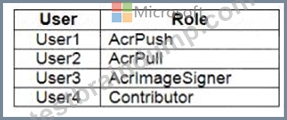
Which users can upload images to Registry1 and download images from Registry1? To answer, select the appropriate options in the answer area.
NOTE: Each correct selection is worth one point.
Answer:
Explanation:
Explanation:
Box 1: User1 and User4 only
Owner, Contributor and AcrPush can push images.
Box 2: User1, User2, and User4
All, except AcrImagineSigner, can download/pull images.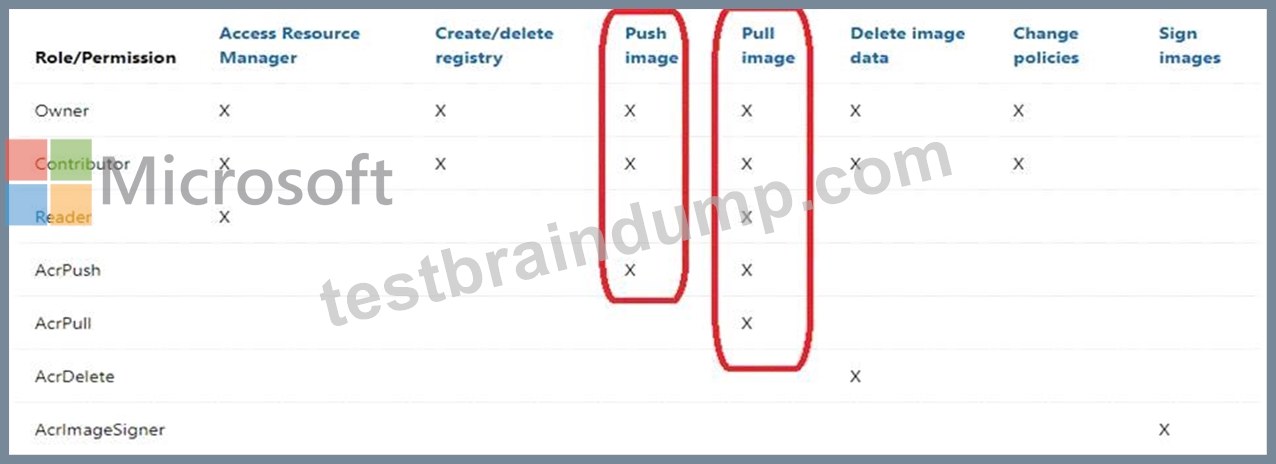
References:
https://docs.microsoft.com/bs-latn-ba/azure/container-registry/container-registry-roles
NEW QUESTION # 284
You have an Azure subscription that contains an Azure key vault and an Azure SQL database named SQL1.
You generate a key named Key1.
You need to enable Transparent Data Encryption (TDE) for SQL1 by using Key1.
Which two settings should you modify for Key1? To answer, select the appropriate settings in the answer area.
NOTE: Each correct selection is worth one point.
Answer:
Explanation:
Explanation:
NEW QUESTION # 285
You have an Azure subscription that contains the Azure Active Directory (Azure AD) resources shown in the following table.
You create the groups shown in the following table.
Which resources can you add to Group5 and Group6? To answer, select the appropriate options in the answer area.
NOTE: Each correct selection is worth one point.
Answer:
Explanation:
Explanation:
Graphical user interface, text, application Description automatically generated
NEW QUESTION # 286
You plan to use Azure Sentinel to create an analytic rule that will detect suspicious threats and automate responses.
Which components are required for the rule? To answer, select the appropriate options in the answer area.
NOTE: Each correct selection is worth one point.
Answer:
Explanation:
Reference:
https://docs.microsoft.com/en-us/azure/sentinel/tutorial-detect-threats-custom
https://docs.microsoft.com/en-us/azure/sentinel/tutorial-respond-threats-playbook
NEW QUESTION # 287
You have a Microsoft Entra tenant that contains the users shown in the following table.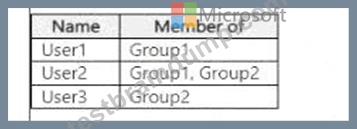
You configure a Conditional Access policy that has the following settings:
* Name: CAPolicy1
* Assignments
o Users or workload identities: Group1
o Target resources: All cloud apps
* Access controls
o Grant access: Require multifactor authentication
From Microsoft Authenticator settings for the tenant, the Enable and Target settings are configured as shown in the Enable and Target exhibit. (Click the Enable and Target tab.)
From Microsoft Authenticator settings for the tenant, the Configure settings are configured as shown in the Configure exhibit. (Click the Configure tab.)
For each of the following statements, select Yes if the statement is true. Otherwise, select No.
NOTE: Each correct selection is worth one point.
Answer:
Explanation:
Explanation: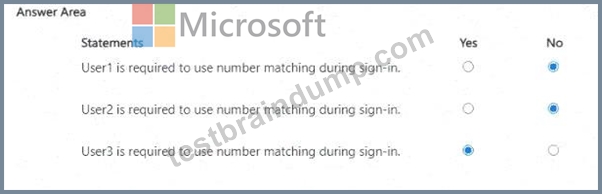
NEW QUESTION # 288
You have an Azure subscription that contains the key vaults shown in the following table.
The subscription contains the users shown in the following table.
On June 1, you perform the following actions:
* Delete a key named key1 from KeyVault1.
* Delete a secret named secret 1 from KeyVault2.
For each of the following statements, select Yes if the statement is true. Otherwise, select No.
Answer:
Explanation:
Explanation
Yes
Yes
No
NEW QUESTION # 289
You have three Azure subscriptions and a user named User1.
You need to provide User1 with the ability to manage and view costs for the resources across all three subscriptions. The solution must use the principle of least privilege.
Which three actions should you perform in sequence? To answer, move the appropriate actions from the list of actions to the answer area and arrange them in the correct order.
NOTE: More than one order of answer choices is correct. You will receive credit for any of the correct orders you select.
Answer:
Explanation:
1 - Assign User 1 the Cost Management Reader role for the management group.
2 - Assign User 1 the Global administrator role.
3 - Add the there subscription to the management group.
NEW QUESTION # 290
You have an Azure Storage account that contains a blob container named container1 and a client application named App1.
You need to enable App1 access to container1 by using Azure Active Directory (Azure AD) authentication.
What should you do? To answer, select the appropriate options in the answer area.
NOTE: Each correct selection is worth one point.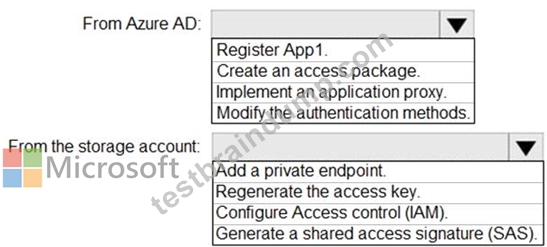
Answer:
Explanation:
Reference:
https://azure.microsoft.com/en-in/blog/announcing-the-preview-of-aad-authentication-for-storage/
https://github.com/MicrosoftDocs/azure-docs/blob/master/articles/storage/common/storage-auth-aad-rbac-portal.md
NEW QUESTION # 291
You have an Azure Active Directory (Azure AD) tenant and a root management group.
You create 10 Azure subscriptions and add the subscriptions to the root management group.
You need to create an Azure Blueprints definition that will be stored in the root management group.
What should you do first?
- A. Modify the role-based access control (RBAC) role assignments for the root management group.
- B. Add an Azure Policy definition to the root management group.
- C. Create a user-assigned identity.
- D. Create a service principal.
Answer: A
Explanation:
Explanation/Reference:
https://docs.microsoft.com/en-us/azure/role-based-access-control/elevate-access-global-admin
NEW QUESTION # 292
You have the Azure virtual machines shown in the following table.
Each virtual machine has a single network interface.
You add the network interface of VM1 to an application security group named ASG1.
You need to identify the network interfaces of which virtual machines you can add to ASG1.
What should you identify?
- A. VM2, VM3, VM4, and VM5
- B. VM2, VM3, and VM5 only
- C. Vm2 and Vm3 only
- D. VM2 only
Answer: C
Explanation:
Reference:
https://docs.microsoft.com/en-us/azure/virtual-network/application-security-groups
NEW QUESTION # 293
Note: This question is part of a series of questions that present the same scenario. Each question in the series contains a unique solution that might meet the stated goals. Some question sets might have more than one correct solution, while others might not have a correct solution.
After you answer a question in this section, you will NOT be able to return to it. As a result, these questions will not appear in the review screen.
You have an Azure Subscription named Sub1. Sub1 contains an Azure virtual machine named VM1 that runs Windows Server 2016.
You need to encrypt VM1 disks by using Azure Disk Encryption.
Which three actions should you perform in sequence? To answer, move the appropriate actions from the list of actions to the answer area and arrange them in the correct order.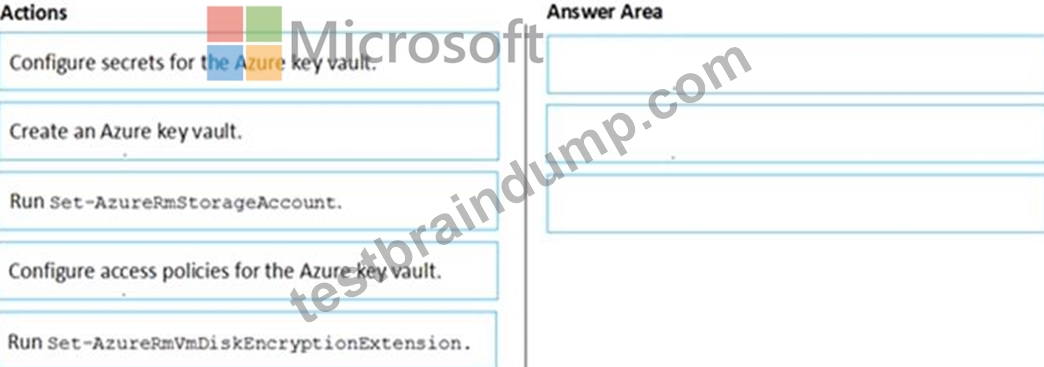
Answer:
Explanation:
References:
https://docs.microsoft.com/en-us/azure/virtual-machines/windows/encrypt-disks
NEW QUESTION # 294
You have the Azure key vaults shown in the following table.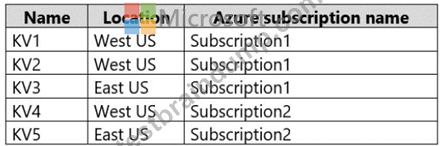
KV1 stores a secret named Secret1 and a key for a managed storage account named Key1.
You back up Secret1 and Key1.
To which key vaults can you restore each backup? To answer, select the appropriate options in the answer area.
NOTE: Each correct selection is worth one point.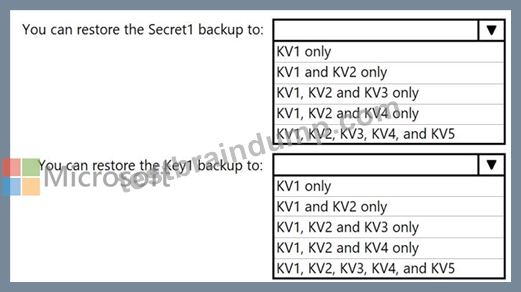
Answer:
Explanation: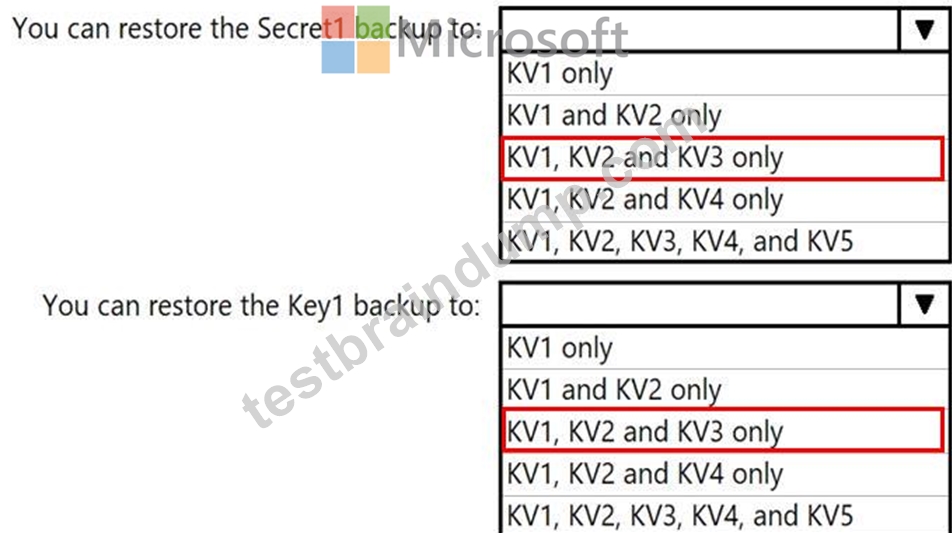
NEW QUESTION # 295
: 2 HOTSPOT
Which virtual networks in Sub1 can User2 modify and delete in their current state? To answer, select the appropriate options in the answer area.
NOTE: Each correct selection is worth one point.
Answer:
Explanation:
Explanation
Box 1: VNET4 and VNET1 only
RG1 has only Delete lock, while there are no locks on RG4.
RG2 and RG3 both have Read-only locks.
Box 2: VNET4 only
There are no locks on RG4, while the other resource groups have either Delete or Read-only locks.
Note: As an administrator, you may need to lock a subscription, resource group, or resource to prevent other users in your organization from accidentally deleting or modifying critical resources. You can set the lock level to CanNotDelete or ReadOnly. In the portal, the locks are called Delete and Read-only respectively.
* CanNotDelete means authorized users can still read and modify a resource, but they can't delete the resource.
* ReadOnly means authorized users can read a resource, but they can't delete or update the resource.
Applying this lock is similar to restricting all authorized users to the permissions granted by the Reader role.
Scenario:
User2 is a Security administrator.
Sub1 contains six resource groups named RG1, RG2, RG3, RG4, RG5, and RG6.
User2 creates the virtual networks shown in the following table.
Sub1 contains the locks shown in the following table.
References:
https://docs.microsoft.com/en-us/azure/azure-resource-manager/resource-group-lock-resources
NEW QUESTION # 296
......
Microsoft AZ-500 certification exam is an essential credential for professionals who want to demonstrate their expertise in securing cloud-based workloads in the Azure environment. AZ-500 exam covers a wide range of topics related to Azure security and requires candidates to have a strong understanding of Azure technologies and services. Passing AZ-500 exam will earn candidates the Microsoft Certified: Azure Security Engineer Associate certification and demonstrate their ability to manage and secure cloud-based workloads.
2025 New TestBraindump AZ-500 PDF Recently Updated Questions: https://actualtests.testbraindump.com/AZ-500-exam-prep.html
