
Pass FCSS_SASE_AD-24 Brain Dump Updated Certification Sample Questions
Online FCSS_SASE_AD-24 Test Brain Dump Question and Test Engine
NEW QUESTION # 29
Which of the following describes the FortiSASE inline-CASB component?
- A. It is placed directly in the traffic path between the endpoint and cloud applications.
- B. It detects data at rest.
- C. It uses API to connect to the cloud applications.
- D. It provides visibility for unmanaged locations and devices.
Answer: A
Explanation:
The FortiSASE inline-CASB (Cloud Access Security Broker) component is designed to provide real-time security and visibility by being placed directly in the traffic path between the endpoint and cloud applications . Inline-CASB inspects traffic as it flows to and from cloud applications, enabling enforcement of security policies, detection of threats, and prevention of unauthorized access. This approach ensures that all interactions with cloud applications are monitored and controlled in real time.
Here's why the other options are incorrect:
A . It provides visibility for unmanaged locations and devices: While inline-CASB enhances visibility, its primary function is to inspect and secure traffic in real time. Visibility for unmanaged locations and devices is typically achieved through other components like endpoint agents or API-based CASB.
C . It uses API to connect to the cloud applications: API-based CASB is a different approach that relies on APIs provided by cloud applications to monitor and manage data. Inline-CASB operates directly in the traffic flow rather than using APIs.
D . It detects data at rest: Detecting data at rest is typically handled by Data Loss Prevention (DLP) tools or API-based CASB solutions. Inline-CASB focuses on inspecting traffic in motion, not data stored in cloud applications.
Reference:
Fortinet FCSS FortiSASE Documentation - Inline-CASB Overview
FortiSASE Administration Guide - Cloud Application Security
NEW QUESTION # 30
Which secure internet access (SIA) use case minimizes individual workstation or device setup, because you do not need to install FortiClient on endpoints or configure explicit web proxy settings on web browser-based end points?
- A. SIA for inline-CASB users
- B. SIA for agentless remote users
- C. SIA for site-based remote users
- D. SIA for SSLVPN remote users
Answer: B
Explanation:
The Secure Internet Access (SIA) use case that minimizes individual workstation or device setup is SIA for agentless remote users. This use case does not require installing FortiClient on endpoints or configuring explicit web proxy settings on web browser-based endpoints, making it the simplest and most efficient deployment.
SIA for Agentless Remote Users:
Agentless deployment allows remote users to connect to the SIA service without needing to install any client software or configure browser settings.
This approach reduces the setup and maintenance overhead for both users and administrators.
Minimized Setup:
Without the need for FortiClient installation or explicit proxy configuration, the deployment is straightforward and quick.
Users can securely access the internet with minimal disruption and administrative effort.
Reference:
FortiOS 7.2 Administration Guide: Details on different SIA deployment use cases and configurations.
FortiSASE 23.2 Documentation: Explains how SIA for agentless remote users is implemented and the benefits it provides.
NEW QUESTION # 31
Which deployment case scenario effectively illustrates FortiSASE's capability in handling high-traffic environments?
Response:
- A. A local retailer using a single cloud provider
- B. A home office setup with basic web filtering needs
- C. A multinational company with global data exchanges
- D. A small office with limited internet usage
Answer: C
NEW QUESTION # 32
Which three ways does FortiSASE provide Secure Private Access (SPA) to corporate, non-web applications? (Choose three.)
- A. Using SD-WAN technology
- B. Using zero trust network access (ZTNA) technology
- C. Using secure web gateway (SWG)
- D. Using next generation firewall (NGFW)
- E. Using digital experience monitoring
Answer: A,B,D
NEW QUESTION # 33
How does integrating endpoint detection and response (EDR) systems into SASE contribute to security posture?
Response:
- A. It provides real-time threat detection and response at endpoints
- B. It isolates the network from the internet
- C. It serves as the primary firewall
- D. It enhances user interface designs
Answer: A
NEW QUESTION # 34
What are two advantages of using zero-trust tags? (Choose two.)
- A. Zero-trust tags can be used to create multiple endpoint profiles which can be applied to different endpoints
- B. Zero-trust tags can be used to allow or deny access to network resources
- C. Zero-trust tags can determine the security posture of an endpoint.
- D. Zero-trust tags can be used to allow secure web gateway (SWG) access
Answer: B,C
Explanation:
Zero-trust tags are critical in implementing zero-trust network access (ZTNA) policies. Here are the two key advantages of using zero-trust tags:
* Access Control (Allow or Deny):
* Zero-trust tags can be used to define policies that either allow or deny access to specific network resources based on the tag associated with the user or device.
* This granular control ensures that only authorized users or devices with the appropriate tags can access sensitive resources, thereby enhancing security.
* Determining Security Posture:
* Zero-trust tags can be utilized to assess and determine the security posture of an endpoint.
* Based on the assigned tags, FortiSASE can evaluate the device's compliance with security policies, such as antivirus status, patch levels, and configuration settings.
* Devices that do not meet the required security posture can be restricted from accessing the network or given limited access.
References:
FortiOS 7.2 Administration Guide: Provides detailed information on configuring and using zero-trust tags for access control and security posture assessment.
FortiSASE 23.2 Documentation: Explains how zero-trust tags are implemented and used within the FortiSASE environment for enhancing security and compliance.
NEW QUESTION # 35
Which FortiSASE components are critical for protecting remote users?
(Select all that apply)
Response:
- A. Zero Trust Network Access (ZTNA)
- B. Secure SD-WAN
- C. Data Loss Prevention (DLP)
- D. Secure Web Gateway (SWG)
Answer: A,C,D
NEW QUESTION # 36
In which three ways does FortiSASE help organizations ensure secure access for remote workers? (Choose three.)
- A. It uses the identity & access management (IAM) portal to validate the identities of remote workers.
- B. It enforces granular access policies based on user identities.
- C. It secures traffic from endpoints to cloud applications.
- D. It enforces multi-factor authentication (MFA) to validate remote users.
- E. It offers zero trust network access (ZTNA) capabilities.
Answer: B,C,E
Explanation:
FortiSASE provides several features to ensure secure access for remote workers. The following three ways are particularly relevant:
It secures traffic from endpoints to cloud applications (Option B):
FortiSASE secures all traffic between remote endpoints and cloud applications by inspecting it in real time. This includes applying security policies, threat detection, and data protection measures to ensure that traffic is safe and compliant.
It offers zero trust network access (ZTNA) capabilities (Option D):
ZTNA ensures that remote workers are granted access to resources based on strict verification of their identity and device posture. By treating all users and devices as untrusted by default, ZTNA minimizes the risk of unauthorized access and lateral movement within the network.
It enforces granular access policies based on user identities (Option E):
FortiSASE allows administrators to define and enforce fine-grained access policies based on user identities, roles, and other attributes. This ensures that remote workers only have access to the resources they need, reducing the attack surface.
Here's why the other options are incorrect:
A . It enforces multi-factor authentication (MFA) to validate remote users: While MFA is a critical security measure, it is typically implemented through identity providers (e.g., FortiAuthenticator or third-party solutions) rather than directly through FortiSASE.
C . It uses the identity & access management (IAM) portal to validate the identities of remote workers: FortiSASE integrates with IAM systems but does not use the IAM portal itself to validate identities. Identity validation is handled through authentication mechanisms like SAML, LDAP, or OAuth.
Reference:
Fortinet FCSS FortiSASE Documentation - Secure Remote Access
FortiSASE Administration Guide - ZTNA and Access Policies
NEW QUESTION # 37
Which two advantages does FortiSASE bring to businesses with multiple branch offices? (Choose two.)
- A. it offers customizable dashboard views for each branch location
- B. It enables seamless integration with third-party firewalls.
- C. It offers centralized management for simplified administration.
- D. It eliminates the need to have an on-premises firewall for each branch.
Answer: C,D
Explanation:
FortiSASE brings the following advantages to businesses with multiple branch offices:
* Centralized Management for Simplified Administration:
* FortiSASE provides a centralized management platform that allows administrators to manage security policies, configurations, and monitoring from a single interface.
* This simplifies the administration and reduces the complexity of managing multiple branch offices.
* Eliminates the Need for On-Premises Firewalls:
* FortiSASE enables secure access to the internet and cloud applications without requiring dedicated on-premises firewalls at each branch office.
* This reduces hardware costs and simplifies network architecture, as security functions are handled by the cloud-based FortiSASE solution.
References:
FortiOS 7.2 Administration Guide: Provides information on the benefits of centralized management and cloud- based security solutions.
FortiSASE 23.2 Documentation: Explains the advantages of using FortiSASE for businesses with multiple branch offices, including reduced need for on-premises firewalls.
NEW QUESTION # 38
Refer to the exhibit. In the user connection monitor, the FortiSASE administrator notices the user name is showing random characters. Which configuration change must the administrator make to get proper user information?
- A. Change the deployment type from SWG to VPN.
- B. Turn off log anonymization on FortiSASE.
- C. Add more endpoint licenses on FortiSASE.
- D. Configure the username using FortiSASE naming convention.
Answer: B
Explanation:
In the user connection monitor, the random characters shown for the username indicate that log anonymization is enabled. Log anonymization is a feature that hides the actual user information in the logs for privacy and security reasons. To display proper user information, you need to disable log anonymization.
Log Anonymization:
When log anonymization is turned on, the actual usernames are replaced with random characters to protect user privacy.
This feature can be beneficial in certain environments but can cause issues when detailed user monitoring is required.
Disabling Log Anonymization:
Navigate to the FortiSASE settings.
Locate the log settings section.
Disable the log anonymization feature to ensure that actual usernames are displayed in the logs and user connection monitors.
NEW QUESTION # 39
Which logs are important for compliance in FortiSASE?
(Select all that apply)
Response:
- A. Security incident logs
- B. User activity logs
- C. Server performance logs
- D. Compliance rule updates
Answer: A,B,D
NEW QUESTION # 40
Your organization is currently using FortiSASE for its cybersecurity. They have recently hired a contractor who will work from the HQ office and who needs temporary internet access in order to set up a web-based point of sale (POS) system.
What is the recommended way to provide internet access to the contractor?
- A. Use a proxy auto-configuration (PAC) file and provide secure web gateway (SWG) service as an explicit web proxy.
- B. Use FortiClient on the endpoint to manage internet access.
- C. Configure a VPN policy on FortiSASE to provide access to the internet.
- D. Use zero trust network access (ZTNA) and tag the client as an unmanaged endpoint.
Answer: A
Explanation:
References:
Fortinet FCSS FortiSASE Documentation - Zero Trust Network Access (ZTNA) Use Cases FortiSASE Administration Guide - Managing Unmanaged Endpoints
NEW QUESTION # 41
Which role does FortiSASE play in supporting zero trust network access (ZTNA) principles9
- A. It integrates with software-defined network (SDN) solutions.
- B. It offers hardware-based firewalls for network segmentation.
- C. It enables VPN connections for remote employees.
- D. It can identify attributes on the endpoint for security posture check.
Answer: D
Explanation:
FortiSASE supports zero trust network access (ZTNA) principles by identifying attributes on the endpoint for security posture checks. ZTNA principles require continuous verification of user and device credentials, as well as their security posture, before granting access to network resources.
Security Posture Check:
FortiSASE can evaluate the security posture of endpoints by checking for compliance with security policies, such as antivirus status, patch levels, and configuration settings.
This ensures that only compliant and secure devices are granted access to the network.
Zero Trust Network Access (ZTNA):
ZTNA is based on the principle of "never trust, always verify," which requires continuous assessment of user and device trustworthiness.
FortiSASE plays a crucial role in implementing ZTNA by performing these security posture checks and enforcing access control policies.
Reference:
FortiOS 7.2 Administration Guide: Provides information on ZTNA and endpoint security posture checks.
FortiSASE 23.2 Documentation: Details on how FortiSASE implements ZTNA principles.
NEW QUESTION # 42
Refer to the exhibit.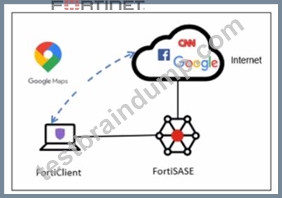
A company has a requirement to inspect all the endpoint internet traffic on FortiSASE, and exclude Google Maps traffic from the FortiSASE VPN tunnel and redirect it to the endpoint physical Interface.
Which configuration must you apply to achieve this requirement?
- A. Exempt the Google Maps FQDN from the endpoint system proxy settings.
- B. Change the default DNS server configuration on FortiSASE to use the endpoint system DNS.
- C. Configure the Google Maps FQDN as a split tunneling destination on the FortiSASE endpoint profile.
- D. Configure a static route with the Google Maps FQDN on the endpoint to redirect traffic
Answer: C
Explanation:
To meet the requirement of inspecting all endpoint internet traffic on FortiSASE while excluding Google Maps traffic from the FortiSASE VPN tunnel and redirecting it to the endpoint's physical interface, you should configure split tunneling. Split tunneling allows specific traffic to bypass the VPN tunnel and be routed directly through the endpoint's local interface.
Split Tunneling Configuration:
Split tunneling enables selective traffic to be routed outside the VPN tunnel.
By configuring the Google Maps Fully Qualified Domain Name (FQDN) as a split tunneling destination, you ensure that traffic to Google Maps bypasses the VPN tunnel and uses the endpoint's local interface instead.
Implementation Steps:
Access the FortiSASE endpoint profile configuration.
Add the Google Maps FQDN to the split tunneling destinations list.
This configuration directs traffic intended for Google Maps to bypass the VPN tunnel and be routed directly through the endpoint's physical network interface.
Reference:
FortiOS 7.2 Administration Guide: Provides details on split tunneling configuration.
FortiSASE 23.2 Documentation: Explains how to set up and manage split tunneling for specific destinations.
NEW QUESTION # 43
During FortiSASE provisioning, how many security points of presence (POPs) need to be configured by the FortiSASE administrator?
- A. 0
- B. 1
- C. 2
- D. 3
Answer: A
Explanation:
https://docs.fortinet.com/document/fortisase/latest/administration-guide/751044/appendix-a-fortisase-data- centers#Number
NEW QUESTION # 44
For FortiSASE point of presence (POP) to connect as a spoke, which Fortinet solution is required as standalone IPSec VPN hub?
- A. secure web gateway (SWG)
- B. SD-WAN
- C. zero trust network access (ZTNA)
- D. next generation firewall (NGFW)
Answer: D
Explanation:
A next-generation firewall is capable of acting as an IPSec VPN hub, providing the necessary functionality to establish and manage VPN connections. It can handle the encryption, decryption, and authentication of traffic between the FortiSASE POP and the on-premises network.
While other options like SD-WAN or ZTNA can also provide VPN capabilities, they are typically designed for different use cases and may not have the same level of flexibility or control as a dedicated NGFW.
NEW QUESTION # 45
Refer to the exhibits.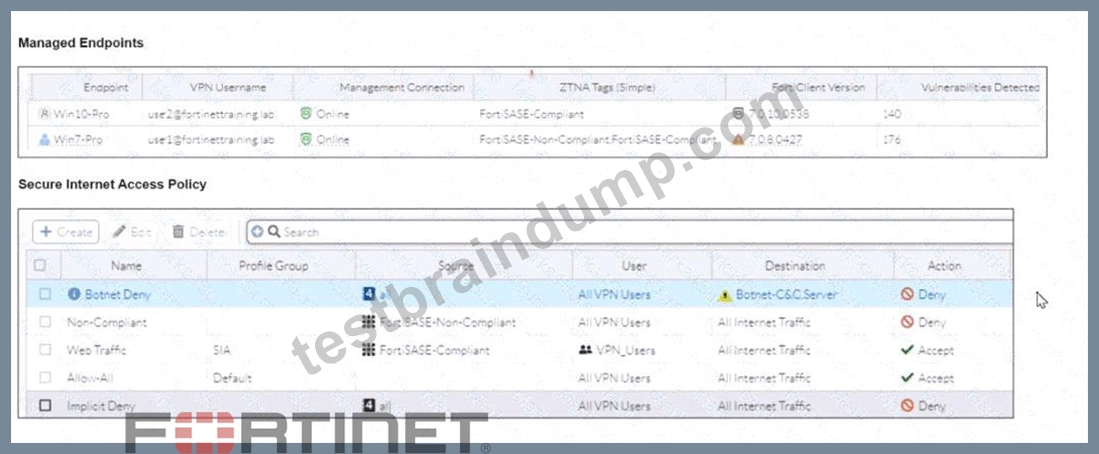
WiMO-Pro and Win7-Pro are endpoints from the same remote location. WiMO-Pro can access the internet though FortiSASE, while Wm7-Pro can no longer access the internet Given the exhibits, which reason explains the outage on Wm7-Pro?
- A. The Win7-Pro FortiClient version does not match the FortiSASE endpoint requirement.
- B. Win-7 Pro has exceeded the total vulnerability detected threshold.
- C. Win7-Pro cannot reach the FortiSASE SSL VPN gateway
- D. The Win7-Pro device posture has changed.
Answer: B
Explanation:
Based on the provided exhibits, the reason why the Win7-Pro endpoint can no longer access the internet through FortiSASE is due to exceeding the total vulnerability detected threshold. This threshold is used to determine if a device is compliant with the security requirements to access the network.
* Endpoint Compliance:
* FortiSASE monitors endpoint compliance by assessing various security parameters, including the number of vulnerabilities detected on the device.
* The compliance status is indicated by the ZTNA tags and the vulnerabilities detected.
* Vulnerability Threshold:
* The exhibit shows that Win7-Pro has 176 vulnerabilities detected, whereas Win10-Pro has 140 vulnerabilities.
* If the endpoint exceeds a predefined vulnerability threshold, it may be restricted from accessing the network to ensure overall network security.
* Impact on Network Access:
* Since Win7-Pro has exceeded the vulnerability threshold, it is marked as non-compliant and subsequently loses internet access through FortiSASE.
* The FortiSASE endpoint profile enforces this compliance check to prevent potentially vulnerable devices from accessing the internet.
References:
FortiOS 7.2 Administration Guide: Provides information on endpoint compliance and vulnerability management.
FortiSASE 23.2 Documentation: Explains how vulnerability thresholds are used to determine endpoint compliance and access control.
NEW QUESTION # 46
FortiSASE delivers a converged networking and security solution. Which two features help with integrating FortiSASE into an existing network?
(Choose two.)
Response:
- A. security, orchestration, automation, and response (SOAR)
- B. zero trust network access (ZTNA)
- C. SD-WAN
- D. remote browser isolation (RBI)
Answer: B,C
NEW QUESTION # 47
FortiSASE automatically updates compliance rules to adhere to the latest regulations without manual intervention.
Response:
- A. True
- B. False
Answer: B
NEW QUESTION # 48
......
Real Fortinet FCSS_SASE_AD-24 Exam Dumps with Correct 56 Questions and Answers: https://actualtests.testbraindump.com/FCSS_SASE_AD-24-exam-prep.html
