
Real Salesforce-MuleSoft-Developer-I Exam Questions are the Best Preparation Material
Practice on 2025 LATEST Salesforce-MuleSoft-Developer-I Exam Updated 237 Questions
NEW QUESTION # 63
An organization is beginning to follow Mulesoft's recommended API led connectivity approach to use modern API to support the development and lifecycle of the integration solutions and to close the IT delivery gap.
What distinguishes between how modern API's are organized in a MuleSoft recommended API-led connectivity approach as compared to other common enterprise integration solutions?
- A. The API interfaces are specified at a granularity intended for developers to consume specific aspect of integration processes
- B. The APIO implementations are monitored with common tools, centralized monitoring and security systems
- C. The API implementation are built with standards using common lifecycle and centralized configuration management tools
- D. The API interfaces are specified as macroservices with one API representing all the business logic of an existing and proven end to end solution
Answer: A
Explanation:
Correct answer is The API interfaces are specified at a granularity intended for developers to consume specific aspect of integration processes
NEW QUESTION # 64
Refer to the exhibit. APIkit is used to generate flow components for the RAML specification.
How many apikit:router XML elements are generated to handle requests to every endpoint defined in the RAML specification?
- A. 0
- B. 1
- C. 2
- D. 3
Answer: A
NEW QUESTION # 65
Refer to the exhibit.
The main flow contains a Flow Reference for the child flow.
What values are accessible in the child flow after a web client submits a request to http://localhost:8Q81/order? color=red?
- A. payload
- B. payload
quantity var color query param - C. payload
quantity var - D. payload
color query param
Answer: B
Explanation:
Flow Reference Component
Flow Reference routes the Mule event to another flow or subflow, executes all processors in the referenced flow, and then routes the event back within the same Mule application. The following diagram shows the order of processing when one flow references another:
When the main flow is triggered, the Mule event travels through and executes the flow until the event reaches the Flow Reference. The event then travels through and executes the referenced flow from beginning to end, and then returns to the main flow.
This process enables you to treat the entire referenced flow like a single component in your current flow.
Mule Ref Doc : https://docs.mulesoft.com/mule-runtime/4.3/flowref-about Correct answer is payload quantity var color query param
NEW QUESTION # 66
Refer to the exhibits.
The two Mule configuration files belong to the same Mule project. Each HTTP Listener is configured with the same host string and the port number, path, and operation values are shown in the display names.
What is the minimum number of global elements that must be defined to support all these HTTP Listeners?
- A. 0
- B. 1
- C. 2
- D. 3
Answer: A
Explanation:
In this case three configurations will be required each for port 8000, 6000 and 7000.
There would be three global elements defined for HTTP connections.
Each HTTP connection will have host and port. One example shown below with host as localhost and port 6000
To use an HTTP listener, you need to declare a configuration with a corresponding connection. This declaration establishes the HTTP server that will listen to requests.
Additionally, you can configure a base path that applies to all listeners using the configuration.
<http:listener-config name="HTTP_Listener_config" basePath="api/v1">
<http:listener-connection host="0.0.0.0" port="8081" />
</http:listener-config>
https://docs.mulesoft.com/http-connector/1.6/http-listener-ref#http-listener-configuration
NEW QUESTION # 67
Refer to the exhibits.

Mule application has an HTTP request configuration where host name is hardcoded. Organization is looking to move host and port values to configuration file. What valid expression can be used to so that HTTP configuration can pick the value from configuration file?
- A. ${training.host}
- B. #[training.host]
- C. ${http.host}
- D. #{training.host}
Answer: A
Explanation:
Correct answer is ${training.host}
NEW QUESTION # 68
Refer to the exhibit.
The API needs to be updated using the company-wide standard for the Plan data type. The Object data type has already been published in Anypoint Exchange with the global reference . ACME/DataTypes/PlanDataType.raml.
What is a valid RAML specification that reuses the Plan data type?
- A.

- B.

- C.

- D.

Answer: B
Explanation:
As can be seen in RAML, POST expects input in application/json format which eliminates two of the options as two options are in xml format.
Now out of the two remaining options, one has id field in request which is only mentioned for get response and not for POST request. Hence id field is not expected in POST request.
Hence correct answer is
{
"name": "GoerdiLa Forge",
"address": "1 Westland CA",
"customer_since": "2014-01-04",
"balance": "4829.29",
"bank_agend_id": "12556"
}
NEW QUESTION # 69
What are the latest specification of RAML available?
- A. 0
- B. 0.8
- C. 1.2
- D. 1
Answer: A
Explanation:
The current version of the RAML specification is 1.0
You can check RAML version in RAML definition by referring to first comment. See highlighted part in below image.
NEW QUESTION # 70
Refer to the exhibits.
The input array of strings is processed by the batch job that processes, filters, and aggregates the values. What is the last message logged by the Logger component after the batch job completes processing?
- A. [ "A", "C, "D", "E" ]
- B. [''D", "E"]
- C. [''E'']
- D. [ ["A", "C", "D" ], ["E"] ]
Answer: C
Explanation:
Logs would look like:
INFO 2021-06-09 19:14:56,039 [[MuleRuntime].uber.06: [validationtest].batch-job-validationtestBatch_Job-work-manager @6de10f3e] [processor: validationtestFlow/processors/1/route/0/route/0/aggregator/processors/0; event: bfb751e1-9939-11eb-9f69-02053763653a] org.mule.runtime.core.internal.processor.LoggerMessageProcessor:
[
"\"A\"",
"\"C\"",
"\"D\""
]
--
INFO 2021-06-09 19:15:02,486 [[MuleRuntime].uber.06: [validationtest].batch-job-validationtestBatch_Job-work-manager @6de10f3e] [processor: validationtestFlow/processors/1/route/0/route/0/aggregator/processors/0; event: bfb751e1-9939-11eb-9f69-02053763653a] org.mule.runtime.core.internal.processor.LoggerMessageProcessor: [
"\"E\""
]
Batch aggregator value is 3. Hence in first time it will print ["A", "C", "D"] and in next iteration it will print [ "E" ]
-------------------------------------------------------------------------------------------------------------------------------------------------- Correct answer is [ "E" ]
NEW QUESTION # 71
Refer to the exhibits.
What is written to the records.csv file when the flow executes?
- A. The payload convert to CVS
- B. The JSON payload
- C. Nothing
- D. An error message
Answer: B
Explanation:
Transform Message Add write_date is coverting payload in JSON format and same JSON payload is avaialble to file write processor. However, if the payload is a different format (for example, not CSV) , you can place the transformation inside the Write operation to generate content that will be written without producing a side effect on the message in transit. This is not done in this case. By default, the connector writes whatever is in the message payload. Hence JSON payload will be written to file.
NEW QUESTION # 72
Refer to the exhibit.
What expression correctly specifies input parameters to pass the city and state values to the SQL query?
- A.

- B.

- C.

- D.

Answer: B
Explanation:
MuleSoft Documentation Reference : https://docs.mulesoft.com/db-connector/1.9/database-connector-select
NEW QUESTION # 73
Refer to the exhibit.
What Database expression transforms the input to the output?
- A.

- B.

- C.

- D.

Answer: A
NEW QUESTION # 74
Refer to the exhibits. Client sends the request to ClientRequestFlow which calls ShippingFlow using HTTP Request activity.
During E2E testing it is found that that HTTP:METHOD_NOT_ALLOWED error is thrown whenever client sends request to this flow.
What attribute you would change in ClientRequestFlow to make this implementation work successfully?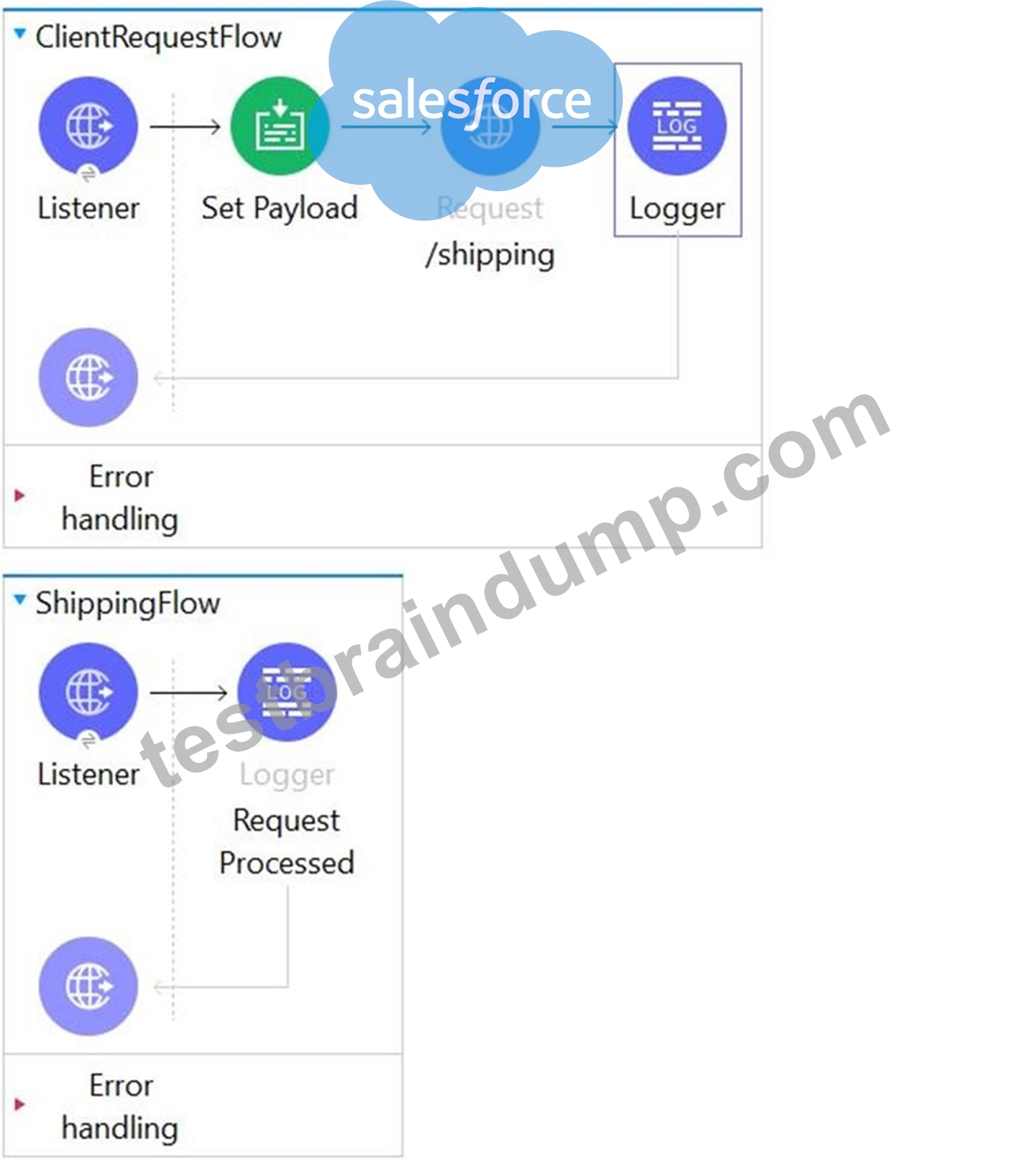


- A. Change the allowed method attributes value to "POST"
- B. Change the method attribute value to "*''
- C. Change the path attribute value to "/api/ship"
- D. Change the protocol attribute value to "HTTPS"
Answer: A
Explanation:
Correct answer is Change the method attributes value to "POST".
It can be fixed in either of the two ways as below.
1) Changing method attribute to POST in ClientRequestFlow
2) Setting allowedMethods as PUT in ShippingFlow (but doesn't fit as question mentions about changing ClientRequestFlow)
NEW QUESTION # 75
Refer to the exhibits.

Set paylaod transformer is set the firstName and lastName of the customer as shown in below images.
What is the correct Dataweave expression which can be added in message attribute of a Logger activity to access firstName (which in this case is Madhav) from the incoming event?
- A. vars."customer"."firstName"
- B. customer.firstName
- C. firstName
- D. vars."customer.firstName"
Answer: A
Explanation:
Correct answer is vars."customer"."firstName"
Please note that you can also access firstName using this syntax vars.customer.firstName.
Mule Ref Doc : Variables in Mule Apps | MuleSoft Documentation
NEW QUESTION # 76
Refer to the exhibits. A database Address table contains a ZIPCODE column and an increasing ID column. The Address table currently contains tour (4) records. The On Table Row Database listener is configured with its watermark set to the Address table's ZIPCODE column and then the Mule application is run in Anypoint Studio tor the first time, and the On Table Row Database listener polls the Address table.
Anew row is added to the database with 1D=5 and ZIPCODE-90006, and then the On Table Row Database listener polls the database again.
Alter the next execution of the On Table Row Database listener polling, what database rows have been processed by the Mule flow since the Mule application was started?
- A. ID ZIPCODE
1 90001
2 90005
3 90009
5 90006 - B. ID ZIPCODE
1 90001
2 90005
3 90009 - C. ID ZIPCODE
1 90001
2 90005
3 90009
4 90001 - D. ID ZIPCODE
1 90001
2 90005
3 90009
4 90001
Answer: D
Explanation:
5 90006
NEW QUESTION # 77
Refer to the exhibit. What is the output of logger component?
- A. Array
- B. String
- C. Object
- D. Map
Answer: A
Explanation:
Database always return rows as an array.
Array is the correct answer
NEW QUESTION # 78
Refer to the exhibit.
What is the output payload in the On Complete phase
- A. The records processed by all batch steps: [StepTwostepOnel, stepTwostepOne2, StepTwoStepOne3]
- B. The original payload: [1,2,31
- C. summary statistics with NO record data
- D. The records processed by the last batch step: [StepTwol, StepTwo2, StepTwo3]
Answer: C
Explanation:
This is a trcik question. On complete phase pyalod consists of summary of records processed which gives insight on which records failed or passed. Hence option 4 is correct answer MuleSoft Documentation Reference : https://docs.mulesoft.com/mule-runtime/4.3/batch-processing-concept#on-complete
NEW QUESTION # 79
A Database On Table Row listener retrieves data from a CUSTOMER table that contains a primary key userjd column and an increasing kxjin_date_time column. Neither column allows duplicate values.
How should the listener be configured so it retrieves each row at most one time?
- A. Set the watermark column to the bgin_date_time column
- B. Set the target value to the last retrieved user_jd value
- C. Set the target value to the last retrieved login_date_time value
- D. Set the watermark column to the user_Id column
Answer: A
Explanation:
* Watermark allows the poll scope to poll for new resources instead of getting the same resource over and over again.
* The database table must be ordered so that the "watermark functionality" can move effectively in the ordered list. Watermark stores the current/last picked up "record id."
* If the Mule application is shut down, it will store the last picked up "record id" in the Java Object Store and the data will continue to exist in the file. This watermark functionality is valuable and enables developers to have increased transparency.
* Developers do not need to create code to handle caching; it is all configurable!
* There are two columns and both are unique but user_id can't guaranty sequence whereas date_time will always be in increasing order and table content can easily be ordered on the basis of last processed date_time.
So correct answer is: Set the watermark column to the date_time column
NEW QUESTION # 80
Refer to the exhibit.
The error occurs when a project is run in Anypoint Studio. The project, which has a dependency that is not in the MuleSoft Maven repository, was created and successfully run on a different computer.
What is the next step to fix the error to get the project to run successfully?
- A. Add the dependency to the MULE_HOME/bin folder
- B. Install the dependency to the computer's local Maven repository
- C. Deploy the dependency to MuleSoft's Maven repository
- D. Edit the dependency in the Mule project's pom.xml file
Answer: B
Explanation:
As dependency is not present in Mulesoft Maven repository, we need to install the dependency on computer's local Maven repository.
https://docs.mulesoft.com/mule-runtime/4.3/maven-reference
NEW QUESTION # 81
Refer to the exhibits.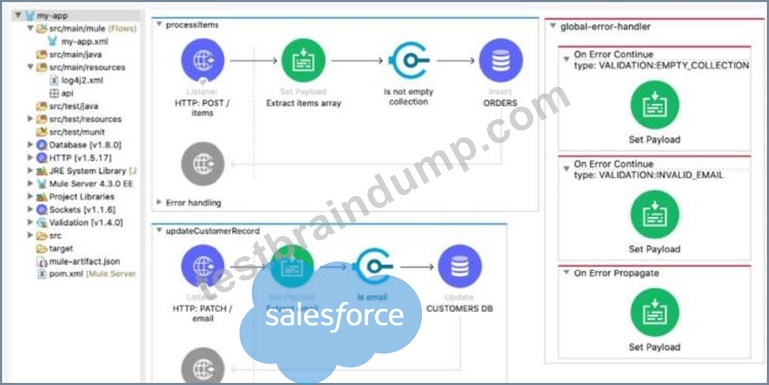

The my-app xml file contains an Error Handier scope named "global-error-handler" The Error Handler scope needs to be set to be the default error handler for every flow in the Mule application Where and how should the value "global-error-handler" be added in the Mule project so that the Error Handler scope is the default error handler of the Mule application?
- A. In the my-app.xml file, as an attribute of a configuration element
- B. In the Validation folder as the value of a global element in the error-handling yaml file
- C. In the mule-artifact json file, as the value of a key-value pair
- D. In the pom.xml file, as the value of a global element
Answer: A
NEW QUESTION # 82
Refer to the exhibit.
In the execution of the Scatter_Gather, the flow1 route completes after 10 seconds and the flow2 route completes after 20 seconds.
How many seconds does it take for the Scatter_Gather to complete?
- A. 0
- B. 1
- C. 2
- D. 3
Answer: A
NEW QUESTION # 83
Refer to the exhibits.
Larger image
Larger image
Larger image
The Mule application configures and uses two HTTP Listener global configuration elements.
Mule application is run in Anypoint Studio.
If the mule application starts correctly, what URI and port numbers can receive web client requests? If the mule applications fails to start , what is the reason for the failure?
- A. The mule application start successfully
Web client requests can only be received at URI on port 2222 but not on port 3333 - B. The mule application start successfully
Web client requests can be received at URI on port 2222 and on port 3333. - C. The mule application fails to start
There is URL path conflict because both HTTP Listeners are configured with same path - D. The mule application fails to start because of the port binding conflict as HTTP request also use same port i.e. 3333
Answer: B
Explanation:
In this case both the flows can start without any error and requests can be received on both ports. Flow names httpListener1 can call other flow using HTTP request without any issues.
Hence correct answer is
The mule application start successfully
Web client requests can be received at URI on port 2222 and on port 3333.
Lets check why other options are incorrect
1) The mule application fails to start. There is URL path conflict because both HTTP Listeners are configured with same path ---- This is incorrect as port value is different in both listeners
2) The mule application start successfully. Web client requests can only be received at URI on port 2222 but not on port 3333 --- This is incorrect as there is no reason for not receiving requests on port 3333
3) The mule application fails to start because of the port binding conflict as HTTP request also use same port i.e. 3333 --- Port binding conflict will not happen in this case. It would have if both listener configurations would have been on same port . But that is not the case here.
Mule Ref Doc : HTTP Listener Reference - Mule 4 | MuleSoft Documentation
NEW QUESTION # 84
......
Salesforce Salesforce-MuleSoft-Developer-I Exam Syllabus Topics:
| Topic | Details |
|---|---|
| Topic 1 |
|
| Topic 2 |
|
| Topic 3 |
|
| Topic 4 |
|
| Topic 5 |
|
| Topic 6 |
|
| Topic 7 |
|
| Topic 8 |
|
Authentic Salesforce-MuleSoft-Developer-I Exam Dumps PDF - Mar-2025 Updated: https://actualtests.testbraindump.com/Salesforce-MuleSoft-Developer-I-exam-prep.html
