
SAP C-ABAPD-2507 Exam Prep Guide: Prep guide for the C-ABAPD-2507 Exam
2025 New Preparation Guide of SAP C-ABAPD-2507 Exam
SAP C-ABAPD-2507 Exam Syllabus Topics:
| Topic | Details |
|---|---|
| Topic 1 |
|
| Topic 2 |
|
| Topic 3 |
|
| Topic 4 |
|
| Topic 5 |
|
NEW QUESTION # 38
Which of the following are rules that extensions in SAP S/4HANA Cloud, public edition must adhere to?
(Select 3 correct answers)
- A. Modify SAP objects in exceptional cases only.
- B. Use tier 2 wrappers to enable access to non-released SAP APIs.
- C. Use cloud-enabled and released technologies.
- D. Extend SAP objects through predefined extension points.
- E. Use released remote or local SAP APIs.
Answer: C,D,E
Explanation:
Comprehensive and Detailed Explanation From Exact Extract:
* Tier 1 (cloud-ready) extensions "follow ABAP Cloud rules and hence by default can only access the public SAP interfaces (objects released for cloud development)." This directly supports using released APIs (C) and cloud-enabled/released technologies (D).
* The three-tier extensibility model separates safe cloud extensions (Tier 1) from classic code; Tier 2 wrappers exist only to mitigate missing public APIs, but they are not the recommended pattern for S
/4HANA Cloud public-edition extensions (therefore B is not a rule).
* In S/4HANA Cloud, object changes are not allowed; instead, customers must use predefined extension points (E)-for example, whitelisted extension includes, released BAdIs, or CDS extension points exposed for cloud usage-consistent with the ABAP Cloud principle of public, released artifacts only. (This is the prescribed approach in the ABAP Cloud extensibility guidance that accompanies the three-tier model.)
NEW QUESTION # 39
What RESTful Application Programming object contains only the fields required for a particular app?
- A. Projection View
- B. Database view
- C. Metadata extension
- D. Data model view
Answer: A
Explanation:
A projection view is a RESTful Application Programming object that contains only the fields required for a particular app. A projection view is a CDS view entity that defines a projection on an existing CDS view entity or CDS DDIC-based view. A projection view exposes a subset of the elements of the projected entity, which are relevant for a specific business service. A projection view can also define aliases, virtual elements, and annotations for the projected elements. A projection view is the top-most layer of a CDS data model and prepares data for a particular use case. A projection view can have different provider contracts depending on the type of service it supports, such as transactional query, analytical query, or transactional interface.
A database view is a CDS DDIC-based view that defines a join or union of database tables. A database view has an SQL view attached and can be accessed by Open SQL or native SQL. A database view can be used as a projected entity for a projection view, but it does not contain only the fields required for a particular app.
A metadata extension is a RESTful Application Programming object that defines additional annotations for a CDS view entity or a projection view. A metadata extension can be used to enhance the metadata of a CDS data model without changing the original definition. A metadata extension does not contain any fields, but only annotations.
A data model view is a CDS view entity that defines a data model based on database tables or other CDS view entities. A data model view can have associations, aggregations, filters, parameters, and annotations. A data model view can be used as a projected entity for a projection view, but it does not contain only the fields required for a particular app.
NEW QUESTION # 40
In CDS views, what do joins and associations have in common?
Note: There are 2 correct answers to this question.
- A. An alias can be assigned to the data sources and to the fields in the field list.
- B. They can expose an entire data source without listing individual fields.
- C. The data sources are linked using an ON clause.
- D. The field list can include fields of the linked table without specifying the name of the corresponding data source.
Answer: A,C
NEW QUESTION # 41
When you create an exception class, what does SAP recommend you do? Note: There are 3 correct answers to this question.
- A. Implement interface if_t100_message, if you want to reuse messages from a message class.
- B. Inherit from cx_static_check, if you want a warning at design time that the exception will not be caught.
- C. Inherit from cx_static_check, if you want a warning at design time that the exception can never be raised.
- D. Inherit from cx_no_check, if you want to reuse messages from a system exception class.
- E. Define corresponding public attributes, if you want to pass context-specific values to placeholders of a message.
Answer: A,B,E
NEW QUESTION # 42
You want to define the following CDS view entity with an input parameter:
Define view entity Z_CONVERT With parameters currency : ???
Which of the following can you use to replace "???? Note: There are 2 correct answers to this question.
- A. A component of an ABAP Dictionary structure
- B. A data element
- C. A built-in ABAP Dictionary type
- D. built-in ABAP type
Answer: B,D
Explanation:
The possible replacements for "???" in the CDS view entity definition with an input parameter are A. built-in ABAP type and C. A data element. These are the valid types that can be used to specify the data type of an input parameter in a CDS view entity. A built-in ABAP type is a predefined elementary type in the ABAP language, such as abap.char, abap.numc, abap.dec, etc. A data element is a reusable semantic element in the ABAP Dictionary that defines the technical attributes and the meaning of a field12. For example:
The following code snippet defines a CDS view entity with an input parameter currency of type abap.cuky, which is a built-in ABAP type for currency key:
Define view entity Z_CONVERT With parameters currency : abap.cuky as select from ... { ... } The following code snippet defines a CDS view entity with an input parameter currency of type waers, which is a data element for currency key:
Define view entity Z_CONVERT With parameters currency : waers as select from ... { ... } You cannot do any of the following:
B . A built-in ABAP Dictionary type: This is not a valid type for an input parameter in a CDS view entity. A built-in ABAP Dictionary type is a predefined elementary type in the ABAP Dictionary, such as CHAR, NUMC, DEC, etc. However, these types cannot be used directly in a CDS view entity definition. Instead, they have to be prefixed with abap. to form a built-in ABAP type, as explained above12.
D . A component of an ABAP Dictionary structure: This is not a valid type for an input parameter in a CDS view entity. A component of an ABAP Dictionary structure is a field that belongs to a structure type, which is a complex type that consists of multiple fields. However, an input parameter in a CDS view entity can only be typed with an elementary type, which is a simple type that has no internal structure12.
NEW QUESTION # 43
Which of the following are ABAP Cloud Development Model rules?
Note: There are 2 correct answers to this question.
- A. Build ABAP reports with either ABAP List Viewer (ALV) or SAP Fiori.
- B. Reverse modifications when a suitable public SAP API becomes available.
- C. Build ABAP RESTful application programming model-based services.
- D. Use public SAP APIs and SAP extension points.
Answer: B,D
Explanation:
Use public SAP APIs and SAP extension points. This rule ensures that the ABAP Cloud code is stable, reliable, and compatible with the SAP solutions and the cloud operations. Public SAP APIs and SAP extension points are the only allowed interfaces and objects to access the SAP platform and the SAP applications. They are documented, tested, and supported by SAP. They also guarantee the lifecycle stability and the upgradeability of the ABAP Cloud code1.
Build ABAP RESTful application programming model-based services. This rule ensures that the ABAP Cloud code follows the state-of-the-art development paradigm for building cloud-ready business services. The ABAP RESTful application programming model (RAP) is a framework that provides a consistent end-to-end programming model for creating, reading, updating, and deleting (CRUD) business dat a. RAP also supports draft handling, authorization checks, side effects, validations, and custom actions. RAP exposes the business services as OData services that can be consumed by SAP Fiori apps or other clients2.
NEW QUESTION # 44
Which function call produces the string 'LORE_IPSUM_FACTUM'?
- A. condense( to_upper( 'LorelpsumFactum' ) )
- B. to_upper( condense( 'LorelpsumFactum' ) )
- C. from_mixed( val = 'LorelpsumFactum' sep = '_' )
- D. to_mixed( val = 'LorelpsumFactum' sep = '_' )
Answer: C
Explanation:
Comprehensive and Detailed Explanation from Exact Extract:
* from_mixed converts a mixed-case string into uppercase with a chosen separator between words.
* Given input 'LorelpsumFactum', the function splits at uppercase letters, uppercases the parts, and joins them with _.
* Output: LORE_IPSUM_FACTUM.
* condense only removes extra spaces, to_upper only changes case, and to_mixed does the reverse of from_mixed.
Study Guide Reference: ABAP Keyword Documentation - String Functions (from_mixed, to_mixed).
NEW QUESTION # 45
Constructors have which of the following properties?
(Select 2 correct answers)
- A. The constructor is automatically called during instantiation.
- B. The constructor can have importing parameters.
- C. The constructor can have returning parameters.
- D. The constructor must be the first method called by the client.
Answer: A,B
Explanation:
Comprehensive and Detailed Explanation from Exact Extract:
* A. Automatic execution # # A constructor (CONSTRUCTOR) is automatically invoked when an instance of a class is created.
* B. Importing parameters # # Constructors can have importing parameters to initialize the object with values.
* C. First method called by client # # Not correct, because constructors are called by the system, not the client explicitly.
* D. Returning parameters # # Constructors cannot return values; they only set up the object.
This behavior is consistent across ABAP Cloud OOP classes, ensuring encapsulated initialization logic.
Verified Study Guide Reference: ABAP Objects Guide - Class Constructors and Instance Constructors.
NEW QUESTION # 46
What are some of the reasons that Core Data Services are preferable to the classical approach to data modeling? Note: There are 2 correct answers to this question.
- A. They avoid data transfer completely.
- B. They implement code pushdown.
- C. They transfer computational results to the application server.
- D. They compute results on the application server.
Answer: B,C
Explanation:
Core Data Services (CDS) are preferable to the classical approach to data modeling for several reasons, but two of them are:
They implement code pushdown. Code pushdown is the principle of moving data-intensive logic from the application server to the database server, where the data resides. This reduces the data transfer between the application server and the database server, which improves the performance and scalability of the application. CDS enable code pushdown by allowing the definition of semantic data models and business logic in the database layer, using SQL and SQL-based expressions1.
They transfer computational results to the application server. CDS allow the application server to access the data and the logic defined in the database layer by using Open SQL statements. Open SQL is a standardized and simplified subset of SQL that can be used across different database platforms. Open SQL statements are translated into native SQL statements by the ABAP runtime environment and executed on the database server. The results of the computation are then transferred to the application server, where they can be further processed or displayed2.
NEW QUESTION # 47
While debugging an ABAP program, you want the program to stop whenever the value of a variable changes. Which of the following do you use?
- A. Watchpoint
- B. Conditional breakpoint
- C. Exception breakpoint
Answer: A
NEW QUESTION # 48
Which of the following types of Core Data Services Views can be used at the consumption layer?
Note: There are 3 correct answers to this question.
- A. Hierarchy
- B. Transactional Interface
- C. Analytical Query
- D. Transactional Query
- E. Table Function
Answer: A,C,E
Explanation:
Comprehensive and Detailed Explanation From Exact Extract:
The consumption layer in ABAP CDS views is used to define views for user-facing applications, analytical scenarios, and UI services. The valid view types used at this layer include:
* Table Function: Used where custom logic or complex data transformations are required. These are implemented with AMDP or class-based logic and exposed via CDS consumption views.
* Analytical Query: Designed for analytical use cases with annotations like @Analytics.query: true to allow exposure to Fiori Analytical apps.
* Hierarchy: Used for defining and consuming hierarchical data in CDS. These can be displayed in Fiori Tree tables and analytical contexts.
The following options are incorrect:
* Transactional Interface and Transactional Query are not standard view types or part of the CDS view hierarchy used in the consumption layer. These terms may have been incorrectly stated and do not reflect supported CDS artifacts.
Reference: SAP Help 3, page 3 - Developing Common Capabilities, and ABAP CDS Development User Guide, section 3.1 - Creating and Activating Data Models
NEW QUESTION # 49
What would be the correct expression to change a given string value 'mr joe doe' into 'JOE' in an ABAP SQL field list?
- A. SELECT FROM TABLE dbtabl FIELDS
Of1,
substring(upper('mr joe doe'), 4, 3) AS f2_sub_up, f3,... - B. SELECT FROM TABLE dbtabl FIELDS
Of1,
upper(left( 'mr joe doe', 6)) AS f2_up_left, f3, - C. SELECT FROM TABLE dbtabl FIELDS
Of1,
left(lower(substring( 'mr joe doe', 4, 3)), 3) AS f2_left_lo_sub, f3, - D. SELECT FROM TABLE dbtabl FIELDS
Of1,
substring(lower(upper( 'mr joe doe' ) ), 4, 3) AS f2_sub_lo_up, f3,
Answer: A
Explanation:
The correct expression to change a given string value 'mr joe doe' into 'JOE' in an ABAP SQL field list is C. SELECT FROM TABLE dbtabl FIELDS Of1, substring(upper('mr joe doe'), 4, 3) AS f2_sub_up, f3,... This expression uses the following SQL functions for strings12:
upper: This function converts all lowercase characters in a string to uppercase. For example, upper('mr joe doe') returns 'MR JOE DOE'.
substring: This function returns a substring of a given string starting from a specified position and with a specified length. For example, substring('MR JOE DOE', 4, 3) returns 'JOE'.
AS: This keyword assigns an alias or a temporary name to a field or an expression in the field list. For example, AS f2_sub_up assigns the name f2_sub_up to the expression substring(upper('mr joe doe'), 4, 3).
You cannot do any of the following:
A . SELECT FROM TABLE dbtabl FIELDS Of1, upper(left( 'mr joe doe', 6)) AS f2_up_left, f3,...: This expression uses the wrong SQL function for strings to get the desired result. The left function returns the leftmost characters of a string with a specified length, ignoring the trailing blanks. For example, left( 'mr joe doe', 6) returns 'mr joe'. Applying the upper function to this result returns 'MR JOE', which is not the same as 'JOE'.
B . SELECT FROM TABLE dbtabl FIELDS Of1, left(lower(substring( 'mr joe doe', 4, 3)), 3) AS f2_left_lo_sub, f3,...: This expression uses unnecessary and incorrect SQL functions for strings to get the desired result. The lower function converts all uppercase characters in a string to lowercase. For example, lower(substring( 'mr joe doe', 4, 3)) returns 'joe'. Applying the left function to this result with the same length returns 'joe' again, which is not the same as 'JOE'.
D . SELECT FROM TABLE dbtabl FIELDS Of1, substring(lower(upper( 'mr joe doe' ) ), 4, 3) AS f2_sub_lo_up, f3,...: This expression uses unnecessary and incorrect SQL functions for strings to get the desired result. The lower function converts all uppercase characters in a string to lowercase, and the upper function converts all lowercase characters in a string to uppercase. Applying both functions to the same string cancels out the effect of each other and returns the original string. For example, lower(upper( 'mr joe doe' ) ) returns 'mr joe doe'. Applying the substring function to this result returns 'joe', which is not the same as 'JOE'.
NEW QUESTION # 50
You have attached a system field too an input parameter of a CDS view entity as follows:
* define view entity Z_ENTITYY with parameters
* @Environment.SystemFieldd: #SYSTEM_LANGUAGE
* language :spras...
What are the effects of this annotation?
Note: There are 2 correct answers to this question.
- A. You can still override the default value with a value of your own.
- B. The value of sy-langu will be passed to the CDS view automatically when you use the CDS view in ABAP but not when you use it in another view entity.
- C. The value of sy-langu will be passed to the CDS view automatically both when you use the CDS view in ABAP and in another CDS view entity (view on view).
- D. It is no longer possible to pass your own value to the parameter.
Answer: A,B
NEW QUESTION # 51
You select a field flight_date with type DATS in the field list of a CDS view.
Which of the following expressions returns the 2-digit month from the field? Note: There are 2 correct answers to this question.
- A. substring( flight_date, 5, 2)
- B. left(right( flight_date, 6), 2))
- C. substring( flight_date, 4, 2)
- D. right(left( flight_date, 6), 2))
Answer: A,B
NEW QUESTION # 52
You are given the following information:
1.
The data source "spfli" on line #2 is an SAP HANA
database table
2.
"spfli" will be a large table with over one million rows.
3.
This program is the only one in the system that accesses
the table.
4.
This program will run rarely.
Based on this information, which of the following general
settings should you set for the spfli database table? Note:
There are 2 correct answers to this question.
- A. "Storage Type" to "Column Store"
- B. "Load Unit' to 'Page Loadable"
- C. "Storage Type" to "Row Store"
- D. "Load Unit to "Column Loadable"
Answer: B,C
Explanation:
Based on the given information, the spfli database table should have the following general settings:
"Storage Type" to "Row Store": This setting determines how the data is stored in the SAP HANA database. Row store is suitable for tables that are accessed by primary key or by a small number of columns. Column store is suitable for tables that are accessed by a large number of columns or by complex analytical queries. Since the spfli table is a large table with over one million rows, and this program is the only one in the system that accesses the table, it is likely that the program will use primary key access or simple queries to access the table. Therefore, row store is a better choice than column store for this table12.
"Load Unit" to "Page Loadable": This setting determines how the data is loaded into the memory when the table is accessed. Page loadable means that the data is loaded in pages of 16 KB each, and only the pages that are needed are loaded. Column loadable means that the data is loaded in columns, and only the columns that are needed are loaded. Since the spfli table is a row store table, and this program will run rarely, it is more efficient to use page loadable than column loadable for this table. Page loadable will reduce the memory consumption and the loading time of the table13.
NEW QUESTION # 53
To give authorization to users, in which order are the artifacts used?
- A. 1) The IAM app uses the Business User. 2) The Business User uses the Business Catalog. 3) The Business Catalog uses the Business Role. 4) The Business Role uses the Authorization Object.
- B. 1) The IAM app uses the Business Role. 2) The Business Role uses the Authorization Object. 3) The Authorization Object uses the Business Catalog. 4) The Business User uses the Authorization Object.
- C. 1) The IAM app uses the Authorization Object. 2) The Business Catalog uses the IAM app. 3) The Business Role uses the Business Catalog. 4) The Business User uses the Business Role.
- D. 1) The IAM app uses the Business Catalog. 2) The Business Catalog uses the Business Role. 3) The Business Role uses the Business User. 4) The Business User uses the Authorization Object.
Answer: C
Explanation:
Comprehensive and Detailed Explanation From Exact Extract:
* In RAP/ABAP Cloud, authorization objects define authorizations for roles and are invoked from CDS (read) and behavior (modify). This ties app operations to authorization objects and roles administered in IAM.
* RAP services are exposed for Fiori apps via service bindings; the resulting Fiori app uses the service and its enforcement (which includes the authorization objects configured for roles). Putting it together for S/4HANA Cloud IAM: Apps carry/trigger checks based on authorization objects; Business Catalogs collect apps; Business Roles collect catalogs; Business Users are assigned roles. This aligns with the ABAP Cloud guidance that authorizations are grouped into roles and checked against authorization objects during access.
NEW QUESTION # 54
In a RESTful Application Programming application, in which objects do you bind a CDS view to create a value help? Note: There are 3 correct answers to this question.
- A. Data model view
- B. Behavior definition
- C. Projection View
- D. Service Definition
- E. Metadata Extension
Answer: A,C,E
Explanation:
In a RESTful Application Programming (RAP) application, you can bind a CDS view to create a value help in the following objects:
Data model view: A data model view is a CDS view that defines the data structure and the associations of an entity in the RAP application. You can use the annotation @Consumption.valueHelpDefinition to bind a value help provider CDS view to an element of the data model view. The value help provider CDS view must contain the key fields of the value help entity and the fields that are displayed in the value help dialog. The value help annotation specifies the entity name, the element name, and optionally the additional binding conditions for the value help provider1.
Metadata Extension: A metadata extension is a CDS view that extends the metadata of another CDS view without changing its data structure. You can use the annotation @MetadataExtension.extendView to specify the target CDS view that you want to extend. You can then use the same annotation @Consumption.valueHelpDefinition to bind a value help provider CDS view to an element of the target CDS view. The metadata extension allows you to add value help definitions to existing CDS views without modifying them2.
Projection View: A projection view is a CDS view that defines the projection of another CDS view. You can use the annotation @AbapCatalog.sqlViewType: #PROJECTION to specify that the CDS view is a projection view. You can then use the same annotation @Consumption.valueHelpDefinition to bind a value help provider CDS view to an element of the projection view. The projection view allows you to add value help definitions to projected elements of another CDS view3.
You cannot bind a value help provider CDS view to a behavior definition or a service definition, because these objects do not define the data structure or the metadata of an entity in the RAP application. A behavior definition defines the behavior and the validation rules of an entity, such as the create, read, update, and delete (CRUD) operations, the draft handling, the authorization checks, and the side effects4. A service definition defines the service exposure and the service binding of an entity, such as the protocol, the version, the namespace, and the service name5.
NEW QUESTION # 55
In what order are objects created to generate a RESTful Application Programming application?
Answer:
Explanation: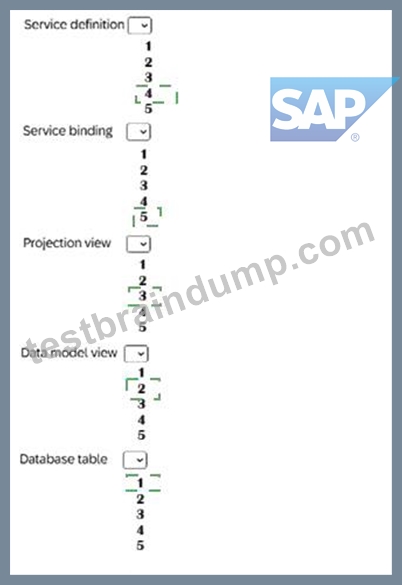
Explanation:
Database table
Data model view
Projection view
Service definition
Service binding
In RAP, the development flow follows a bottom-up approach, beginning with persistence and ending with OData exposure:
* Database table:The persistence layer where data is stored. This is the foundation of the business object model.
* Data model view (CDS entity):The CDS view is defined on top of the database table to provide a semantic data model. It represents entities like Travel or Booking.
* Projection view:Provides an abstraction of the data model view and controls which fields and associations are exposed externally.
* Service definition:Specifies which projection views (entities) are exposed in the OData service.
* Service binding:Connects the service definition to a communication protocol (e.g., OData V2 or V4), generating the final consumable service endpoint.
This sequence ensures a layered architecture consistent with RAP guidelines:
* Persistence layer # Data model layer # Projection layer # Service layer # Binding to protocol.
Reference: SAP Help 1, pages 4-6 - RAP design time development flow (data modeling, business service provisioning, service consumption).
NEW QUESTION # 56 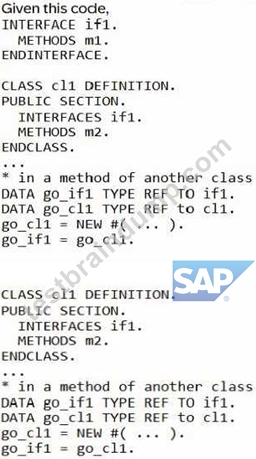
what are valid statements? Note: There are 3 correct answers to this question.
- A. go_cl1 may call method m11 with go_cl1->if1~m1(...).
- B. Instead of go_cl1 = NEW #(...) you could use go_if1 = NEW #(...).
- C. Instead of go_cl1 = NEW #(...) you could use go_if1 = NEW cl1(...).
- D. go_if1 may call method m1 with go_if1->m1(...).
- E. go_if1 may call method m2 with go_if->m2(...).
Answer: A,C,D
NEW QUESTION # 57
In ABAP SQL, which of the following retrieves the association field_Airline-Name of a CDS view?
- A. /_Airline Name
- B. @_Airline-Name
- C. "_Airline Name
- D. \_Airline-Name
Answer: B
Explanation:
In ABAP SQL, the syntax to retrieve the association field of a CDS view is to use the @ sign followed by the association name and the field name, separated by a period sign (.). For example, to retrieve the association field _Airline-Name of a CDS view, the syntax is @_Airline.Name. This syntax allows the access to the fields of the target data source of the association without explicitly joining the data sources1. The other options are incorrect because they use the wrong symbols or formats to access the association field.
NEW QUESTION # 58
Which statement can you use to change the contents of a row of data in an internal table?
- A. INSERT
- B. MODIFY
- C. APPEND
- D. UPDATE
Answer: B
NEW QUESTION # 59
What are some properties of database tables? Note: There are 2 correct answers to this question.
- A. They can have any number of key fields.
- B. They may have key fields.
- C. They store information in two dimensions.
- D. They can have relationships to other tables.
Answer: C,D
Explanation:
Database tables are data structures that store information in two dimensions, using rows and columns. Each row represents a record or an entity, and each column represents an attribute or a field. Database tables may have key fields, which are columns that uniquely identify each row or a subset of rows. Key fields can be used to enforce data integrity, perform efficient searches, and establish relationships to other tables. Database tables can have relationships to other tables, which are associations or links between the key fields of two or more tables. Relationships can be used to model the logical connections between different entities, join data from multiple tables, and enforce referential integrity12.
NEW QUESTION # 60
While debugging an ABAP program, you want the program to stop whenever the value of a variable change.
Which of the following do you use?
- A. breakpoint Watchpoint
- B. Exception
- C. Conditional breakpoint
Answer: A
NEW QUESTION # 61
......
Latest Questions C-ABAPD-2507 Guide to Prepare Free Practice Tests: https://actualtests.testbraindump.com/C-ABAPD-2507-exam-prep.html
