
Updated Google Professional-Cloud-Developer Dumps – Check Free Professional-Cloud-Developer Exam Dumps (2024)
Updated Professional-Cloud-Developer exam with Google Real Exam Questions
Google Professional-Cloud-Developer Certification Exam is an important credential for developers who want to demonstrate their expertise in developing cloud-based applications using GCP. Google Certified Professional - Cloud Developer certification is recognized by employers and peers in the industry as a mark of excellence, and it can help developers advance their careers and increase their earning potential. Professional-Cloud-Developer exam is a rigorous test of a developer's knowledge and skills, and passing it requires significant preparation and study. However, the benefits of obtaining the certification can be significant, both in terms of personal and professional development.
NEW QUESTION # 17
Your company has deployed a new API to a Compute Engine instance. During testing, the API is not behaving as expected. You want to monitor the application over 12 hours to diagnose the problem within the application code without redeploying the application. Which tool should you use?
- A. Cloud Trace
- B. Cloud Debugger snapshots
- C. Cloud Monitoring
- D. Cloud Debugger logpoints
Answer: D
Explanation:
https://cloud.google.com/debugger/docs/using/logpoints
Logpoints allow you to inject logging into running services without restarting or interfering with the normal function of the service
NEW QUESTION # 18
Your existing application keeps user state information in a single MySQL database. This state information is very user-specific and depends heavily on how long a user has been using an application. The MySQL database is causing challenges to maintain and enhance the schema for various users.
Which storage option should you choose?
- A. Cloud Storage
- B. Cloud SQL
- C. Cloud Datastore/Firestore
- D. Cloud Spanner
Answer: B
Explanation:
Explanation/Reference: https://cloud.google.com/solutions/migrating-mysql-to-cloudsql-concept
NEW QUESTION # 19
You are trying to connect to your Google Kubernetes Engine (GKE) cluster using kubectl from Cloud Shell. You have deployed your GKE cluster with a public endpoint. From Cloud Shell, you run the following command:
You notice that the kubectl commands time out without returning an error message. What is the most likely cause of this issue?
- A. Your user account does not have privileges to interact with the cluster using kubectl.
- B. Your Cloud Shell external IP address is not part of the authorized networks of the cluster.
- C. A VPC firewall is blocking access to the cluster's endpoint.
- D. The Cloud Shell is not part of the same VPC as the GKE cluster.
Answer: B
Explanation:
https://cloud.google.com/kubernetes-engine/docs/how-to/private-clusters#cloud_shell If you want to use Cloud Shell to access the cluster, you must add the public IP address of your Cloud Shell to the cluster's list of authorized networks.
NEW QUESTION # 20
You are developing a new public-facing application that needs to retrieve specific properties in the metadata of users' objects in their respective Cloud Storage buckets. Due to privacy and data residency requirements, you must retrieve only the metadata and not the object data. You want to maximize the performance of the retrieval process. How should you retrieve the metadata?
- A. Use the copy method.
- B. Use the fields request parameter.
- C. Use the compose method.
- D. Use the patch method.
Answer: B
Explanation:
Explanation
https://cloud.google.com/storage/docs/json_api/v1/objects/get
NEW QUESTION # 21
Your teammate has asked you to review the code below, which is adding a credit to an account balance in Cloud Datastore. Which improvement should you suggest your teammate make?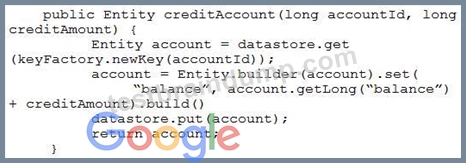
- A. Use a strongly consistent transactional database.
- B. Don't return the account entity from the function.
- C. Get and put the entity in a transaction.
- D. Get the entity with an ancestor query.
Answer: D
NEW QUESTION # 22
You need to copy directory local-scripts and all of its contents from your local workstation to a Compute Engine virtual machine instance.
Which command should you use?
gsutil cp --project "my-gcp-project" -r ~/local-scripts/ gcp-instance-name:~/
- A. server-scripts/ --zone "us-east1-b"
gcloud compute scp --project "my-gcp-project" --recurse ~/local-scripts/ gcp- - B. instance-name:~/server-scripts/ --zone "us-east1-b"
gcloud compute mv --project "my-gcp-project" --recurse ~/local-scripts/ gcp- - C. instance-name:~/server-scripts/ --zone "us-east1-b"
- D. server-scripts/ --zone "us-east1-b"
gsutil cp --project "my-gcp-project" -R ~/local-scripts/ gcp-instance-name:~/
Answer: B
Explanation:
Explanation
Explanation/Reference: https://cloud.google.com/sdk/gcloud/reference/compute/copy-files
NEW QUESTION # 23
This architectural diagram depicts a system that streams data from thousands of devices. You want to ingest data into a pipeline, store the data, and analyze the data using SQL statements. Which Google Cloud services should you use for steps 1, 2, 3, and 4?
- A. 1) Pub/Sub
2) Dataflow
3) Firestore
4) BigQuery - B. 1) App Engine
2) Pub/Sub
3) BigQuery
4) Firestore - C. 1) Pub/Sub
2) Dataflow
3) BigQuery
4) Firestore - D. 1) Dataflow
2) Pub/Sub
3) Firestore
4) BigQuery
Answer: A
NEW QUESTION # 24
Your application is deployed in a Google Kubernetes Engine (GKE) cluster. When a new version of your application is released, your CI/CD tool updates the spec.template.spec.containers[0].image value to reference the Docker image of your new application version. When the Deployment object applies the change, you want to deploy at least 1 replica of the new version and maintain the previous replicas until the new replica is healthy.
Which change should you make to the GKE Deployment object shown below?
- A. Set the Deployment strategy to Recreate with maxSurge set to 1, maxUnavailable set to 0.
- B. Set the Deployment strategy to RollingUpdate with maxSurge set to 1, maxUnavailable set to 0.
- C. Set the Deployment strategy to RollingUpdate with maxSurge set to 0, maxUnavailable set to 1.
- D. Set the Deployment strategy to Recreate with maxSurge set to 0, maxUnavailable set to 1.
Answer: A
NEW QUESTION # 25
You are evaluating developer tools to help drive Google Kubernetes Engine adoption and integration with your development environment, which includes VS Code and IntelliJ. What should you do?
- A. Use the Cloud Shell integrated Code Editor to edit code and configuration files.
- B. Use Cloud Code to develop applications.
- C. Use a Cloud Notebook instance to ingest and process data and deploy models.
- D. Use Cloud Shell to manage your infrastructure and applications from the command line.
Answer: B
Explanation:
Reference: https://cloud.google.com/code
NEW QUESTION # 26
You are designing an application that uses a microservices architecture. You are planning to deploy the application in the cloud and on-premises. You want to make sure the application can scale up on demand and also use managed services as much as possible. What should you do?
- A. Create a GKE cluster in each environment with Anthos, and use Cloud Run for Anthos to deploy your application to each cluster.
- B. Create a GKE cluster in the cloud and install open-source Kubernetes on-premises. Use an external load balancer service to distribute traffic across the two environments.
- C. Install a GKE cluster in each environment with Anthos, and use Cloud Build to create a Deployment for your application in each cluster.
- D. Deploy open source Istio in a multi-cluster deployment on multiple Google Kubernetes Engine (GKE) clusters managed by Anthos.
Answer: A
Explanation:
https://cloud.google.com/anthos/run
Integrated with Anthos, Cloud Run for Anthos provides a flexible serverless development platform for hybrid and multicloud environments. Cloud Run for Anthos is Google's managed and fully supported Knative offering, an open source project that enables serverless workloads on Kubernetes.
NEW QUESTION # 27
You have a web application that publishes messages to Pub/Sub. You plan to build new versions of the application locally and need to quickly test Pub/Sub integration tor each new build. How should you configure local testing?
- A. Install the Pub/Sub emulator using gcloud and start the emulator with a valid Google Project ID. When developing locally, configure your application to use the local emulator by exporting the fuhsub emulator Host variable
- B. In the Google Cloud console, navigate to the API Library and enable the Pub/Sub API When developing locally, configure your application to call pubsub.googleapis com
- C. Run the gclcud config set api_endpoint_overrides/pubsub https: / 'pubsubemulator.googleapi3.com. coin/ command to change the Pub/Sub endpoint prior to starting the application
- D. Install Cloud Code on the integrated development environment (IDE) Navigate to Cloud APIs, and enable Pub/Sub against a valid Google Project ID. When developing locally, configure your application to call pubsub.googleapis com
Answer: D
NEW QUESTION # 28
Your organization has recently begun an initiative to replatform their legacy applications onto Google Kubernetes Engine. You need to decompose a monolithic application into microservices. Multiple instances have read and write access to a configuration file, which is stored on a shared file system. You want to minimize the effort required to manage this transition, and you want to avoid rewriting the application code. What should you do?
- A. Create a new ConfigMap and volumeMount to store the contents of the configuration file.
- B. Create a new Cloud Storage bucket, and mount it via FUSE in the container.
- C. Create a new Filestore instance, and mount the volume as an NFS PersistentVolume.
- D. Create a new persistent disk, and mount the volume as a shared PersistentVolume.
Answer: A
Explanation:
https://cloud.google.com/kubernetes-engine/docs/concepts/configmap
ConfigMaps bind non-sensitive configuration artifacts such as configuration files, command-line arguments, and environment variables to your Pod containers and system components at runtime.
A ConfigMap separates your configurations from your Pod and components, which helps keep your workloads portable. This makes their configurations easier to change and manage, and prevents hardcoding configuration data to Pod specifications.
NEW QUESTION # 29
Your development team is using Cloud Build to promote a Node.js application built on App Engine from your staging environment to production. The application relies on several directories of photos stored in a Cloud Storage bucket named webphotos-staging in the staging environment. After the promotion, these photos must be available in a Cloud Storage bucket named webphotos-prod in the production environment. You want to automate the process where possible. What should you do?
A)
Manually copy the photos to webphotos-prod.
B)
Add a startup script in the application's app.yami file to move the photos from webphotos-staging to webphotos-prod.
C)
Add a build step in the cloudbuild.yaml file before the promotion step with the arguments:
D)
Add a build step in the cloudbuild.yaml file before the promotion step with the arguments:
- A. Option B
- B. Option C
- C. Option A
- D. Option D
Answer: B
Explanation:
https://cloud.google.com/storage/docs/gsutil/commands/cp
NEW QUESTION # 30
Your service adds text to images that it reads from Cloud Storage. During busy times of the year, requests to Cloud Storage fail with an HTTP 429 "Too Many Requests" status code.
How should you handle this error?
- A. Add a cache-control header to the objects.
- B. Request a quota increase from the GCP Console.
- C. Change the storage class of the Cloud Storage bucket to Multi-regional.
- D. Retry the request with a truncated exponential backoff strategy.
Answer: D
Explanation:
Reference:
https://developers.google.com/gmail/api/v1/reference/quota
NEW QUESTION # 31
Your team detected a spike of errors in an application running on Cloud Run in your production project. The application is configured to read messages from Pub/Sub topic A, process the messages, and write the messages to topic B. You want to conduct tests to identify the cause of the errors. You can use a set of mock messages for testing. What should you do?
- A. Use the gcloud CLI to write mock messages to topic A. Change the logging level in the application to DEBUG or INFO, and then analyze the logs.
- B. Deploy the Pub/Sub and Cloud Run emulators on your local machine. Deploy the application locally, and change the logging level in the application to DEBUG or INFO. Write mock messages to topic A, and then analyze the logs.
- C. Deploy the Pub/Sub emulator on your local machine. Point the production application to your local Pub/Sub topics. Write mock messages to topic A, and then analyze the logs.
- D. Use the Google Cloud console to write mock messages to topic A. Change the logging level in the application to DEBUG or INFO, and then analyze the logs.
Answer: A
NEW QUESTION # 32
Your company has a new security initiative that requires all data stored in Google Cloud to be encrypted by customer-managed encryption keys. You plan to use Cloud Key Management Service (KMS) to configure access to the keys. You need to follow the "separation of duties" principle and Google-recommended best practices. What should you do? (Choose two.)
- A. Grant the roles/cloudkms.admin role to the owner of the project where the keys from Cloud KMS are being used.
- B. Grant an owner role for the Cloud KMS project to a different user than the owner of the project where the keys from Cloud KMS are being used.
- C. Do not assign an owner to the Cloud KMS project.
- D. Provision Cloud KMS in its own project.
- E. Provision Cloud KMS in the project where the keys are being used.
Answer: C,D
Explanation:
https://cloud.google.com/kms/docs/separation-of-duties#using_separate_project
NEW QUESTION # 33
You are designing a resource-sharing policy for applications used by different teams in a Google Kubernetes Engine cluster. You need to ensure that all applications can access the resources needed to run. What should you do? (Choose two.)
- A. Create a Kubernetes service account (KSA) for each application, and assign each KSA to the namespace.
- B. Create a namespace for each team, and attach resource quotas to each namespace.
- C. Create a LimitRange to specify the default compute resource requirements for each namespace.
- D. Specify the resource limits and requests in the object specifications.
- E. Use the Anthos Policy Controller to enforce label annotations on all namespaces. Use taints and tolerations to allow resource sharing for namespaces.
Answer: B,C
Explanation:
https://kubernetes.io/docs/concepts/policy/resource-quotas/
https://kubernetes.io/docs/concepts/policy/limit-range/
https://cloud.google.com/blog/products/containers-kubernetes/kubernetes-best-practices-resource-requests-and-limits
NEW QUESTION # 34
......
Google Professional-Cloud-Developer (Google Certified Professional - Cloud Developer) Certification Exam is designed to validate the skills and knowledge of cloud developers who specialize in Google Cloud Platform (GCP) technologies. Google Certified Professional - Cloud Developer certification is intended for individuals who are involved in developing, deploying, and managing applications and services on the GCP. Professional-Cloud-Developer exam measures various aspects of cloud development, such as designing, building, testing, and deploying cloud-native applications on the GCP.
Actual Professional-Cloud-Developer Exam Recently Updated Questions with Free Demo: https://actualtests.testbraindump.com/Professional-Cloud-Developer-exam-prep.html
