
PMI-RMP Free Certification Exam Easy to Download PDF Format 2026
Get 100% Success with Latest Project Management Professional PMI-RMP Exam Dumps
NEW QUESTION # 137
Della works as a project manager for Tech Perfect Inc. She is studying the documentation of planning of a project. The documentation states that there are twenty-eight stakeholders with the project. What will be the number of communication channels for the project?
- A. 0
- B. 1
- C. 2
- D. 3
Answer: A
NEW QUESTION # 138
A company in the mining industry accommodates a lot of innovation and changing work conditions. Because of this, the company experiences difficulty in predicting long term business plans.
How should a professional risk manager manage the risks in such situations?
- A. Utilize proper documentation to help manage the risks.
- B. Conduct weekly risk management meetings with all stakeholders.
- C. Adopt a predictive approach to manage the risks.
- D. Adopt agile approaches to manage the risks.
Answer: D
Explanation:
In a company with rapidly changing work conditions and difficulty in predicting long-term business plans, a professional risk manager should adopt agile approaches to manage the risks (B). Agile approaches allow for flexibility, adaptability, and quick response to changes, making them suitable for managing risks in such situations. This is supported by the PMI's PMBOK Guide, Sixth Edition, and the Agile Practice Guide.
A professional risk manager should adopt agile approaches to manage the risks in situations where the company accommodates a lot of innovation and changing work conditions, and experiences difficulty in predicting long term business plans. Agile approaches are adaptive, iterative, and collaborative methods that focus on delivering value and reducing uncertainty in a dynamic and complex environment. Agile approaches can help the risk manager to identify, analyze, respond, and monitor risks in a flexible and timely manner, by using tools and techniques such as risk-adjusted backlog, risk burndown charts, risk-based spike, and risk- based testing. Agile approaches can also help the risk manager to engage the stakeholders and the project team in risk management activities, by using practices such as daily stand-up meetings, sprint planning, sprint review, and sprint retrospective. Agile approaches can enable the risk manager to manage the risks effectively and efficiently, by aligning the risk management strategy with the project goals and the customer needs.
Adopting a predictive approach to manage the risks is not the best option, as it may not be suitable or feasible for situations where the project scope, schedule, and budget are uncertain or variable. A predictive approach is a plan-driven and sequential method that relies on upfront planning and detailed documentation to manage the risks. A predictive approach may not be able to cope with the frequent changes and emerging risks that may occur in an innovative and dynamic environment. Utilizing proper documentation to help manage the risks is not the best option, as it may not be sufficient or effective for situations where the project requirements and deliverables are evolving or changing. Proper documentation is a useful and necessary component of risk management, but it is not a substitute for agile risk management practices. Proper documentation may not be able to capture and communicate the current and relevant information about the risks and their impacts in a timely and accurate manner. Conducting weekly risk management meetings with all stakeholders is not the best option, as it may not be optimal or efficient for situations where the project risks and opportunities are changing rapidly or frequently. Weekly risk management meetings are a common and beneficial practice for risk management, but they may not be enough or appropriate for agile risk management. Weekly risk management meetings may not be able to address the risks and their responses as soon as they arise or occur, and they may not be able to involve all the relevant and available stakeholders and project team members. References: 3, 4, 5
NEW QUESTION # 139
In the middle of a construction project, the primary construction materials provider canceled the contract and moved to a competitor offering a higher price. The risk manager considers this a low-impact issue because many construction materials providers can fulfill the project demands.
However, after informing the stakeholders of this issue, the major investor is about to drop their intention to continue executing the project. The risk manager does not understand their decision.
What should the risk manager do next to understand the major stakeholder's decision regarding the project?
- A. Perform a risk reserve analysis.
- B. Perform a procurement analysis.
- C. Perform a stakeholder impact and influence analysis.
- D. Perform a risk impact analysis.
Answer: C
Explanation:
A stakeholder impact and influence analysis is a technique to identify the level of interest and power of each stakeholder, and to assess how they may affect or be affected by the project outcomes. It can help the risk manager to understand the stakeholder's perspective and expectations, and to communicate with them effectively. In this case, the risk manager should perform a stakeholder impact and influence analysis to understand why the major investor is about to drop their intention to continue executing the project, and to address their concerns and needs. A risk impact analysis, a risk reserve analysis, and a procurement analysis are not relevant to the stakeholder's decision, and would not help the risk manager to understand their rationale. References: PMI Risk Management Professional (PMI-RMP)® Exam Content Outline1, PMI Practice Standard for Project Risk Management2, Risk Management Professional (PMI-RMP)® Cert Guide3
NEW QUESTION # 140
You are the project manager of the CUL project in your organization. You and the project team are assessing the risk events and creating a probability and impact matrix for the identified risks. Which one of the following statements best describes the requirements for the data type used in qualitative risk analysis?
- A. A qualitative risk analysis required unbiased stakeholders with biased risk tolerances.
- B. A qualitative risk analysis requires accurate and unbiased data if it is to be credible.
- C. A qualitative risk analysis requires fast and simple data to complete the analysis.
- D. A qualitative risk analysis encourages biased data to reveal risk tolerances.
Answer: B
NEW QUESTION # 141 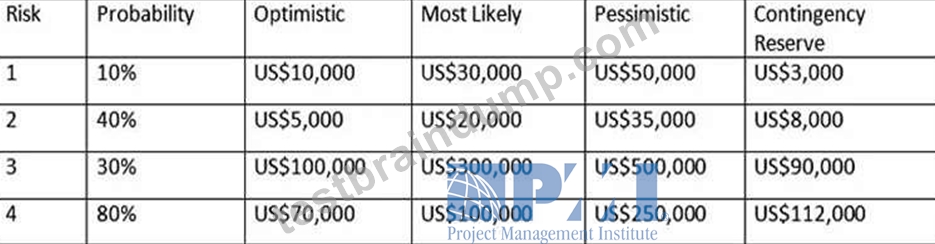
Contingency Reserve Total: US$213,000
Due to a mitigation strategy, Risk 4's probability has been reduced to 40%. What would be the new contingency reserve total?
- A. US$157,000
- B. US$92,400
- C. US$145,800
- D. Unable to calculate a total due to lack of pertinent information.
Answer: A
NEW QUESTION # 142
You are the project manager of the GHY project for your organization. You are about to start the qualitative risk analysis process for the project and you need to determine the roles and responsibilities for conducting risk management. Where can you find this information?
- A. Risk management plan
- B. Staffing management plan
- C. Risk register
- D. Enterprise environmental factors
Answer: A
NEW QUESTION # 143
A complex project that had hundreds of risks is almost done. The project manager is closing the risks as part of the closing process. One team member mentions that there are important documents to be updated.
Which document will need to be updated?
- A. Risk register
- B. Issue log
- C. Contingency register
- D. Lessons learned
Answer: D
Explanation:
When closing risks as part of the closing process, it is important to update the lessons learned document. This document captures the knowledge and experience gained during the project and can be valuable for future projects.
Lessons learned is a document that captures the knowledge gained from the project and can help improve the performance of future projects. It is one of the outputs of the project closure process and should include information on the project risks, issues, and responses. Lessons learned can help identify the best practices and lessons to be applied or avoided in similar projects. Updating the lessons learned document is an important part of closing the risks as it can provide valuable insights for risk management. References: PMI, Project Risk Management, 2nd edition, 2019, p. 97-981
NEW QUESTION # 144
A new risk manager is assigned to an ongoing project, what should the new risk manager dofirst to assess the project environment?
- A. Review the contract and determine the resources and project funding.
- B. Review potential next steps with the project team.
- C. Review the policies and practices that are outlined in the risk management plan.
- D. Review the scope of work to determine the prescribed project methodology.
Answer: C
Explanation:
Explanation
When a new risk manager is assigned to an ongoing project, their first step should be to review the existing risk management plan to understand the current policies, practices, and strategies in place.
NEW QUESTION # 145
Harry works as a project manager for the NHQ Project. He is performing quantitative risk analysis for his project. One of the project risks has a 40 percent probability of happening, and it will cost the project
$65,000 if the risk happens. What is the expected monetary value of this risk event?
- A. Negative $67,000
- B. Negative $26,000
- C. $27,000
- D. Zero - the risk event has not yet occurred
Answer: B
NEW QUESTION # 146
You are the project manager of the NNN project for your company. You and the project team are working together to plan the risk responses for the project. You feel that the team has successfully completed the risk response planning and now you must initiate what risk process it is. Which of the following risk processes is repeated after the plan risk responses to determine if the overall project risk has been satisfactorily decreased?
- A. Risk identification
- B. Quantitative risk analysis
- C. Risk response implementation
- D. Qualitative risk analysis
Answer: B
Explanation:
Explanation
NEW QUESTION # 147
Thomas is a key stakeholder in your project. Thomas has requested several changes to the project scope for the project you are managing. Upon review of the proposed changes, you have discovered that these new requirements are laden with risks and you recommend to the change control board that the changes be excluded from the project scope. The change control board agrees with you. What component of the change control system communicates the approval or denial of a proposed change request?
- A. Scope change control system
- B. Integrated change control
- C. Change log
- D. Configuration management system
Answer: B
NEW QUESTION # 148
You are the project manager for your organization. You are preparing for the quantitative risk analysis. Mark, a project team member, wants to know why you need to do quantitative risk analysis when you just completed qualitative risk analysis. Which one of the following statements best defines what quantitative risk analysis is?
- A. Quantitative risk analysis is the planning and quantification of risk responses based on probability and impact of each risk event.
- B. Quantitative risk analysis is the review of the risk events with the high probability and the highest impact on the project objectives.
- C. Quantitative risk analysis is the process of prioritizing risks for further analysis or action by assessing and combining their probability of occurrence and impact.
- D. Quantitative risk analysis is the process of numerically analyzing the effect of identified risks on overall project objectives.
Answer: D
NEW QUESTION # 149
A budget change request was initiated by a functional manager in an organization due to a shortage in the functional manager's department budget. The functional manager asks the CEO to approve utilization of a contingency budget reserved for one of the projects in its closing phase.
What should the risk manager of the related project have done to prevent this situation from happening?
- A. Educated the project team on budget change requests.
- B. Reformed the risk monitoring and closing process properly.
- C. Communicated better with the organization's CEO.
- D. Created the project work plan and budget more accurately.
Answer: B
Explanation:
Explanation
According to the PMI Risk Management Professional (PMI-RMP) Handbook1, one of the domains of the PMI-RMP exam is Risk Monitoring and Reporting, which involves tracking identified risks, monitoring residual risks, identifying new risks, executing risk response plans, and evaluating risk process effectiveness throughout the project1. The risk manager of the related project should have reformed the risk monitoring and closing process properly to ensure that the contingency budget is only used for the intended risks and not for other purposes. The risk manager should have also communicated the status and outcomes of the risk activities to the relevant stakeholders, such as the functional manager and the CEO, to avoid any confusion or conflict over the budget allocation1. References: 1: PMI Risk Management Professional (PMI-RMP) Handbook, page 6.
The risk manager should have ensured a more accurate project work plan and budget to prevent the functional manager from requesting to use the project's contingency budget. A well-planned budget would have avoided the shortage in the functional manager's department budget.
NEW QUESTION # 150
A project manager must have certain interpersonal skills to communicate with stakeholders and manage their expectations of the project work. Which of the following interpersonal skills has been identified as one of the biggest reasons for project success or failure?
- A. Influencing
- B. Political and cultural awareness
- C. Communication
- D. Motivation
Answer: C
NEW QUESTION # 151
A risk manager was recently hired to assist with a mid-sized infrastructure project. The risk manager becomes aware that they have an inexperienced project team.
What two items should the risk manager have their team review in order to prepare for an upcoming risk identification workshop? (Choose two.)
- A. Organization chart for city permit department
- B. Risk management plan
- C. Scope of work and requirements
- D. List of pre-approved contractors
- E. Monte Carlo analysis from a similar project
Answer: B,C
Explanation:
Explanation
The risk manager should have their team review the scope of work and requirements to ensure they understand the project's objectives and deliverables. Additionally, reviewing the risk management plan will help the team understand the risk management process, roles, and responsibilities, and prepare for the risk identification workshop.
According to the PMBOK Guide - Sixth Edition1, the scope of work and requirements are key inputs for the risk identification process, as they define the project boundaries, deliverables, assumptions, and constraints.
The risk management plan is also an essential input, as it provides the guidelines and framework for how risk management will be performed throughout the project. The other options are not relevant for risk identification, as they are either related to other processes (such as Monte Carlo analysis for quantitative risk analysis) or not directly related to the project risks (such as the list of pre-approved contractors or the organization chart for city permit department). References: PMBOK Guide - Sixth Edition, pages 397-398.
NEW QUESTION # 152
An organization faces immense competition in the market and decides to accelerate a key project. What is the first action for the project risk manager to take?
- A. Update the risk register
- B. Meet with the project's stakeholders
- C. Revise the risk management plan
- D. Ensure sufficient resources are available
Answer: C
Explanation:
According to the PMBOKGuide1, the risk management plan is a component of the project management plan that describes how risk management activities will be structured and performed. It provides guidance on how the project team will identify, analyze, respond, monitor, and control risks throughout the project life cycle. The risk management plan should be reviewed and updated whenever there are changes in the project scope, schedule, budget, or objectives, as these changes may introduce new risks or affect the existing ones. In this case, the organization's decision to accelerate a key project is a significant change that may alter the risk profile of the project. Therefore, the first action for the project risk manager to take is to revise the risk management plan to reflect the new situation and ensure that the risk management processes are aligned with the project objectives and constraints. This is part of the Plan Risk Management process in the PMBOK® Guide1. References: 1: A Guide to the Project Management Body of Knowledge (PMBOKGuide) - Sixth Edition
NEW QUESTION # 153
A project has a significant impact on an organization. Multiple stakeholders expressed concerns regarding the overall project risk during construction of the risk management plan, and they agreed that the risk appetite is low.
What should the project risk manager monitor closely?
- A. Risk thresholds
- B. Risk response strategies
- C. Risk breakdown structure (RBS)
- D. Risk management reports
Answer: A
Explanation:
The project risk manager should monitor risk thresholds closely, as they represent the organization's risk appetite. In a project with a low risk appetite, it is essential to ensure that risks are managed within the defined thresholds to address stakeholders' concerns and maintain their confidence in the project's success.
According to the PMI Risk Management Professional (PMI-RMP) Reference Materials, risk thresholds are the measure of acceptable variation around an objective that reflects the risk appetite of the organization1. Risk appetite is the degree of uncertainty an entity is willing to take on in anticipation of a reward2. In this case, the project has a significant impact on the organization and the stakeholders have a low risk appetite, meaning they are not willing to accept much deviation from the project objectives. Therefore, the project risk manager should monitor the risk thresholds closely to ensure that the project risks do not exceed the acceptable level of variation and impact the project performance negatively. By monitoring the risk thresholds, the project risk manager can also identify when risk responses are needed and evaluate their effectiveness.
References: 1: PMI, Practice Standard for Project Risk Management, 2009, p. 20 2: PMI, A Guide to the Project Management Body of Knowledge (PMBOK® Guide), Sixth Edition, 2017, p. 720
NEW QUESTION # 154
A two-year project with a budget of US$2 million has completed about 60% of the work at the end of the first year. The actual cost incurred to complete the remaining 40% of work is about USS1.5 million. As a part of performing a specialized risk analysis, the calculated schedule performance index (SPI) is 1.2 and cost performance index (CPI) is 0.53.
How should the risk manager interpret such a low CPI value?
- A. The cost related risks are effectively managed.
- B. The actual reported costs are inaccurate.
- C. The cost baseline is inaccurate.
- D. The cost control processes is ineffective.
Answer: C
Explanation:
A low CPI value (0.53) indicates that the project is over budget. This may be due to an inaccurate cost baseline, which means the initial budget estimation was not correct. This would not necessarily mean that cost control processes are ineffective, actual reported costs are inaccurate, or cost-related risks are effectively managed.
The CPI value is calculated by dividing the earned value (EV) by the actual cost (AC). A CPI value of less than 1 indicates that the project is over budget, meaning that the actual cost is higher than the planned cost. A low CPI value can have several possible causes, such as poor estimation, scope creep, change requests, or inaccurate reporting. However, in this case, the SPI value is greater than 1, which indicates that the project is ahead of schedule, meaning that the earned value is higher than the planned value. This suggests that the cost baseline, which is derived from the planned value, is inaccurate and does not reflect the true cost of the work. Therefore, the risk manager should interpret such a low CPI value as a sign of an inaccurate cost baseline, and not as a result of ineffective cost control processes, inaccurate actual costs, or effective cost related risk management. References: PMI-RMP® Certification Handbook1, page 9; PMBOK® Guide, page
267.
NEW QUESTION # 155
Upon reviewing the risk analysis results, the project manager notices several risks that occur more frequently than others. What should the project manager do?
- A. Transfer ownership of those risks to the customer
- B. Reduce the probabilities of those risks on the risk register
- C. Implement the risk handling strategies for those risks
- D. Request additional management reserve for those risks
Answer: D
Explanation:
The project manager should implement the risk handling strategies for the risks that occur more frequently, as this will help reduce their impact on the project and improve overall project performance.
Exploit is a positive risk response strategy that aims to ensure that the opportunity is realized 1. It involves eliminating the uncertainty associated with a particular upside risk and making it happen 2. For example, if there is an opportunity to reduce the project cost by using a cheaper supplier, the project manager can exploit it by signing a contract with the supplier and securing the savings. Exploit is the opposite of avoid, which is a negative risk response strategy that seeks to eliminate the threat or protect the project from its impact 2.
The other options are not appropriate for taking full advantage of opportunities. Mitigate is a negative risk response strategy that reduces the probability and/or impact of a threat 2. It is the opposite of enhance, which is a positive risk response strategy that increases the probability and/or impact of an opportunity 1. Accept is a risk response strategy that involves acknowledging the risk and not taking any action unless the risk occurs 2. It can be applied to both threats and opportunities, but it does not actively pursue them. Transfer is a negative risk response strategy that shifts the impact of a threat to a third party, along with ownership of the response 2. It is the opposite of share, which is a positive risk response strategy that allocates ownership of an opportunity to a third party who is best able to capture it for the benefit of the project 1.
NEW QUESTION # 156
During a brainstorming session, a stakeholder identifies a risk that, if realized, could greatly impact their team. The stakeholder insists that this particular risk should be mitigated to the greatest extent possible, however, the majority of other stakeholders feel that different risks have higher probabilities of occurring.
Which action should the risk manager take to address this risk?
- A. Add the identified risk to the risk register for future probability and impact analysis.
- B. Accept the identified risk because other stakeholders feel that there are higher priority risks to address.
- C. Escalate the identified risk to the project sponsor and allow them to determine the best course of action.
- D. Mitigate the identified risk in order to reduce the probability of impacting the stakeholder's team.
Answer: A
Explanation:
Adding the identified risk to the risk register is the best action that the risk manager can take to address this risk. The risk register is a document that records the identified risks, their characteristics, their status, and their responses. By adding the risk to the risk register, the risk manager can ensure that the risk is not overlooked or ignored, and that it will be subjected to further probability and impact analysis to determine its priority and response strategy. Accepting the identified risk because other stakeholders feel that there are higher priority risks to address is not a good practice, as it may lead to overlooking a potentially significant risk that could affect the stakeholder's team. Mitigating the identified risk in order to reduce the probability of impacting the stakeholder's team is not advisable, as it may be a premature or unnecessary action without proper analysis of the risk probability and impact. Escalating the identified risk to the project sponsor and allowing them to determine the best course of action is not appropriate, as it may be an overreaction or a sign of lack of competence from the risk manager, who should be able to handle the risk identification and analysis process. References: PMI Risk Management Professional (PMI-RMP)® Exam Content Outline1, PMI Practice Standard for Project Risk Management2, Risk Management Professional (PMI-RMP)® Cert Guide3
NEW QUESTION # 157
You work as the project manager for BlueWell Inc. You are monitoring the project performance. You want to make a decision to change the project plan to eliminate a risk in order to protect the project objectives. Which of the following strategies will you use to tackle the risk?
- A. Risk acceptance
- B. Risk avoidance
- C. Risk mitigation
- D. Risk transference
Answer: B
NEW QUESTION # 158
A project manager identifies a risk in a multifunctional project and decides to take no action. What should the risk manager do if the risk occurs?
- A. Create a change request.
- B. Review the project management plan.
- C. Implement a workaround.
- D. Implement a contingency or fallback plan.
Answer: D
NEW QUESTION # 159
Fred is the project manager of the CPS project. He is working with his project team to prioritize the identified risks within the CPS project. He and the team are prioritizing risks for further analysis or action by assessing and combining the risks probability of occurrence and impact.
What process is Fred completing?
- A. Perform quantitative analysis
- B. Risk identification
- C. Risk Breakdown Structure creation
- D. Perform qualitative analysis
Answer: D
NEW QUESTION # 160
......
Get Ready to Pass the PMI-RMP exam Right Now Using Our Project Management Professional Exam Package: https://actualtests.testbraindump.com/PMI-RMP-exam-prep.html
