
Verified PMI-RMP exam dumps Q&As with Correct 267 Questions and Answers
PMI PMI-RMP Test Engine PDF - All Free Dumps from TestBraindump
PMI-RMP certification is an important credential for project managers who want to advance their careers in risk management. PMI-RMP exam focuses on risk management concepts, principles, and practices, and covers topics such as risk identification, risk analysis, risk response planning, and risk monitoring and control. PMI Risk Management Professional certification is recognized globally, and employers in various industries seek PMI-RMP certified professionals to manage their projects.
NEW QUESTION # 150
There are seven risk responses, a project manager can use to address risk events. Which one of the following is a risk response that is appropriate for positive or negative risk events depending on the scenario in the project?
- A. Acceptance
- B. Sharing
- C. Transference
- D. Avoidance
Answer: A
Explanation:
Explanation
NEW QUESTION # 151
Frank is the project manager of the NHH Project. He is working with the project team to create a plan to document the procedures to manage risks throughout the project. This document will define how risks will be identified and quantified. It will also define how contingency plans will be implemented by the project team.
What document is Frank and the NHH Project team creating in this scenario?
- A. Project management plan
- B. Resource management plan
- C. Project plan
- D. Risk management plan
Answer: D
Explanation:
Explanation/Reference:
NEW QUESTION # 152
A subcontractor working on a project may cause delays in the construction schedule. The project manager records this risk in the risk register and issues a change request sponsor rejects the change request.
What should the project manager have done differently?
- A. Performed an analysis to affirm the request is valid before submitting.
- B. Contacted the other stakeholders so they know the request is in process.
- C. Executed the risk strategy response and recorded it in the risk register.
- D. Informed the client and the project sponsor that the request is being submitted.
Answer: A
Explanation:
Explanation
The project manager should have performed an analysis to ensure that the change request was valid and well-supported before submitting it to the sponsor. This would help in making a strong case for the change request and increase the chances of its approval.
NEW QUESTION # 153
Which statement describes the risk portrayed on the risk matrix heat map below?
- A. The risk has a probability of 60% of occurrence and a medium impact rating.
- B. The risk has a probability of 40% of occurrence and a high impact rating.
- C. The risk has a low probability and high impact rating.
- D. The risk has a high impact and probability of occurring.
Answer: B
Explanation:
The risk matrix heat map is a graphical tool that displays the probability and impact of risks in a project. The horizontal axis represents the probability of occurrence, and the vertical axis represents the impact rating. The colors indicate the level of risk exposure, from green (low) to red (high). The risk in question is located in the upper right quadrant of the matrix, which means it has a high impact rating. The probability of occurrence can be estimated by looking at the scale on the horizontal axis. The risk is slightly to the left of the 50% mark, which means it has a probability of occurrence of about 40%. Therefore, the correct statement that describes the risk is B. The risk has a probability of 40% of occurrence and a high impact rating. Reference: PMI, The Standard for Risk Management in Portfolios, Programs, and Projects, 2019, p. 104-105.
NEW QUESTION # 154
Beth is a project team member on the JHG Project. Beth has added extra features to the project and this has introduced new risks to the project work. The project manager of the JHG project elects to remove the features Beth has added. The process of removing the extra features to remove the risks is called what?
- A. Corrective action
- B. Scope creep
- C. Defect repair
- D. Preventive action
Answer: D
NEW QUESTION # 155
Della works as a project manager for Tech Perfect Inc. She is studying the documentation of planning of a project. The documentation states that there are twenty-eight stakeholders with the project. What will be the number of communication channels for the project?
- A. 0
- B. 1
- C. 2
- D. 3
Answer: A
NEW QUESTION # 156
You are the project manager of the NNH project. In this project you have created a contingency response that the cost performance index should be less than 0.93. The NHH project has a budget at completion of $945,000 and is 45 percent complete - though the project should be 49 percent complete. The project has spent $455,897 to reach the 45 percent complete milestone.
What is the project's cost performance index?
- A. 0.93
- B. 0.92
- C. -$30,647
- D. 1.06
Answer: A
NEW QUESTION # 157
Fill in the blank with an appropriate phrase.
________is the study of how the variation (uncertainty) in the output of a mathematical model can be apportioned, qualitatively or quantitatively, to different sources of variation in the input of a model.
- A. Sensitivity analysis
Answer: A
NEW QUESTION # 158
You are the project manager for TTP project. You are in the Identify Risks process. You have to create the risk register. Which of the following are included in the risk register? Each correct answer represents a complete solution. Choose two.
- A. List of potential responses
- B. List of mitigation techniques
- C. List of key stakeholders
- D. List of identified risks
Answer: A,D
NEW QUESTION # 159
A risk manager for a cross-functional project is initiating the risk identification process. The risk manager conducted some meetings for stakeholders to express their concerns, but some stakeholders are complaining that their opinions were not considered.
How should the risk manager address these concerns?
- A. Refer to the project charter to find guidelines and stakeholder communication channels.
- B. Refer to the requirements documentation to confirm stakeholder requirements as they relate to risks.
- C. Rewrite the risk register to include the additional possible risks and inform the stakeholders.
- D. Review the stakeholder register and stakeholder engagement plan to communicate and solicit stakeholder input.
Answer: D
Explanation:
According to the PMI Risk Management Professional (PMI-RMP)Examination Content Outline1, one of the tasks in the domain of Risk Identification is to review the stakeholder register and stakeholder engagement plan to communicate and solicit stakeholder input on risks throughout the project life cycle1. The stakeholder register is a project document that identifies the project stakeholders, their roles, interests, expectations, influence, and communication requirements2. The stakeholder engagement plan is a component of the project management plan that describes the strategies and actions to promote productive involvement of stakeholders in project decision making and execution3. In this scenario, the risk manager should review these documents to address the concerns of some stakeholders who are complaining that their opinions were not considered in the risk identification process. The risk manager should communicate with the stakeholders according to their preferences and needs, and solicit their input on the project risks using various tools and techniques, such as interviews, surveys, brainstorming, etc. The risk manager should also update the stakeholder register and stakeholder engagement plan as needed to reflect any changes in the stakeholder community or their expectations. The risk manager should not refer to the requirements documentation to confirm stakeholder requirements as they relate to risks, because that is not a direct way to address the stakeholders' concerns, and it may not capture all the potential risks that the stakeholders may identify4. The risk manager should not refer to the project charter to find guidelines and stakeholder communication channels, because the project charter is a high-level document that does not provide detailed information on how to communicate and engage with the stakeholders5. The risk manager should not rewrite the risk register to include the additional possible risks and inform the stakeholders, because that is a premature and presumptuous action that may not reflect the actual views and inputs of the stakeholders, and it may create more confusion and dissatisfaction among them6. Reference: 1: PMI Risk Management Professional (PMI-RMP)Examination Content Outline, page 82: A Guide to the Project Management Body of Knowledge (PMBOKGuide) - Sixth Edition, page 5133: A Guide to the Project Management Body of Knowledge (PMBOKGuide) - Sixth Edition, page 5184: A Guide to the Project Management Body of Knowledge (PMBOKGuide) - Sixth Edition, page 1525: A Guide to the Project Management Body of Knowledge (PMBOKGuide) - Sixth Edition, page 776: A Guide to the Project Management Body of Knowledge (PMBOKGuide) - Sixth Edition, page 414.
NEW QUESTION # 160
Della works as a project manager for SoftTech Inc. She is working with the project stakeholders to begin the quantitative risk analysis process. Which of the following inputs will be needed for the quantitative risk analysis process in her project? Each correct answer represents a complete solution. Choose all that apply.
- A. Cost management plan
- B. Project scope statement
- C. Risk management plan
- D. Risk register
Answer: A,C,D
NEW QUESTION # 161
A project team is concerned about a risk which, if occurs, might add additional complexity to their work. The team will need help from an external vendor, but the contracting process is long.
What should the risk manager do in this case?
- A. Document the detailed risk consequences,
- B. Proceed with the quantitative risk analysis.
- C. Immediately start the contracting process.
- D. Document the risk in the risk register for analysis.
Answer: C
Explanation:
If a risk requires external help and the contracting process is long, it is prudent to start the process immediately to avoid delays. This proactive approach ensures that the necessary resources will be available when needed. According to PMI guidelines, early action to address risk is essential, especially when external dependencies are involved. Documenting the risk in the risk register or analyzing it further can be done concurrently, but starting the contracting process mitigates the risk of delay.
NEW QUESTION # 162
During a risk identification session, the risk manager notices that subject matter experts (SMEs) are reluctant to participate because some risks could expose the poor maturity of processes in other business units. Which risk analysis technique should the risk manager use?
- A. Strengths, weakness, opportunities, and threats (SWOT) analysis
- B. Decision tree analysis
- C. Probability impact matrix
- D. Delphi technique
Answer: D
Explanation:
According to the PMI-RMP Exam Content Outline1, one of the tools and techniques for risk identification is the Delphi technique. This is a method of obtaining expert opinions anonymously and iteratively until a consensus is reached. The Delphi technique can help overcome the problem of SMEs being reluctant to participate in risk identification because it allows them to express their views without fear of criticism or confrontation from other participants. The Delphi technique can also reduce the influence of dominant or biased individuals and encourage honest and independent feedback. Therefore, the best answer is B. Reference: 1: PMI-RMP Exam Content Outline, page 8.
NEW QUESTION # 163
The project manager must evaluate two separate contractors for a project with an absolute finish date of 15 December. After performing a Monte Carlo assessment on the submitted schedules, the following information is found: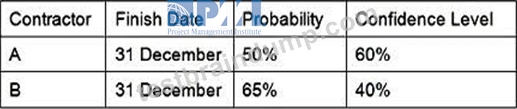
Which contractor should be chosen, because of having the highest statistical output?
- A. Contractor B should be chosen based on probability and confidence level.
- B. Contractor B should be chosen based on probability.
- C. Contractor A should be chosen based on confidence level.
- D. Contractor A should be chosen based on probability and confidence level.
Answer: C
NEW QUESTION # 164
Wendy is about to perform qualitative risk analysis on the identified risks within her project. Which one of the following will NOT help Wendy to perform this project management activity?
- A. Project scope statement
- B. Stakeholder register
- C. Risk management plan
- D. Risk register
Answer: B
NEW QUESTION # 165
Which of the following are parts of SWOT Analysis? Each correct answer represents a complete solution.
Choose all that apply.
- A. Strengths
- B. Optimism
- C. Threats
- D. Tools
- E. Opportunities
- F. Weaknesses
Answer: A,C,E,F
NEW QUESTION # 166
During a project meeting, the project sponsor asks to close a project risk. The team does not recommend closing the risk because it is expected to be present in the next phase of the project work.
How should the risk manager address this concern?
- A. Compare the actual data with the risk baseline.
- B. Compare the actual data with the subject matter expert (SME) criteria.
- C. Compare the actual data with the historical data.
- D. Compare the actual data with the project sponsor's expectation.
Answer: A
NEW QUESTION # 167
Which of the following documents is described in the statement below? "It is developed along with all processes of the risk management. It contains the results of the qualitative risk analysis, quantitative risk analysis, and risk response planning."
- A. Quality management plan
- B. Risk management plan
- C. Risk register
- D. Project charter
Answer: C
NEW QUESTION # 168
You are the project manager for BlueWell Inc. You are reviewing the risk register for your project.
The risk register provides much information to you, the project manager and to the project team during the risk response planning. All of the following are included in the risk register except for which item?
- A. Trends in qualitative risk analysis results
- B. List of potential risk responses
- C. Symptoms and warning signs of risks
- D. Network diagram analysis of critical path activities
Answer: D
NEW QUESTION # 169 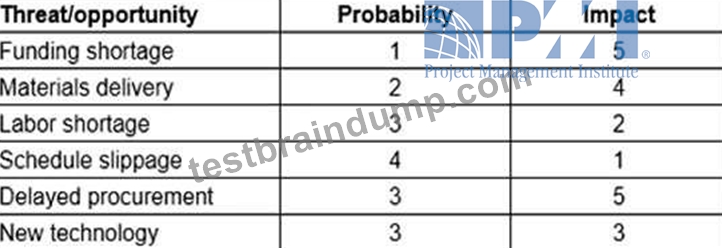
Very low = 1, Low = 2, Moderate = 3, High = 4, Very High = 5.
A project manager must complete a report for a stakeholder who is concerned about the possibility of a funding shortfall. What is the most effective way to explain the risk to this stakeholder?
- A. The funding shortage is the lowest ranked/scored risk.
- B. The funding shortage has a very low probability of occurring and is not a concern for the project.
- C. The funding shortage is a significant risk.
- D. The funding shortage will have a very high impact on the project and is the highest priority.
Answer: C
NEW QUESTION # 170
Mark works as a project manager of the NNH project. In this project, he has created a contingency response that the cost performance index should be less than 0.91. The NHH project has a budget at completion of $950,000 and is 43 percent complete - though the project should be 50 percent complete. The project has spent $470,897 to reach the 43 percent complete milestone. What is the project's cost performance index?
- A. 0.80
- B. 0.95
- C. 0.91
- D. 0.87
Answer: D
NEW QUESTION # 171
Tracy is the project manager of the NLT Project for her company. The NLT Project is scheduled to last 14 months and has a budget at completion of $4,555,000. Tracy's organization will receive a bonus of $80,000 per day that the project is completed early up to $800,000. Tracy realizes that there are several opportunities within the project to save on time by crashing the project work. Crashing the project is what type of risk response?
- A. Enhance
- B. Mitigation
- C. Exploit
- D. Transference
Answer: A
NEW QUESTION # 172
A project manager wants to introduce a new technology to improve a project's performance. However, there are some costs associated that are beyond the current budget, and the proposed technology has not been applied to any previous company projects.
What should the project manager do in this situation?
- A. Take advantage of this opportunity of Improving the project performance.
- B. Escalate this initiative to project decision makers and sponsors.
- C. Accept the fact that there is a risk associated with this new technology.
- D. Outsource the implementation of the new technology as soon as possible.
Answer: A
Explanation:
The project manager should escalate this initiative to project decision makers and sponsors, as they have the authority to approve changes in budget and scope. They can evaluate the potential benefits and associated with the new technology and make an informed decision on whether to proceed.
According to the PMBOK® Guide1, an opportunity is a risk that would have a positive effect on one or more project objectives if it occurs. Opportunities are uncertain events or conditions that can enhance or facilitate the achievement of project goals, such as cost savings, schedule acceleration, quality improvement, or scope expansion. A project manager should take advantage of opportunities by implementing risk responses that seek to maximize their probability and/or positive impact. In this case, the project manager wants to introduce a newtechnology to improve the project's performance, which is an opportunity for the project. The project manager should take advantage of this opportunity by planning and executing appropriate risk responses, such as exploiting, enhancing, sharing, or accepting the opportunity. This is part of the Plan Risk Responses and Implement Risk Responses processes in the PMBOK® Guide1. References: 1: A Guide to the Project Management Body of Knowledge (PMBOK® Guide) - Sixth Edition.
NEW QUESTION # 173
A risk manager of a major project facilitates a meeting to develop the risk management plan. What two factors does the risk manager need to consider to ensure an effective risk management plan is developed?
(Choose two.)
- A. Obtaining stakeholder acceptance
- B. Ensuring risk response strategies mitigate all risks.
- C. Aligning to project constraints and priorities.
- D. Applying modern risk management techniques.
- E. Minimizing implementation costs.
Answer: A,C
Explanation:
To ensure an effective risk management plan, the risk manager needs to consider aligning the plan to project constraints and priorities and obtaining stakeholder acceptance, as these factors will help ensure that the plan is relevant and supported by the project team and stakeholders.
According to the PMI-RMP Handbook, the risk management plan is a document that describes how risk management activities will be structured and performed on the project. It is one of themain outputs of the Plan Risk Management process. The risk management plan should consider the following factors to ensure its effectiveness:
* Aligning to project constraints and priorities: The risk management plan should be aligned with the project objectives, scope, schedule, cost, quality, resources, and stakeholder expectations. It should also reflect the project's risk appetite, tolerance, and threshold levels, which indicate the degree of uncertainty that the project can accept. The risk management plan should prioritize the risk management activities based on the project's critical success factors and key performance indicators.
* Obtaining stakeholder acceptance: The risk management plan should be developed with the involvement and input of key stakeholders, such as the project sponsor, customer, team members, subject matter experts, and other relevant parties. The risk management plan should be communicated and approved by the stakeholders to ensure their commitment and support for the risk management process. The risk management plan should also define the roles and responsibilities of the stakeholders in risk management, as well as the reporting and escalation mechanisms.
The other options are not valid factors for ensuring an effective risk management plan:
* Applying modern risk management techniques: The risk management plan should apply the appropriate risk management techniques that suit the project's context, complexity, and characteristics.
The techniques should be based on the best practices and standards of the profession, such as the PMBOK® Guide and the Practice Standard for Project Risk Management. The techniques do not have to be modern or innovative, as long as they are effective and efficient.
* Ensuring risk response strategies mitigate all risks: The risk management plan should define the risk response strategies that will be used to address the identified risks. However, the risk response strategies do not have to mitigate all risks, as some risks may be accepted, transferred, or avoided. The risk response strategies should be based on the risk analysis and evaluation, which consider the probability and impact of the risks, as well as the cost and benefits of the responses.
* Minimizing implementation costs: The risk management plan should consider the budget and resources available for the risk management activities. However, the risk management plan should not aim to minimize the implementation costs at the expense of the quality and effectiveness of the risk management process. The risk management plan should balance the costs and benefits of the risk management activities, and ensure that they provide value to the project.
References: PMI-RMP Handbook1, PMBOK® Guide2, Practice Standard for Project Risk Management2
NEW QUESTION # 174
......
100% Passing Guarantee - Brilliant PMI-RMP Exam Questions PDF: https://actualtests.testbraindump.com/PMI-RMP-exam-prep.html
